Sunday
13 September, 2026
News Flash
News Flash
By Md Aynal Haque
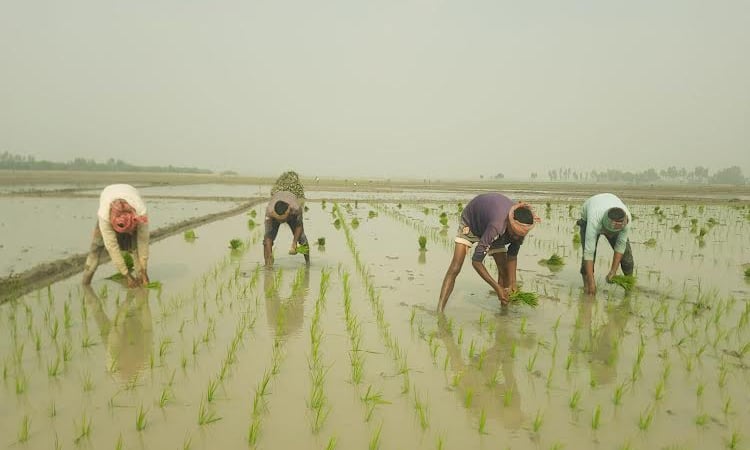
RAJSHAHI, Jan 10, 2026 (BSS)- Most of the grassroots farmers are passing busy times in transplanting boro seedlings braving the winter chill and fog everywhere in the region at present, including the vast Barind tract, with the hope of attaining cherished yield.
They are also spending their time on land preparation, nursing, and caring for the seedbeds of the paddy, as the full-swing seedling transplantation will start within the next couple of days.
Boro rice transplantation in the Rajshahi division, particularly across the Barind tract, typically begins in early January and continues through February, with peak activity in mid-January, aiming for high yields.
According to the sources close to the Department of Agriculture Extension (DAE), both traditional manual transplantation and mechanical rice transplanters are used, with the latter gaining traction in certain areas.
Farmers utilize modern, high-yielding, and drought-tolerant varieties, such as BRRI dhan 28, 29, 58, 84, 89, 92, and 100, while preparing seed beds with protective measures against cold.
Increased cultivation of newer, high-yielding varieties like BRRI dhan74, BRRI dhan92, and BRRI dhan100 is observed, with a shift away from older varieties.
Sources said short-duration and drought-tolerant varieties like BRRI dhan48 are favored for their ability to provide good yields with limited irrigation.
Around 37.25 lakh tonnes of IRRI-Boro rice is expected to be produced from 8.19 lakh hectares of land in all eight districts of the division during the current season, officials said.
The DAE has set the target of producing 17.23 lakh tonnes of rice from 3.66 lakh hectares of land in four districts of Rajshahi Agricultural Zone, while 20.02 lakh tonnes from 4.53 lakh hectares in four other districts of Bogra Agricultural Zone.
Azizur Rahman, additional director of the DAE, said that all the district, upazila and field level officials and others concerned were giving suggestions to the farmers to protect their seedbeds from cold covering their seedbeds with polythene at night.
He said that they were adopting all possible measures to ensure food security through attaining the rice production target everywhere in the region including its vast Barind tract to ensure food security.
Azibar Rahman, a farmer of Kodomshohar village under Godagari upazila, said that he had prepared seedbeds on 30 decimals of land for cultivating paddy on 20 bigha of land this season.
Rahman has adopted some preventive measures to protect the seedbeds from any cold-related diseases. He has been transplanting seedlings since last week.
Regional office of Bangladesh Rice Research Institute has taken diversified steps including farmers training, projection plot and supplying of the newly developed high-yielding varieties among the growers to make IRRI-Boro farming a total success.
BRRI has developed 14 Boro varieties of paddy which are appropriate for the Rajshahi region including its vast Barind tract, said Muhammad Hossain, chief scientific officer of BRRI.
Of those, BRRI dhan50 is an export-oriented, premium-quality rice, BRRI dhan58 is comparatively high-yielding and BRRI dhan84 is iron and zinc-enriched.
Hossain said that the field level agriculture officials, researchers and scientists were reaching the developed varieties to the farmers' doorsteps so that they can boost the Boro paddy yield after the best uses of the varieties.
The conventional varieties are being replaced by modern varieties which are good signs for the region in terms of boosting yield, he said.
The BRRI chief scientific officer said that there was no way but to enhance rice production by facing the existing challenges of the adverse impact of climate change with gradually declining resources and agricultural lands.
However, the grassroots farmers are happy after getting better yields and market price of their harvested rice, contributing a lot towards ensuring food security in the region for the last couple of years.