Tuesday
28 July, 2026
News Flash
News Flash
By S M Zahid Hossain
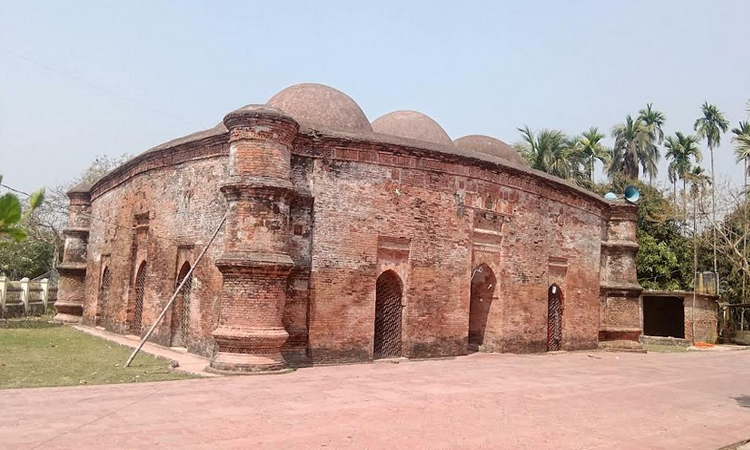
KHULNA, April 10, 2026 (BSS) - The nearly 600-year-old historic Masjidkur Mosque, located in Amadi Union of Koyra upazila in the district, is on the verge of ruin due to lack of proper conservation, raising concerns among locals and heritage enthusiasts.
The ancient structure, now under the Department of Archaeology, is suffering from severe deterioration. Plaster is peeling off, cracks have developed on the wall, and intricate designs are gradually fading.
Although some minor renovation work was recently carried out to make the mosque usable for prayers, it is widely considered insufficient.
Situated near the Sundarbans, Masjidkur Mosque stands as a remarkable example of early Islamic architecture in southern Bengal.
Beyond its religious significance, it is a living testament to the region's rich history and heritage.
Experts believe that with proper maintenance, improved facilities, and effective promotion, the site could emerge as one of the country's most attractive tourist destinations.
On a recent visit, it was observed that the mosque features nine domes and is constructed with lime-surki and thin square bricks. Built on approximately 45 of land, each side of the structure measures 16.76 meters, while the interior spans 12.19 meters.
Inside, four brick pillars, each embedded with two stone slabs, divide the mosque into nine equal square sections, each topped with a dome.
The qibla-facing wall contains a semicircular mihrab, and the grand entrance along with its unique architectural style draws visitors' attention.
There is no inscription on a stone pillar in the mosque premises indicating its exact date of construction.
However, due to its architectural resemblance to the Sixty Dome Mosque, historians believe it was built during the time of Hazrat Khan Jahan Ali (RA). At present, the mosque is under the supervision of the Department of Archaeology.
Historical accounts suggest that Sultan Jalaluddin Muhammad Shah ruled Bengal from 1418 AD to 1433 AD. During that period, Khan Jahan Ali (RA) reached up to Murli in Jessore and divided his entourage into two groups.
While he himself moved towards Bagerhat, another group led by his associates Borhan Khan (also known as Bura Khan) and his son Fateh Khan proceeded southwards to the Sundarbans-adjacent Amadi area.
It is believed that they established the Masjidkur Mosque around 1445 AD.
Locals say the village itself derives its name from the mosque. "Our village is known as Masjidkur because of this historic mosque. Though many people may not know the name of our upazila, they recognize the mosque," said Abu Tayeb Sana, a resident of the area.
He added that people from different regions visit the mosque daily, and arrangements for iftar are made during Ramadan, attracting large gatherings.
Regular worshippers, Muhammad Mohiuddin, Said Hossain and Harun Molla told BSS the interior of the mosque remains cool even during extreme heat, making it a unique place of interest for visitors.
Talking to BSS, Khateeb of the mosque, Hafez Maulana Amirul Islam, who has been serving there for nearly two years, emphasized the urgent need for proper renovation and preservation.
"Although some repair work was done a few months ago, the mosque still remains at risk," he said.
When contacted, Field Officer of the Department of Archaeology, Khulna division, Irene Parveen told the news agency that the allocation for conservation of historical sites is inadequate.
"We carried out limited renovation this fiscal year to make the mosque usable for prayers. If we receive a larger budget in the next fiscal year, more comprehensive restoration work will be undertaken," she added.