Sunday
16 August, 2026
News Flash
News Flash
By Md Aynal Haque
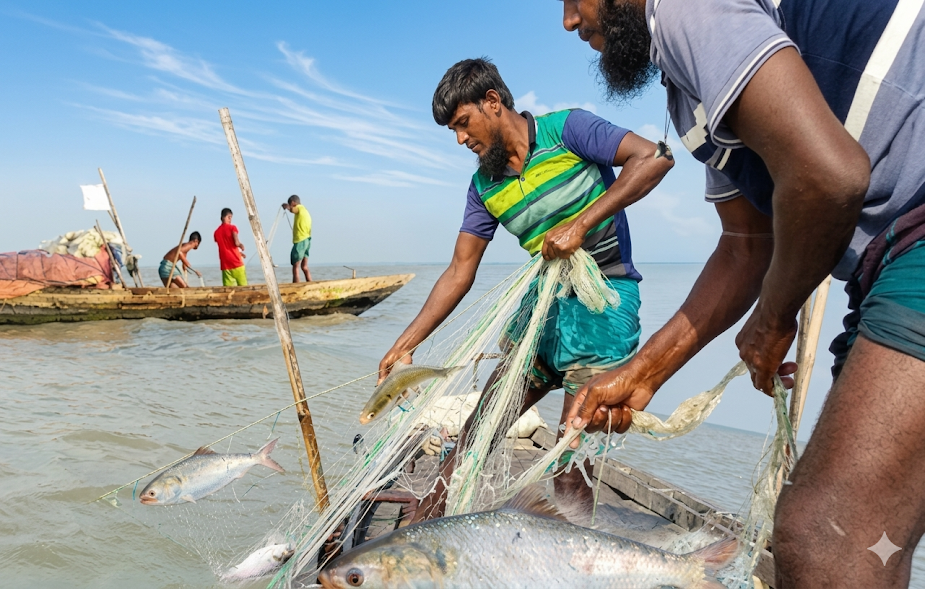
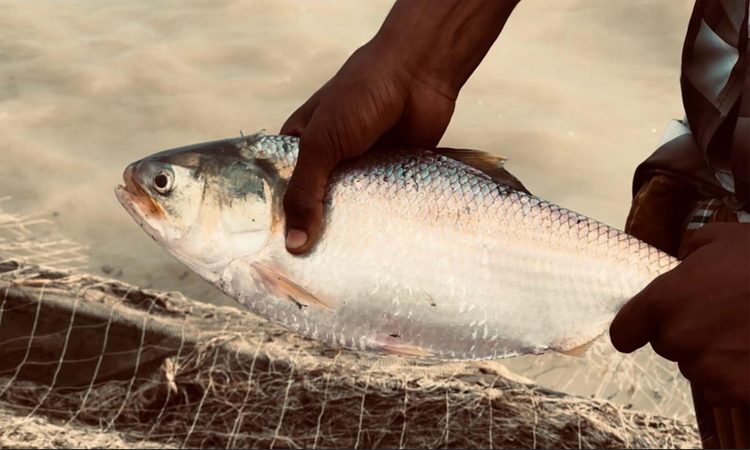
RAJSHAHI, Aug 16, 2026 (BSS) - Although the Padma riverbed once resounded with shoals of silvery Hilsa and native fish, today it is just a memory of the past.
Due to the impact of the deadly upstream Farakka Barrage, the Padma River, having lost its navigability, turns into a vast sandy desert in the summer season.
As water depth and natural flow have decreased at an alarming rate, the historic and incomparably tasty and aromatic Hilsa of Rajshahi is now facing a severe existential crisis.
At the same time, due to the changing river environment, native fish species are also facing a severe crisis of breeding and habitat.
According to researchers and concerned officials, as breeding grounds have shrunk due to the navigability crisis, about 60 percent of the fish species of the Padma are now at extreme risk of extinction.
A review of the information provided by the Rajshahi District Fisheries Department shows how quickly the presence of hilsa in the Padma has hit rock bottom, which is clear from the catch statistics.
Between July and September last year, a total of only 5.37 tons of Hilsa was caught in just four upazilas of the district - Godagari, Paba, Charghat and Bagha.
Whereas, 28.55 tons of Hilsa was harvested in Rajshahi during the period of 2016-2017 fiscal year.
Since then, the hilsa catch index has mainly started to decline and in just eight years it has decreased at an alarming rate. A similar miserable condition is seen when analyzing the picture at the divisional level.
In Rajshahi division, where 507 tons of Hilsa was harvested in the 2018-19 fiscal year, it increased to 735 tons in the next 2019-20 fiscal year and to 741 tons in 2020-21.
However, a continuous decline began after that. Although 581 tons of Hilsa was harvested in 2021-22 and 600 tons in 2022-23, in 2023-24 it dropped to only 492 tons.
Although complete data for the current 2024-25 fiscal year is not yet available, fisheries officials fear that this time the catch will hit even lower.
The terrible impact of the Farakka Barrage has been clearly revealed in a 2023 study in the international scientific journal 'Biodiversity and Conservation'.
It shows that compared to 1984, the area of the Padma River in the dry season has decreased by about 50 percent, depth by 17.8 percent and flow by 26.2 percent.
At the same time, the supply of fresh water in the river has decreased by up to 90 percent.
Professor Yamin Hossain, a teacher of the Fisheries Department of Rajshahi University, told journalists that Hilsa is a fast-moving and upstream-migrating fish.
In the pre-Pakistan era, Hilsa used to travel freely from the Bay of Bengal through the Padma to Bhagalpur in India and lay eggs.
But since the Farakka Barrage became operational, the route of Hilsa in the Padma of Rajshahi has been blocked due to reduced navigability and depth.
Essentially, before the commissioning of the upstream Farakka Barrage from 1969 to 1974, the water flow in the Padma was 9,032 cubic meters per second.
After the barrage was commissioned from 1975 to 2019, this average flow dropped to 5,146 cubic meters per second.
According to researchers, Hilsa does not want to come upstream unless the water depth is at least 20 to 25 feet for breeding.
In addition, unplanned use of chemical fertilizers and pesticides in agriculture and increased sand content in the water causing turbidity due to dredging in the name of river training are also seen as one of the reasons for the decline in hilsa arrival.
Other native fish species have also fallen victim to this environmental disaster of the Padma.
A survey conducted from 2007 to 2017 found that among 77 native fish species of the Padma, three are critically endangered, 10 are endangered, nine are highly endangered and nine species are near threatened.
According to the Department of Fisheries, 2,283 tons of native fish were harvested from the Padma in the 2019-20 fiscal year.
However, it was 2,221 tons in 2020-21, 2,152 tons in 2021-22, 2,040 tons in 2022-23 and finally dropped to 1,850 tons in 2023-24. That is, in the last five years, the catch of native fish from the Padma River alone has decreased by 433 tons.
Regarding the current situation of the Padma, Rajshahi District Fisheries Officer Jahangir Alam told journalists that the amount of Hilsa in the Padma is now very low and whatever is available is also small in size.
In addition, some native fish like Tengra or Puti are found in small quantities.
Mentioning that regular drives are conducted on their part to prevent fishing by unfair means, he said that despite limited manpower, continuous drives are being carried out in various haats and bazaars of the district to protect the river and native fish, especially to stop the harmful China Duari net.