Sunday
16 August, 2026
News Flash
News Flash
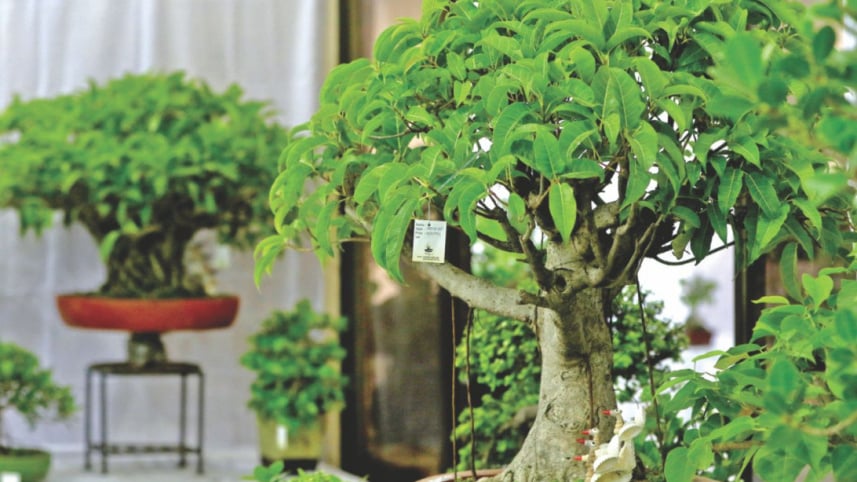
CHATTOGRAM, August 16 2026 (BSS) – As I approached a stall at the Laldighi Tree Fair in Chattogram, my attention was immediately drawn to a fully grown banyan tree displayed in a small tub—'Bonsai!' At first glance, it appeared to encapsulate a vast expanse of nature within a compact container.
Its petite form belied the profound beauty found in the arrangement of its branches! The trunk, marked by age, along with its skilfully spreading branches and the enchanting allure of its green leaves, radiated an otherworldly beauty throughout the tree fair. An organization named 'Jannat shop.
City' showcased this 'Chinese Bonsai'—a miniature tree that evokes the essence of a forest within the upscale interiors of city apartments.
The founder and CEO of the company, Mohammad At-Tawabul Islam, told BSS that this 'bonsai' is currently 47 years old. I was even more astonished upon learning its age.
'How has this tree maintained its condition in the tub for so many years?' I inquired.
Tawabul elaborated in response, stating, 'Bonsai is a living art. A tree with a robust trunk or branches is artificially maintained in a tub or pot, shaped into a short or dwarf form through specialized techniques and careful nurturing.
It is not a genetically small tree; rather, it is a normal tree that is kept small through pruning and care.' He mentioned that the price of this bonsai is TK 165,000 taka, making it the most expensive item at his stall.
He mentioned that a significant market has emerged for small leafy and flowering plants intended for indoor use. Particularly, individuals residing in apartments are purchasing these plants. For them, these plants have evolved from mere garden items to integral components of home aesthetics and mental tranquillity.
Indoor plants and cacti are being sold at prices ranging from a minimum of Tk 200 to as much as Tk 5,000, depending on their variety and size. His observations were corroborated by the sight of crowds gathered around bonsai and indoor plants.
Amid the lively atmosphere of the fair, many were captivated by these plants; some were taking photographs, while others made purchases. Some individuals were acquiring multiple plants for their homes, others for the corners of their drawing rooms, some for their office desks, and several to enhance their balconies.
Interestingly, the term bonsai (banzai or bonzai) is derived from Japanese, which translates to 'living sculpture' in Bengali. While bonsai may appear to be an art form that originated in Japan, it is noteworthy that the practice actually began in China.
Over 2000 years ago, during the Chinese Empire, the technique of cultivating miniature trees in small pots was discovered. Subsequently, the Japanese Zen Buddhist community refined this practice to a more sophisticated level.