Tuesday
04 August, 2026
News Flash
News Flash
By Tahmid Shakib
DHAKA, August 4, 2026 (BSS) – “If you kill one, ten will come; kill ten, millions will arrive. Parents across the country will stand together to protect and raise their children."
These emotional yet unyielding words of Dr. Chowdhury Saima Ferdous, Professor of the Department of International Business at Dhaka University (DU), spoken at the Central Shaheed Minar on August 1, 2024, came to epitomize the heroic stance taken by university teachers during the ‘July-August Student-People Uprising’.
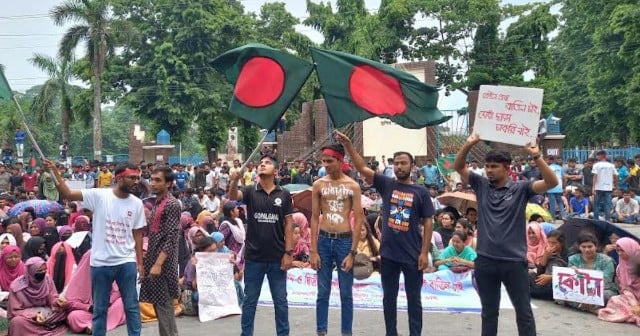
Throughout the fiery days of July and August 2024, when the Anti-Discrimination Student Movement faced brutal state force, university teachers across Bangladesh stepped out of their classrooms to act as guardians and human shields on the streets.
Early in the movement, when the reinstatement of the quota system in government jobs sparked widespread student protests, the University Teachers Association of Bangladesh (UTAB) became one of the first platforms to voice formal support.
In a statement issued by UTAB President Professor ABM Obaidul Islam and Secretary General Professor Md. Morshed Hasan Khan, the organization expressed deep concern over the quota system, declaring that quota could never be an alternative to merit in an independent nation, and affirmed that the ongoing agitation by job seekers and students was not only relevant, but entirely just and logical.
In this regard Dhaka University Vice-chancellor and former UTAB President Professor A B M Obaidul Islam told BSS, "When student casualties were rising on the streets, as teachers, we could no longer remain seated. We had been participating in political movements for a long time, but this was a distinct dimension. When our students were being martyred, shedding blood, or being treated at Dhaka University and other medical colleges and universities, we—as conscious citizens and part of an organization called UTAB (where I served as the former convener)—could not stay away. We all descended onto the streets in protest."
As the movement gained further momentum, violence broke out on July 15 when general students protesting for quota reform were subjected to armed attacks by Chhatra League cadres on the Dhaka University campus.
The nationalist-aligned Sada Dal (a teachers’ platform) of Dhaka University immediately took a strong defensive stand, bursting into protest and issuing a sharp demand for the prompt identification, arrest, and punishment of the attackers.
In this regard, Professor Lutfor Rahman, former convener of Dhaka University Sada Dal and now Pro Vice-Chancellor of National University, recalled the pivotal role of university teachers in the student-led mass movement that led to the fall of the fascist Hasina government.
Recalling the movement, he told BSS that teachers from various universities, including Dhaka University, actively joined the students' protest, giving it a new momentum.
"On July 30, under my leadership as the convener of Dhaka University's Sada Dal , and alongside former UTAB President and current DU Vice-Chancellor Prof. Dr. Obaidul Islam, we held a press conference demanding the immediate resignation of the fascist government. This event gained widespread coverage across all media outlets and added a new dimension to the movement," he said.
The bloodshed intensified on July 16 with the first deaths in Rangpur, Dhaka, and Chattogram. In response, public and private university teachers across the country mobilized under the banner of the 'University Teachers' Network'—a platform uniting teachers from DU, Jahangirnagar University (JU), Rajshahi University (RU), BUET, SUST, and other institutions.
The network issued an emergency joint statement condemning the violence, calling for an immediate halt to attacks on students, and demanding a fair investigation and justice for the killings.
The following day, July 17, when university administrations across the nation officially declared campus closures and ordered students to evacuate their residential halls, the teachers rejected the decision outright. Teachers gathered at DU’s Aparajeyo Bangla to hold an anti-oppression rally.
When police detained two student protesters and took them to Shahbagh Police Station, the teachers immediately formed a procession, marched to the police station, and staged a sit-in.
Following an intense showdown and firm resistance against the police, the teachers successfully secured the release of the two detained students.
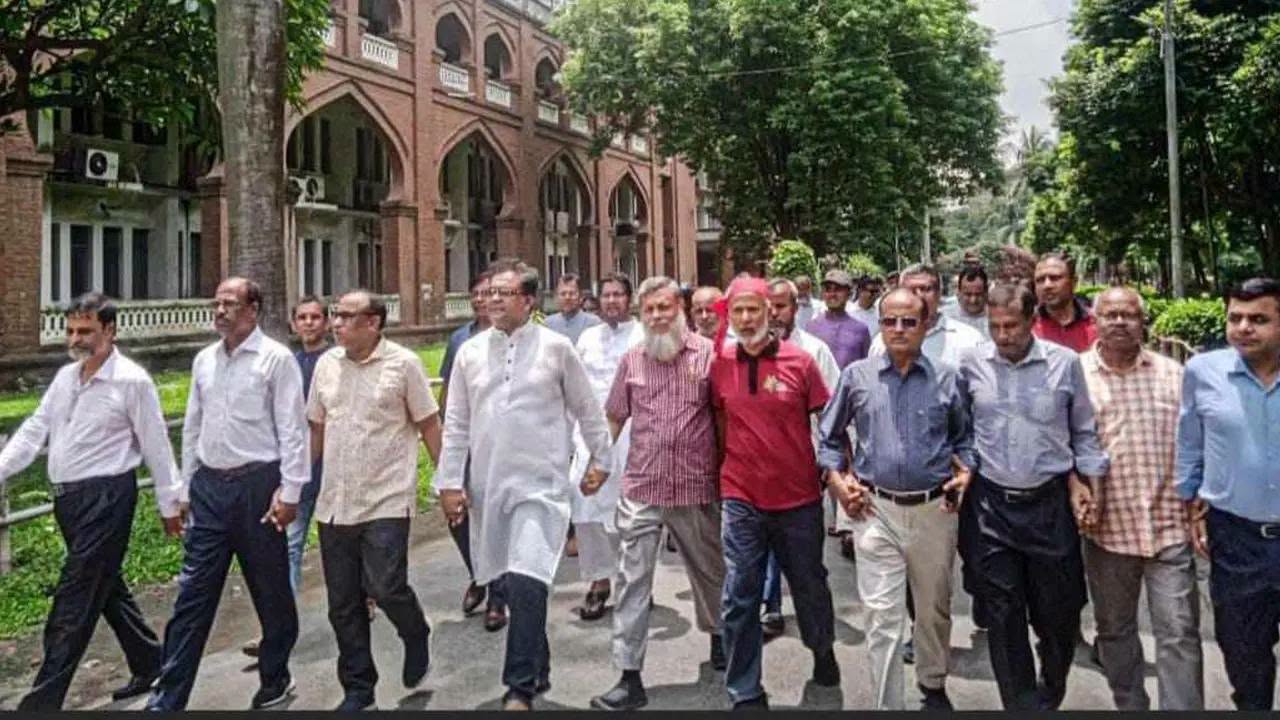
Tragedy deepened on July 19 as student fatalities rose under police firing. On Friday morning at 11:15 AM, teachers of the Sada Dal organized a historic protest march starting from Mall Chattar with black cloths tied over their mouths. The procession marched through TSC and Raju Sculpture before assembling at Aparajeyo Bangla for a rally.
There, the teachers declared that the Sheikh Hasina government, the former Prime Minister, and the former DU Vice-Chancellor—having failed to ensure student safety—must immediately resign, taking full responsibility for the indiscriminate killings, tear gas firing, and forced hall evacuations.
Ten days later, on July 29, amid curfews, state repression, and widespread arrests, Professor Golam Rabbani from JU's Department of History recited poet Nabarun Bhattacharya’s iconic poem "Ei Mrittyu Upottoka Amar Desh Na" (This Valley of Death Is Not My Country) during a protest rally on campus.
His voice echoed across the campus: "I hate the father who fears to identify his child's corpse, I hate the brother who still remains shameless and normal, I hate the teacher, intellectual, poet, and clerk who does not demand revenge for this murder on the open street. This valley of death is not my country, This executioner's stage of triumph is not my country, This vast cremation ground is not my country, This blood-soaked slaughterhouse is not my country."
Professor Rabbani later revealed that he felt extremely vulnerable and endangered when reciting the poem on July 29.
Amid the state-sponsored violence and fear of enforced disappearances, he chose the fierce lines of the poem specifically to call citizens out of their homes to take a stand on the streets.
On that same day, July 29, the University Teachers' Network held one of its largest solidarity rallies at DU's Aparajeyo Bangla under the banner "Not One More Disappearance or Murder." Beginning with a minute of silence for those killed, the rally strongly condemned nationwide mass arrests, disappearances, and false cases.
Following the assembly, the teachers brought out a protest march that circled the TSC and adjacent areas.
By July 28 and 30, state repression reached its peak as key coordinators were forcibly detained at the DB office and late-night raids were carried out on student accommodations. On July 28, the Sada Dal issued a joint statement demanding the immediate release of the detained coordinators and an end to midnight raids.
On July 30, the Sada Dal held a major press conference at the DU Club led by its Convenor, Professor Dr. M. Lutfor Rahman. They presented an 11-point demand framework advocating for the immediate resignation of the Sheikh Hasina government and DU administration, the release of student coordinators, and a complete cessation of killings and mass arrests across the country.
The confrontation escalated dramatically on July 31 near Doel Chattar during the nationwide 'March for Justice' programme. When police officers forcefully grabbed a student and attempted to drag him into a prison van, Shehreen Amin Bhuiyan (Monami), now assistant professor of Public Administration Department, alongside her colleague Nusrat Jahan Chowdhury from the Department of Public Administration, rushed forward without care for their own safety.
Shehreen threw her arms around the student to shield him from the police, repeatedly shouting, "Why are you taking my student? He committed no crime!" In the violent struggle that ensued, Shehreen sustained injuries to her hands and feet and was nearly thrown to the ground, but she refused to let go of the student. Overwhelmed by the teachers' resolute defense, the armed police were forced to step back, enabling the teachers to rescue the student and lead him to safety—a moment captured on video that quickly went viral across social media.
Amid ongoing countrywide turmoil and violent clashes on July 31, prominent thinker and researcher Prof. Dr. Salimullah Khan called for the immediate resignation of the government.
Speaking at a solidarity rally organized by the faculty of the University of Liberal Arts Bangladesh (ULAB)— he then demanded the unconditional release of detained students, withdrawal of cases, and a safe educational environment.
Prof. Khan then said : " The first step toward a political solution is for the current government to issue an unconditional apology and resign. We cannot transition to any new system without this."
By August 1, teachers took to the streets in full force. At the Central Shaheed Minar, Dr. Chowdhury Saima Ferdous delivered her stirring address to the media, confronting the state's actions and questioning the detention of six student coordinators at the DB office.
In her passionate speech, Dr. Saima mentioned: "They say rubber bullets? They stand facing weapons. With bullets bought by our tax money, you are shooting our children. How much more? How much more?
She further reflected on the detained student coordinators: "Will anyone understand if children die? My six children are on a hunger strike at the DB office, who will understand theirs? You have seen the agony and curse of parents—the heavens tremble, does it not shake you? Does it not shake him? Do you not fear the curse? My children's chests are riddled with bullets, and you call them rubber bullets?"
Expressing deep remorse for not being able to protect her students, she said that time: "What answer will we give to those who sent their children to us (teachers)? I have no face left, I am a teacher. I have no language, I fold my hands and ask for their forgiveness, I could not provide security. I could not provide security; I feel that if I am martyred on the street, perhaps this shame will lessen."
On that same day, August 1, in response to the ongoing nationwide student protests, teachers, students, and officials from various departments of Dhaka University organised protest rallies, human chains, and a procession on the campus.
Speaking at the rally, Professor Asif Nazrul of the Law Department that time said, "This government will not prosecute the killings because the government itself is involved in it. Murderous forces and organizations were supported and encouraged by the highest level of the government. Efforts are being made to divert the course of justice."
The Dhaka University teachers that day announced the "Droho Jatra (Revolt March)" programme for August 2 from the National Press Club at 3pm.
The strategic climax of the teachers' resistance occurred on August 4. At a press conference held at the Sagar-Runi Auditorium of Dhaka Reporters Unity (DRU), the University Teachers' Network—represented by leaders including Professor Anu Muhammad, Professor Gitiara Nasreen, Dr. Samina Luthfa and Professor Tanzimuddin Khan—formally demanded the immediate resignation of the Sheikh Hasina government.
To prevent political or constitutional vacuums following the regime's collapse, the network unveiled a "5-Point Outline for an Interim Government" formulated through consultations across civil society.
The outline called for forming an acceptable interim government comprising student representatives, teachers, lawyers, and civil society members, releasing all political prisoners, withdrawing false cases, establishing an independent inquiry commission for the killings, and creating a democratic environment for elections under a new constitutional framework.
According to Dr. Samina Luthfa, Associate Professor of Sociology at Dhaka University, who compiled the article and wrote its introduction titled "July Gonoobhyutthane Bishwabidyalay Shikkhok Network" (University Teachers Network in the July Uprising) published in the journal 'Sarbojonkotha': "During the severe state crackdowns and arbitrary arrests, when student coordinators were being hunted down, forced into hiding, or subjected to enforced disappearances, the University Teachers Network stood steadfast beside them. Teachers provided them with safe shelter, offered strategic advice, and actively intervened by visiting police stations and the Detective Branch (DB) office to trace and rescue detained students and coordinators."
Furthermore, highlighting the broader and more critical roles played by the teachers during the July uprising, Dr. Samina Luthfa noted that they initiated the historic "Anti-Repression Teachers' Rally" at the base of Aparajeyo Bangla on July 17, acted as a physical shield for students against police brutality, and played a vanguard role in the massive 'Droho Jatra' on August 2—where the definitive one-point demand for the government's resignation was formally raised. Right after the uprising, the network also drafted a comprehensive framework for a democratic transition to secure political and academic reforms in post-uprising Bangladesh.
Dhaka University Vice-chancellor and former UTAB President Professor A.B.M. Obaidul Islam told BSS, "I still remember how horrifying those days and nights were. I am often astonished to recall that in independent Bangladesh, a government that considered itself legitimate, or rather, considered the people as its subjects, directed indiscriminate massacres against its own citizens. This will forever remain a horrific memory. Their sole objective was to cling to power at any cost. Power was their only obsession, where public opinion, public demands, and public rights were not recognized as the sources of all authority. Because they did not acknowledge these, the memories of those days are deeply etched in our history.
Obaidul Islam also said, "We broke the curfews. We defied them to bring out processions and hold meetings. We remained steadfast on the streets. On August 5, under the leadership of UTAB—and with me serving as its president—we initially broke the curfew. After breaking it, we joined forces with many colleagues, non-teaching staff, and students from various public and private universities who poured in from all over. They felt secure, knowing their teachers were with them, and that they had nothing to fear. They stood beside us fearlessly. We faced police crackdowns and chased back and forth."
He said, “We documented those memories. Our objective was clear: to see the end of the authoritarian regime in Bangladesh and to help build a new, discrimination-free society. We marched and stayed on the streets with the expectation that this fascist, autocratic regime would never rise again. When the movement faced its early blows and students were injured, we rushed to Dhaka Medical College and other hospitals to stand beside them and offer whatever support we could. Later, we became deeply intertwined with the movement. We owned the students' struggle, embraced it, and realized that students acknowledged our presence. Even when I faced threats—such as being pressured to speak in favour of Sheikh Hasina during a talk show on the night of July 19, 2024, and walking out in refusal— I stayed true to our stance. I refused to speak in favour of a regime that was killing its own people. I chose to walk away, knowing full well that threats of arrest by the police, BDR, or army loomed over me”.
“We returned to the streets, and on July 19, Friday, July 2024, I walked out of that pressure, ready to face whatever consequences came my way. These are dark chapters of history that we lived through,” he said.
Professor Obaidul Islam acknowledged that Sada Dal, the University Teachers Network and UTAB played significant roles, serving as strong platforms with their educational networks.
Pro Vice-Chancellor of National University Professor Lutfor Rahman also said that the student movement ultimately culminated in a successful mass upsurge, achieved through the joint participation of students and teachers from universities across Bangladesh.
"On this day, I remember with deep respect all the teachers whose immense contributions brought about this historic victory. At the same time, I express my strong condemnation towards those teachers and individuals who sided with or supported the fascist regime during that crucial time," he added.