Wednesday
26 August, 2026
News Flash
News Flash
By Md Aynal Haque
RAJSHAHI, Aug 4, 2026 (BSS) – In the history of the '24 mass uprising, August 4 was one of the most important and decisive days.
In response to the call for the non-cooperation movement, unprecedented participation of students, people, teachers, guardians and professionals was witnessed on the streets.
On this day, it became clear that the movement to topple the government would not retreat. Following the call of the Anti-Discrimination Student Movement, an all-out non-cooperation movement began across the country.
Alongside the capital, Rajshahi also emerged as one of the strongest focal points of the movement.
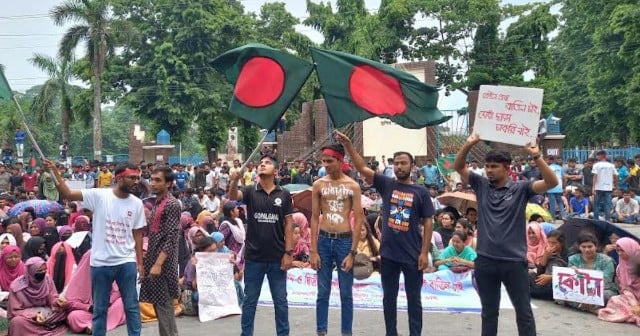
In the morning, protests by students began in front of the main gate of Rajshahi University of Engineering and Technology (RUET).
Within a short time, teachers and students of Rajshahi University, Rajshahi College, New Government Degree College and other educational institutions, along with guardians, professionals and people from all walks of life, joined the protest. As the day progressed, the movement turned into a massive public gathering.
The protesters carried national flags, shrouds as symbols of protest, and various banners. The streets echoed with slogans.
Expressing solidarity with the students, Professor Saleh Hasan Naqib of the Department of Physics at Rajshahi University said the students' just demands and courage were a symbol of hope for the future of the country. He called on the protesters to maintain restraint and move forward.
Taking part in the non-cooperation movement, Rajshahi University Marketing Department Professor and current Vice-Chancellor Dr Md Faridul Islam said the people of the country had lost confidence in the government and that the teaching community stood beside the students' just demands.
At the same time, he also emphasised the need to protect state property during the movement.
When the protest procession from RUET reached the Talaimari area via Bhadra, a clash broke out between the protesters and police from Motihar Police Station.
To control the situation, police fired tear gas shells and rubber bullets. In response, the protesters hurled brickbats and erected barricades on the road. Several students were injured in the clash and admitted to Rajshahi Medical College Hospital.
Recalling the events of August 4, former coordinator of the Anti-Discrimination Student Movement at Rajshahi University, Mehedi Sajib, said the day had changed the course of the movement.
Despite the internet shutdown, the central programme was successfully implemented through alternative coordination. With the participation of teachers, guardians, lawyers, doctors and businessmen, the movement went beyond students and turned into a mass movement.
He said August 4 was the day of final preparation. Everyone was urged to remain peaceful to maintain the moral strength of the movement. The united presence of the people of Rajshahi gave new momentum to the movement.
On that day, in line with the decision to bring forward the 'March to Dhaka' programme in the capital by one day, final preparations were also made in Rajshahi.
With the united participation of teachers, students, guardians and ordinary people, the movement in Rajshahi reached a new dimension.
The next day, August 5, the government fell through a mass uprising of students and people.
The foundation of that victory was laid through the courage, unity and mass participation demonstrated during the non-cooperation movement on August 4. Rajshahi was one of the most active and significant chapters in that history.