Wednesday
26 August, 2026
News Flash
News Flash
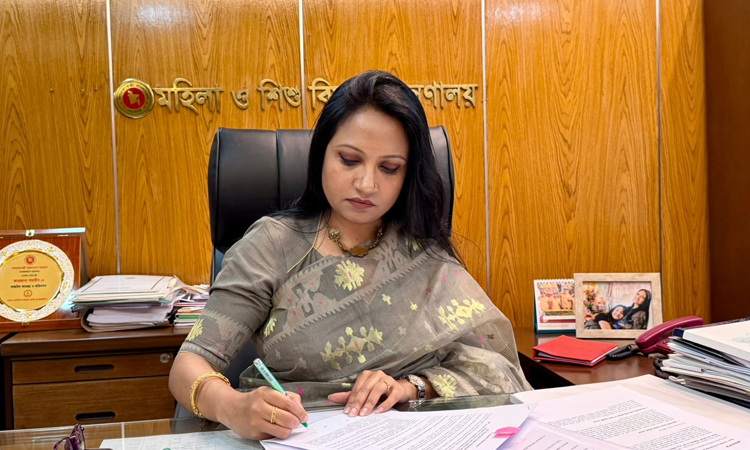
DHAKA, July 13, 2026 (BSS) - State Minister for Social Welfare Farzana Sharmin has said that investigation and judicial proceedings alone are not enough to curb corruption, stressing that effective prevention, establishment of good governance and active participation of people at all levels are also indispensable.
“Corruption is one of the biggest obstacles to development as it undermines public confidence, discourages investment and leads to the misuse of state resources,” she said.
The state minister said no country can become corruption-free overnight. However, political goodwill, institutional reforms and active public participation can play an important role in reducing corruption, she said while talking to Bangladesh Sangbad Sangstha (BSS) at the Secretariat here today.
The present government's main goal is to build accountable state system by consolidating and strengthening democracy, the rule of law and strong democratic institutions, said Farzana Sharmin.
Following the political change, the government is working to build a sustainable development-based state by restoring public confidence, making state institutions more effective, expanding social protection, reducing poverty, taking a firm stand against corruption and strengthening regional cooperation, she added.
Comparing the political realities of Bangladesh and Sri Lanka, the state minister said both countries have gone through experiences of political instability and change.
She said the biggest challenge after any political transition is to restore public confidence while maintaining the continuity of economic progress.
For this, democratic governance, the rule of law, independent and effective institutions, and inclusive economic opportunities are essential, she noted.
Farzana Sharmin said political differences should never be resolved through conflict or violence but through constitutional and democratic means.
She said state institutions must work to protect people's rights, particularly to meet the legitimate aspirations of the youth, and make public services more transparent and accountable.
Ensuring close engagement between the government and the people and effective service delivery is the foundation of a democratic state, she observed.
Highlighting the importance of social protection programmes, the state minister said the present government is further expanding social security activities as part of establishing a welfare state.
One of its major initiatives is the "Family Card" programme, which is considered not only as financial assistance but also as a foundation for human resource development and long-term economic growth.
Farzana Sharmin said the family is the main driving force behind a country's economic and social development. Therefore, overall development can be accelerated by strengthening families.
She said under the Family Card programme, selected women heads of marginalised families will receive direct financial assistance of Taka 2,500 per month. The assistance will be distributed digitally to ensure transparency while enhancing women's financial inclusion and empowerment.
The state minister said more than 67,000 families have been included in the pilot phase of the programme and there is a plan to gradually bring around 1.61 crore low-income families across the country under its coverage.
She said the government aims to bring a broader section of the population under the programme by 2030.
Farzana Sharmin said the main objective of the programme is not only to provide financial assistance but also to create opportunities for the children of poor families to receive education, healthcare and skills development.
She opined the programme in the long run will help break the cycle of poverty and develop productive human resources.
In her view, social protection expenditure should be regarded not as government spending but as a strategic investment for future economic development.
About the poverty situation in Bangladesh, the State Minister for Social Welfare said the country has achieved significant success over the past decades. However, new challenges have emerged due to global inflation, supply chain disruptions, economic uncertainty and other global challenges.
To address these challenges, she said, the government is strengthening social protection programmes while attaching equal importance to employment generation, entrepreneurship development, education and skills enhancement.
According to the state minister, poverty cannot be eliminated only through allowances or assistance. Sustainable economic growth and productive employment are essential for that purpose.
Referring to the experience of the new leadership in running the government, the State Minister said positive change requires new thinking, new perspectives and new plans. Remaining in power for a long time is not the only measure of experience.
She said an effective government can be run through competence, professionalism, consultation with experts and accountability to the people.
The present government is giving special importance to evidence-based policymaking and strengthening institutional capacity, she added.
On regional cooperation, Farzana Sharmin said the government, led by Prime Minister Tarique Rahman, attaches great importance to regional cooperation to ensure peace, stability and shared prosperity in South Asia. Bangladesh remains committed to revitalising SAARC.
At the same time, she said, the country is interested in expanding cooperation through BIMSTEC in trade, energy, connectivity, disaster management, climate resilience and people-to-people contacts.
In her opinion, cooperation is more beneficial than competition for the countries of South Asia and is essential for the region's long-term development.
The State Minister for Social Welfare said she had productive meetings with the Prime Minister of Sri Lanka and government representatives during her visit to the country. The meetings discussed various aspects of social protection, poverty alleviation, inclusion of persons with disabilities and expansion of Bangladesh-Sri Lanka cooperation. Both countries expressed interest in exchanging experiences and enhancing mutual cooperation.
On women's participation in politics, Farzana Sharmin said many women in South Asia have demonstrated capable leadership in governing their countries. Bangladesh also has a long tradition of women's political empowerment.
She said ensuring women's participation at every level of decision-making, increasing women's economic empowerment and creating equal opportunities in education and employment are among the present government's priorities.
Regarding Bangladesh-Sri Lanka relations, she said the two countries have long enjoyed cordial relations based on mutual respect, friendship and trust. There is ample scope to further expand cooperation in trade, investment, education, healthcare, pharmaceuticals, agriculture, tourism, digital innovation and social welfare.
State Minister for Social Welfare Farzana Sharmin expressed the hope that regular high-level dialogue, business contacts and increased people-to-people exchanges would further strengthen Bangladesh-Sri Lanka relations in the future and open a new horizon for peace and development in South Asia.