News Flash

By Osman Gani Rashel
DHAKA, July 02, 2026 (BSS) - A 22-member Bangladeshi youth delegation has returned home after a 10-day visit to China, gaining first-hand experience of the country's innovation-driven development, technological progress, smart urban planning, renewable energy, higher education and governance.
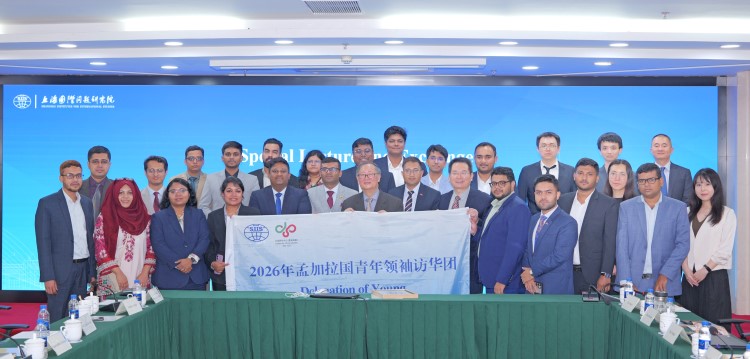
The delegation visited China from June 21 to 30 under the "Bangladesh Youth Leaders Delegation to Visit China 2026" programme at the invitation of the Shanghai Institutes for International Studies (SIIS).

Covering Kunming, Shanghai and Beijing, the visit was designed to introduce emerging Bangladeshi leaders to China's innovation-led development model while promoting academic collaboration, policy dialogue and people-to-people exchanges between the two countries.
The delegation was led by Aga Mostafizur Rahman Chowdhury, a lecturer in the Chinese Language and Culture department at the Institute of Modern Languages of the University of Dhaka. It included academics, researchers, policymakers, law enforcement officials, journalists, development professionals and university students.

The programme began in Kunming, the capital of Yunnan Province, where the delegation attended the opening ceremony hosted by Yunnan University. Delegates also took part in a roundtable discussion and seminar with Chinese academics, government representatives and university students, exchanging views on education, research and youth cooperation.
During their stay in Kunming, the delegation visited the Dounan Flower Market, Asia's largest flower trading centre, toured the scenic Dianchi Lake, and explored the Future Transportation Innovation Research Institute, where they learned about China's latest advancements in intelligent transportation systems and future mobility technologies.
The second phase of the visit took place in Shanghai, China's commercial and innovation hub. The delegates held discussions at the Shanghai Municipal People's Congress to gain insights into the country's legislative system and governance practices.

They also participated in a special lecture and exchange programme at SIIS, where experts and participants discussed Bangladesh-China relations, regional cooperation and prospects for expanding bilateral collaboration.
Innovation remained the central focus of the Shanghai itinerary as the delegation visited the YRD G60 Sci-Tech Innovation Corridor Exhibition Hall, showcasing China's high-tech industrial ecosystem, and the Jiangnan Rice Art Sightseeing Park, which highlights the integration of modern agriculture, technology and sustainable rural development.
The delegates also toured the Shanghai Urban Planning Exhibition Center to observe the city's long-term urban planning strategies and smart city development initiatives.
Alongside official engagements, the delegation explored China's cultural heritage through visits to the centuries-old Sijing Ancient Town, the Memorial of the First National Congress of the CPC, the historic Yu Garden and a night cruise along the Huangpu River.
The final leg of the programme was held in Beijing, where the delegation visited several of China's iconic historical landmarks, including the Forbidden City, the Palace Museum and the Great Wall of China.
The delegates also gained practical exposure to China's industrial and infrastructure development through visits to Sanhe Kangheng Renewable Energy Co., Ltd., China Civil Engineering Construction Corporation (CCECC) and the Power Construction Corporation of China.
During these visits, they exchanged views with senior officials on sustainable development, infrastructure investment and technological innovation.
In Beijing, the delegation attended a seminar at the Ministry of Foreign Affairs of the People's Republic of China, visited the Embassy of Bangladesh and participated in the closing ceremony held at Academy of Contemporary China and World Studies (ACCWS) marking the successful completion of the visit.
The delegates described the visit as a valuable opportunity to observe China's innovation-driven development model firsthand and expressed hope that the experience would help strengthen future Bangladesh-China cooperation in education, technology, research, media and youth leadership.
Executive Deputy Director of the Center for China Studies (SIIS-DU), Dr. Li Hongmei, said the visit was aimed at strengthening people-to-people ties between Bangladesh and China, with particular emphasis on expanding exchanges between young people of the two countries and deepening participants' understanding of China's diplomacy, development, governance, culture and technological advancement.
She said the programme had significantly reshaped delegates' perceptions of China through direct engagement with institutions, experts and local communities, fostering greater mutual understanding and friendship between the two nations.
Dr. Li also said the Center for China Studies plans to organize the Bangladesh Youth Leaders Delegation to China programme every year to further strengthen bilateral exchange.