Monday
29 June, 2026
News Flash
News Flash
By Mohiuddin Sumon
TANGAIL, June 29, 2026 (BSS) - Famous for its distinctive aroma and exceptional sweetness, the Geographical Indication (GI)-recognized pineapple of Madhupur has long been one of the finest fruits of the country.
However, the indiscriminate use of chemicals by a section of dishonest growers in pursuit of higher profits has tarnished its reputation in recent years.
Now, a good number of farmers are embracing organic, chemical-free cultivation to restore the traditional quality of Madhupur’s pineapples. The shift is being driven by lower production costs, better market prices and increasing consumer demand for safe and naturally grown fruits.
Discussions with local farmers reveal that while commercial pineapple cultivation has expanded significantly here -- often referred to as the pineapple capital -- the temptation to maximize profits has led some growers to use excessive chemicals to enlarge fruit size, enhance colour and bring produce to market ahead of the natural season.
To target the lucrative Ramadan market, many farmers apply a chemical mixture locally known as "Caesar" to induce simultaneous flowering and fruiting in both young and mature plants. They also use growth hormones and ripening agents, allowing pineapples to be harvested just 10 to 12 days after the treatment.
Although these chemically treated fruits appear bright yellow and attractive, they often lose their natural fragrance and sweetness, raising concerns about both quality and food safety.
As the consumers become increasingly aware of these issues and avoid chemically treated fruit, chemical-free pineapple farming is gradually gaining momentum in Madhupur.
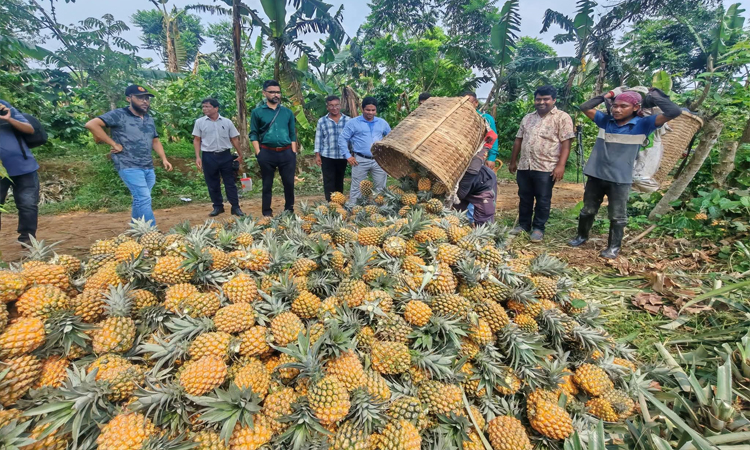
One of the pioneers of this movement is Sohel Rana of Hagura Kuri village at Fulbag Chala Union of Madhupur upazila. During a recent visit, he was seen harvesting pineapples from his orchard for sale.
Rana told BSS that he received training in 2025 under a programme jointly supported by the Palli Karma-Sahayak Foundation (PKSF) and the non-governmental development organisation SSS. With a grant of Taka 60,000 from the organisation and his own investment, he launched his chemical-free pineapple project.
He cultivated 24,000 Honey Queen Pineapple plants on four bighas of land, relying entirely on organic farming methods and organic fertilizers.
From planting to harvest, the project employed around 50 workers over an 18-month period. Rana said his total production cost including labour and other expenses, amounted to Taka 2,35,000. He has already sold pineapples worth Taka 5,28,000 and expects to earn an additional Taka 70,000 from the remaining harvest.
According to him, while large chemically treated pineapples are usually sold wholesale for Taka 25 to Taka 30 each, his organically grown fruits fetch Taka 40 to Taka 45 apiece.
"Madhupur’s pineapples are famous for their unique flavour and aroma," Rana said. "But in pursuit of higher profits, many growers use various chemicals to increase fruit size, improve colour and market them before the natural season. As a result, the reputation of Madhupur’s pineapples has suffered."
He added that many farmers in the hilly Garo region are now returning to fully organic cultivation to restore the fruit's original taste, aroma and heritage.
"Production costs are lower, while market prices are better. That is encouraging more farmers to switch to safe, chemical-free pineapple cultivation," he said.
Inspired by Rana's success, local farmers including Mizanur Rahman Sabuj, Rony Mia and Kalyan Matthew have also started organic pineapple farming. Today, nearly one hundred farmers across the Madhupur Garo region are engaged in producing chemical-free pineapples.
Rana said buyers from Nilphamari, Rangpur, Bogura, Sirajganj and Dhaka regularly visit his orchard to purchase pineapples directly. He also markets his products nationwide through his Facebook page, "SR Blog BD", taking online orders and delivering fruits to customers via courier services.
Explaining how consumers can distinguish naturally ripened pineapples from chemically treated ones, Rana said organically ripened fruits usually turn yellow near the base while remaining green at the top. They release a pleasant fragrance when cut and taste naturally sweet.
In contrast, hormone-treated pineapples become uniformly yellow but lack their characteristic aroma and sweetness despite their attractive appearance.
Acting Executive Director of the SSS Santosh Chandra Pal said the organisation has long been working to improve the socio-economic conditions of the people in Madhupur Garo and surrounding hill areas through innovative agricultural extension programmes.
He said that under the Sustainable Microenterprise and Resilient Transformation (SMART) Project, around 1,800 members are receiving microfinance, training and technical support. "The beneficiaries are becoming self-reliant through the safe pineapple cultivation and self-employment," he added.
Deputy Director of the Department of Agricultural Extension in Tangail Md. Ashek Parvez said several pineapple varieties including Giant Kew, Honey Queen and the imported MD-2 variety from the Philippines are cultivated in the area.
He warned that excessive use of hormones by some growers in pursuit of higher profits could pose serious long-term health risks, including liver and kidney damage and even cancer.
"We are continuously motivating and giving training to the farmers to adopt chemical-free cultivation to preserve the unique aroma, taste and heritage of the GI-recognized Madhupur pineapple," he said.
Parvez also pointed out to the strong international demand for pineapples and pineapple-based products, noting that Thailand and the Philippines are among the world's leading exporters.
He said Bangladesh has significant potential to produce internationally competitive value-added pineapple products using modern food processing technologies. Several domestic beverage companies have already begun exporting pineapple juice, reflecting the growing demand in the overseas markets.