News Flash

By Al-Amin Shahriar
BHOLA, June 22, 2026 (BSS) - Fish trading points in this southwestern district in coastlines become vibrant as the first ray of sunlight sparkle across the waters of the Meghna.
Shutters of fish warehouses are opened with rhythmic metallic sounds, traders start bargains, chunks of ice is unloaded from vans and baskets overflow with hilsa, pangas, poa and other catches and tea stalls became alive with clinking sounds of coronaries.
The entire scene offers a surreal feeling to an onlooker.
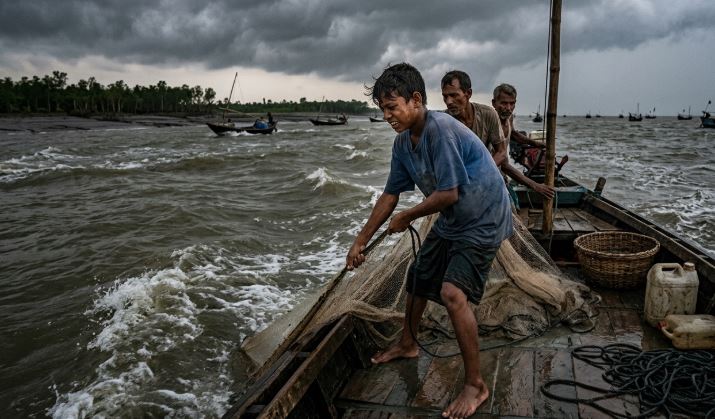
A 12-year-old boy, Tanzil in worn out shirt and pants is seen standing in front of a warehouse, calling out prices to buyers after spending the entire night fishing in the river.
He is one of hundreds such faces here - whose adolescence is stolen by struggle for livelihood.
Instead of attending school, Tanzil joined his father on fishing boats, battling strong currents and rough weather to support his family while poverty left little room for him to go to school, to which he bade a farewell after ending his third grade.
Every night, he and boys of his age cast nets into the river, hoping for a catch that will ensure food for their families the next day.
Villages in the coastline district and islands under its purview child labor become a common reality and it has been increasing gradually.
Children work on fishing boats where they are often exposed to hazardous conditions, including storms, tidal surges and risk of drowning. They carry heavy baskets of fish, sort catches at landing stations and assist in fish processing.
Girls face equally difficult circumstances of different types. In remote char areas, many never attend school and are married off during their early teens. Burdened by household responsibilities, early motherhood, malnutrition and limited healthcare, they often lose the opportunity to enjoy a healthy childhood.
According to official statistics, Bhola has more than 5,26,000 children between the ages of five and 17 years with nearly 47,000 working children. Officials estimated more than 23,000 of them engaged in hazardous labour though there was no accurate data exist on the number of child fishers across the district.
In many cases, children are viewed as an additional source of income, while some fishing families depend on their labour to survive, keeping them away from schools.
ADMINISTRATIVE EFFORTS
Bhola's deputy commissioner or administrative chief Dr Shamim Rahman recently called a monitoring meeting on child labor elimination at the conference hall of his office.
Concerned officials of Barishal coastal region reviewed the situation and identified challenges of eliminating hazardous child labor suggesting and reviewing several initiatives to address the scenario.
"We have launched various programmes to protect children from hazardous jobs in line with national child labor elimination policies," Rahman said.
He said during the monitoring meeting the officials discussed strategies to rescue children involved in dangerous occupations through stronger coordination among the government agencies, local communities and development organizations.
"We are working to stop child labor in coastal areas. But without addressing poverty and guaranteeing educational opportunities, it will be difficult to eliminate child labor completely," he said.
Bangladesh's labour laws prohibit employment of children under 14 and restrict adolescents from engaging in hazardous work while the government also pledged to eliminate the worst forms of child labor.
Yet enforcement remains challenging in isolated coastal communities where economic survival often takes precedence over the legal protections.
For now, as fishing boats continue to set sail in the rivers of the coastal belt before dawn, many children remain caught between poverty and possibility.
Their small hands still grip heavy oars while their dreams of education drift further out to sea.