BSS
  22 Jun 2026, 13:34

Every stitch in nakshi kantha threads story of self-reliance, education

Photo : BSS

By Md Aynal Haque

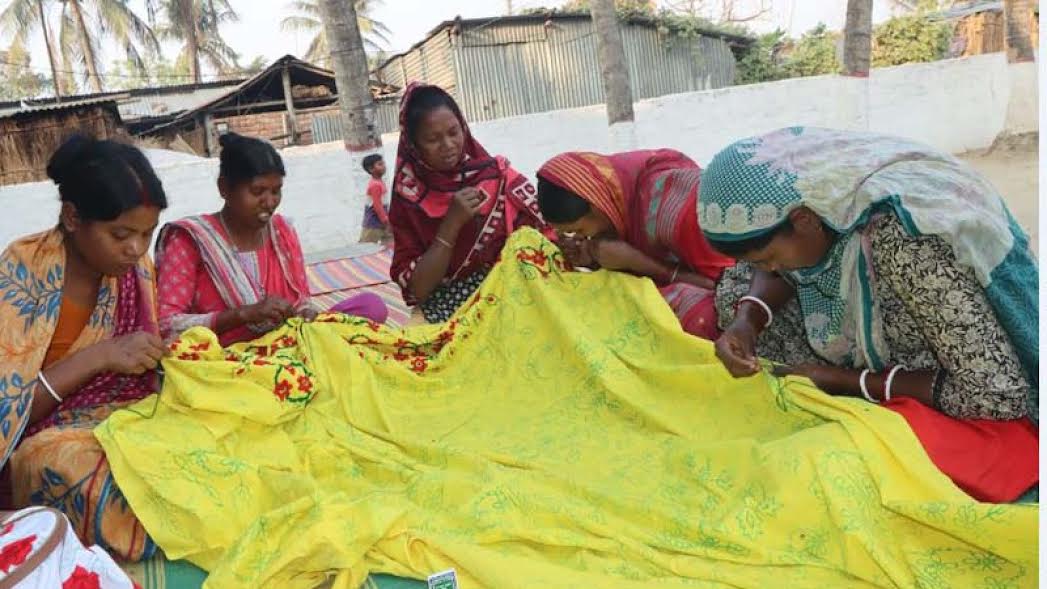
RAJSHAHI, June 22, 2026 (BSS) - In Bhugrail Christian Para village of Paba upazila, an unusual scene unfolds each day-children walk into school with books in hand while their mothers sit nearby, stitching vibrant nakshi kanthas.

Under trees and beside classrooms, women from small ethnic communities embroider flowers, vines, birds and rural alpana motifs on cloth, speaking in Santali or Mahali as they work. 

Each stitch, they say, carries more than design-it reflects a path toward self-reliance and their children's education.

The school, Shishu Probhat Vidyaniketan, is sustained entirely through the sale of these handmade quilts. 

Behind the initiative is Sumi Murmu, who founded the 'Nari O Shishu Kollyan Sangstha' (Women and Children Welfare Organization) to create income opportunities for women while ensuring education for their children.

"We wanted to break the cycle where children grow up without education and repeat the struggles of their parents," Sumi said, adding that many families in the community face challenges such as poverty, early marriage, and lack of awareness.

Her own life reflects that struggle. Born into a modest family in Rajshahi, she faced financial hardship from childhood and was married in 2006 after passing SSC. 

Despite early motherhood and family pressures, she completed her higher education, earning a master's in Political Science, along with professional degrees in education and business administration.

After briefly working in a private bank, she left her job to focus on community development. With training from the Department of Youth Development, she began producing nakshi kanthas from her home and later engaged other women from fieldwork in the process.

Today, 172 women are involved in the initiative, working in embroidery, block printing, finishing and sales. Their monthly income ranges from Tk 3,500 to Tk 15,000, while each kantha sells between Tk 800 and Tk 10,000. On average, around 150 pieces are sold each month through two sales centers named 'Prokriti Collection.'

Many of the women say the work has changed their lives. "Now I can support my child's education and manage household needs," said Amely Baskey, who previously had no independent income.

In 2022, after registration with the Department of Social Services, the organization reopened two closed school buildings in Bhugrail and Santoshpur villages. The schools now provide education from playgroup to class four for children of all communities.

Each school runs with four teachers and one support staff, with all expenses-including salaries and rent-covered by the organization.

For local families, the school represents more than learning-it is part of a broader effort toward dignity and economic independence. "Without this school, our children would not have learned to read and write," said one mother in Mahali.

Father Liton Kosta of Bhugrail Church said the initiative has helped ensure continued education for children from marginalized communities by making use of unused school buildings at nominal rent.

For the women of Bhugrail, every stitch in a nakshi kantha is now tied to two goals: sustaining education and building a future of self-reliance.