News Flash

KHULNA, June 10, 2026 (BSS)- A severe shortage of safe drinking water has emerged in the coastal upazila of Koyra in Khulna district, forcing thousands of residents to travel long distances every day to collect water amid prolonged dry weather and declining groundwater levels.
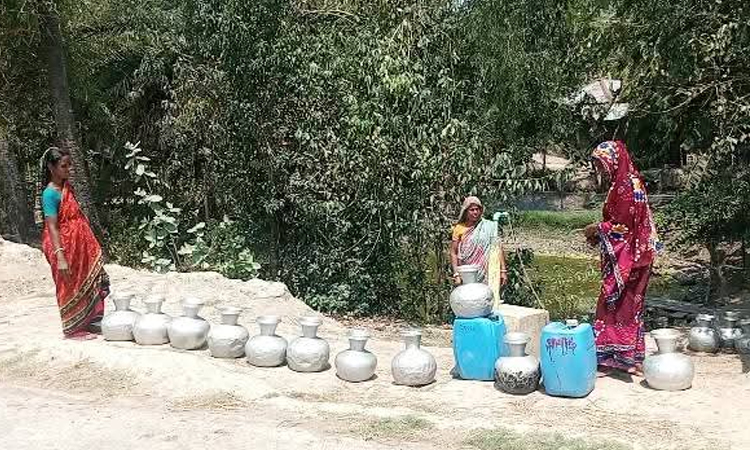
Women and girls often bear the burden of walking long distances to collect water, spending hours each day on the task essential for family survival.
Local people said ponds, the main source of freshwater in many areas, have started drying up due to the ongoing heatwave, while water levels in tube wells have dropped significantly, worsening the crisis across the upazila.
According to local sources, residents of Maharajpur, Koyra Sadar, North Bedkashi and South Bedkashi unions mainly depend on deep tube wells for drinking water.
In contrast, people in Bagali, Maheshwaripur and Amadi unions rely largely on pond water and rainwater harvesting systems as groundwater in those areas is highly salty and unsuitable for consumption.
The drinking water crisis in Koyra has persisted since the devastating Cyclone Aila struck the area on May 25, 2009.
The cyclone and subsequent storm surge inundated large parts of the upazila with saline water, damaging freshwater ponds and pond sand filters (PSFs).
Later, Cyclone Amphan in April 2020 caused further destruction to water sources and water supply infrastructure.
Although the government and several non-governmental organisations have rehabilitated a number of ponds and PSFs over the years, the facilities remain inadequate compared to local demand.
Field visits revealed that residents, particularly women, are spending hours every day collecting water from a limited number of functioning ponds and PSFs. Long queues are a common scenario at water collection points from dawn to dusk.
In the past, every morning began with a major worry for Sufia Begum, as she wondered where she would get safe drinking water for her family. The homemaker from North Bedkashi Union in Koyra faced a constant shortage of clean water. Every day, she had to walk several kilometres to collect water from distant sources.
At that time, unsafe pond water was Sufia Begum's only option. During the dry season, the hardship became even worse as ponds dried up, water sources became scarce, and even basic tasks like cooking faced difficulty.
Recalling those days, Sufia said once she could not cook timely because of the lack of water. She had to spend two to three hours every day for collecting water, making her physically exhausted and sometimes ill.
The water crisis affected Sufia's entire family, but things have now changed. A 2,500-litre rainwater harvesting tank has been installed in her yard, allowing her to meet her family's need throughout the year.
This transformation has also changed her daily life. Instead of spending hours collecting water, she now focuses on caring her family and earning an income.
Sufia Begum's story reflects the reality faced by many women in Bangladesh's south-western coastal region, where access to safe drinking water has long been a major challenge.
Ayesha Khatun, a resident of Maheshwaripur Union, said she has to spend several hours daily collecting drinking water, leaving little time for household work.
Talking to BSS, President of Koyra Upazila Press Club, Shariful Alam, said repeated embankment collapse led to intrusion of saline water in the locality, causing long-term damage to freshwater sources.
President of Koyra Upazila Water Committee H.M. Shahabuddin said the scarcity of safe drinking water has remained a major challenge in the coastal region due to frequent cyclones, river erosion and saline intrusion.
Maheshwaripur Union Parishad Chairman Shahnewaz Shikari told BSS that prolonged absence of rainfall deteriorated the situation. Safe drinking water remains the most pressing concern for the people of this union, he said.
Koyra Upazila Public Health Engineering Department Executive Engineer Istiaq Ahmed said tube wells are largely inoperative in many parts of the upazila due to salinity and geological conditions.
He said the government is continuing pond excavation programmes and distributing rainwater harvesting to meet up the crisis.
Koyra UNO Abdullah Al Baki said efforts to install tube wells, excavate ponds and distribute rainwater harvesting units are ongoing.
Due to the prolonged dry spell, many excavated ponds dried up, and groundwater levels have remarkably fallen, reducing water supply from tube wells and creating a temporary shortage of drinking water in some areas, he said.
Rising salinity in rivers and ground waters, sea-level rise, and inadequate infrastructure have created acute scarcity of clean water.
Research shows that salinity levels in many coastal water sources exceed national standards, while some tube wells and ponds contain harmful metal elements that pose health risks.
The shortage of safe water not only disrupts daily life but also increases health risks for local communities.
A study on water conditions in south-western coastal Bangladesh found that residents face safe water shortages for an average of 4 to 6 months each year, with some areas suffering for more than seven months.
The study also revealed that only 20 percent of families have their own water source, forcing most people to rely on external supplies.
Women basically suffer the most for the coastal region's water crisis, as traditionally it’s women’s duty in nearly 80 percent of households to collect water.
Fetching water from distant sources put impacts on them physically, wastes time, and exposes them to health risks.
Local residents urged the authorities to undertake long-term measures, including the construction of additional water treatment plants, restoration of freshwater ponds and strengthening embankments to ensure a sustainable supply of drinking water in the disaster-prone coastal areas.