Tuesday
30 June, 2026
News Flash
News Flash
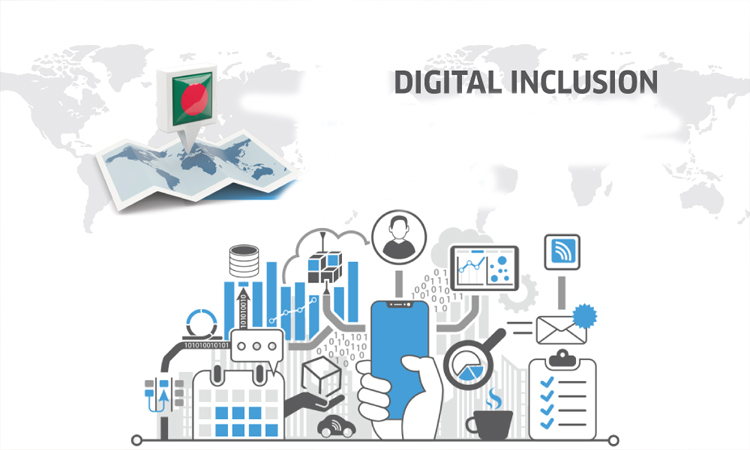
DHAKA, May 25, 2026 (BSS) - Bangladesh's digital transformation is entering a new phase where the challenge is no longer simply connecting people to mobile networks, but ensuring meaningful participation in the digital economy through quality access, ownership and capability.
Recent data from the Bangladesh Bureau of Statistics (BBS) on information and communication technology (ICT) access and usage presents a complex picture of the country's digital landscape, showing that while mobile connectivity has become nearly universal, advanced digital engagement remains uneven across regions, genders and income groups.
The findings suggest that Bangladesh's digital divide is no longer defined merely by access to phones. Instead, it is increasingly shaped by who owns advanced devices, who enjoys reliable internet connectivity and who can use digital tools for productivity and economic advancement.
According to the data, mobile phone access has achieved near-total saturation at more than 98 percent nationally, while city corporation areas have reached a full 100 percent access rate.
However, the data reveals significant gaps in advanced digital access.
Only 8.9 percent of households possess a computer compared to the 98.3 percent mobile phone baseline. Similarly, while 72.8 percent of households have smartphones, only 55.1 percent have active internet access.
The disparity reflects what analysts describe as a "consumption-production paradox", where most citizens can access digital content through mobile devices but lack the tools required for software development, advanced online work, digital entrepreneurship or professional productivity.
The findings indicate that the quality of digital access is now becoming more important than basic connectivity itself.
Geographical disparities also remain a defining feature of Bangladesh's digital ecosystem despite nationwide infrastructure expansion.
City corporation areas continue to maintain a substantial lead over rural regions in smartphone ownership, internet connectivity and computer access.
The gap is especially visible in Mymensingh, Rangpur and Dhaka divisions.
In Mymensingh, the rural-urban gap stands at 12 percentage points in smartphone ownership, 15.4 percentage points in internet access and 12.6 percentage points in computer ownership.
Rangpur also records significant disparities, while Dhaka division shows a striking 23.9 percentage point gap in computer ownership between rural and urban populations.
The findings suggest that even within the country's economic centre, advanced digital capability remains concentrated among a limited urban population, restricting broader regional participation in high-value digital activities.
The data also highlights important gender dimensions in digital access and ownership.
While gender gaps in mobile use are narrowing, ownership disparities remain substantial in several regions.
In Chattogram division, the gender gap in mobile use has fallen to zero, yet a 6.5 percentage point gap persists in smartphone ownership.
Internet usage data further reflects the divide.
In Dhaka division, internet use stands at 75.0 percent for men compared to 66.5 percent for women. In Khulna, the rates are 73.5 percent for men and 60.1 percent for women, while in Chattogram the rates are 68.3 percent and 64.0 percent respectively.
The findings indicate that many women continue to rely on shared household devices rather than owning personal smartphones.
Experts believe this lack of ownership creates barriers to financial autonomy, particularly in the use of Mobile Financial Services (MFS), where privacy, PIN security and personal device control are essential.
The ownership gap is most severe in Rangpur division, where the gender disparity in smartphone ownership reaches 22 percentage points.
District-level findings reveal even sharper inequalities hidden beneath national averages.
Dhaka, Gazipur and Feni consistently rank among the country's strongest performers in smartphone and computer penetration.
In contrast, Panchagarh, Kurigram and Narail remain among the weakest-performing districts.
Panchagarh represents the most severe case of advanced digital exclusion, recording smartphone access nearly 20 percentage points below the national average.
The findings suggest that a uniform national ICT policy may not adequately address such localised disparities, particularly in districts facing severe digital underdevelopment.
The data further identifies three major barriers to wider digital inclusion - lack of perceived need, high costs of equipment and internet services, and privacy or security concerns.
Telecommunication and ICT expert Sumon Ahmed Sabir told BSS that the absence of both mobile and fixed broadband internet in rural areas is a key reason behind slower digital growth compared to urban centres.
He said that if 4G mobile broadband services are made available nationwide, rural users would show greater interest in using the internet on their own devices. However, he noted that mobile operators remain reluctant to expand full 4G coverage in all areas due to commercial considerations.
Sabir also identified the high price of smartphones as a major barrier and called for government policy support to make devices more affordable for low-income people in rural areas.
He further suggested expanding online public services-similar to land-related digital services-to encourage more citizens to become internet users.
Replying to a query, he said that expanding 4G coverage alongside fixed broadband infrastructure and ensuring affordable smartphones would be a practical and effective way to boost internet penetration across the country.
The findings indicate that Bangladesh's digital divide is evolving into a more complex system where basic connectivity is becoming universal, but meaningful digital empowerment remains unevenly distributed.
Industry observers say the country's next challenge will be ensuring that digital access translates into broader economic participation, regional inclusion and social empowerment rather than remaining concentrated within limited urban and socio-economic groups.