Saturday
05 September, 2026
News Flash
News Flash
By Naziur Rahman Sohel
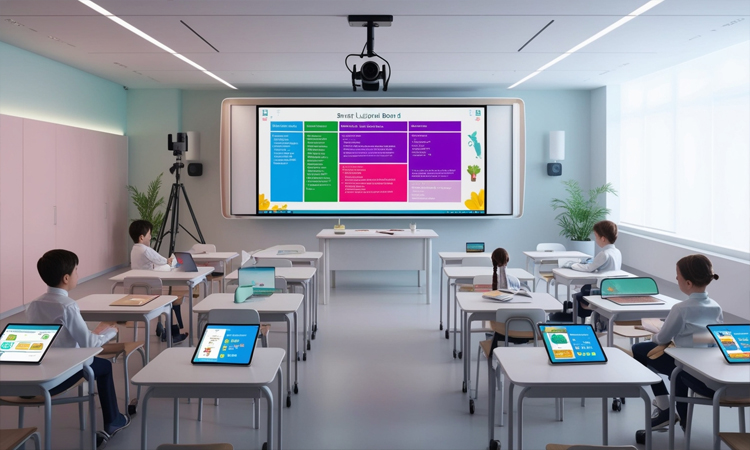
DHAKA, May 3, 2026 (BSS) - The government has taken an initiative to introduce 'Smart Classrooms' in selected secondary educational institutions across the country with the aim of modernizing teaching methods and making the education system more technology-driven and globally competitive.
Under the proposed project, 300 new smart classrooms will be established in 150 selected government and private secondary schools. In addition, 300 existing classrooms will be renovated and upgraded with modern facilities.
The project also includes the construction of recording rooms, meeting rooms, and a central data centre to support digital learning and administration.
The Directorate of Secondary and Higher Education (DSHE) said the feasibility study of the project has already been completed. The initiative will be implemented with financial grants and technical assistance from the Government of China.
The estimated cost of the Artificial Intelligence (AI) and cloud-based project is around Tk 135 crore. Preparatory work is underway so that implementation can begin from the 2026-27 fiscal year.
Director General of DSHE Prof. Dr. Khan Moinuddin Al Mahmud Sohel told BSS that China has expressed strong interest in supporting the modernization of secondary education in Bangladesh.
"A project proposal has been prepared to establish smart classrooms in selected schools with Chinese grant assistance. The selected classrooms will be equipped with world-class facilities. We hope to start implementation from the next fiscal year," he said.
According to the proposal, each selected school will receive two interactive education panels. The classrooms will feature AI-based automatic recording systems so that lectures can be stored as video content and accessed by students in remote areas through a cloud platform.
Students will also be able to access notes and learning materials instantly by scanning QR codes.
Director (Planning and Development Wing) of DSHE Professor Dr. Mir Zahida Naznin said the initiative is expected to reduce the digital divide and improve the overall quality of education.
She said the feasibility study of the China-funded smart classroom project has been completed. A modern data centre will also be established, and discussions have been held with the Bangladesh Computer Council regarding space allocation.
"After finalizing the site, formal approval from the Chinese side will follow. We have also requested inclusion of the project in the Planning Commission's list. Field-level implementation is expected in the 2026-27 fiscal year," she added.
The project will also include 10 modern recording studios and 30 special meeting rooms for education offices. A central cloud-based networking data centre will be set up at the DSHE premises to connect smart teaching activities across the country.
Research Officer Md. Sifatul Islam said the final report of the feasibility study is being prepared. Following this, a Technical Assistance Project Proposal (TAPP) will be jointly developed by Bangladesh and China.
After review by the Ministry of Education and approval from the Planning Commission and Project Evaluation Committee (PEC), implementation will begin.
Earlier, a Chinese expert firm conducted the feasibility study, while the Economic Relations Division is coordinating the overall process. A focal person has also been appointed at DSHE, and initial technical discussions have been held between the Education Management Information System (EMIS) cell and the Chinese monitoring team.
Meanwhile, the Ministry of Education has approved a pilot programme proposed by Huawei titled 'One classroom, one smart board and one teacher, one tablet'. The pilot is being implemented at Betgari Mir Shah Alam Girls' High School in Bogura and Obaidul Haque High School in Chandpur.
Officials said the AI and cloud-based initiatives are expected to transform learning from memorization-based methods to analytical and technology-oriented education, contributing to the vision of a more future-ready Bangladesh.