Saturday
05 September, 2026
News Flash
News Flash
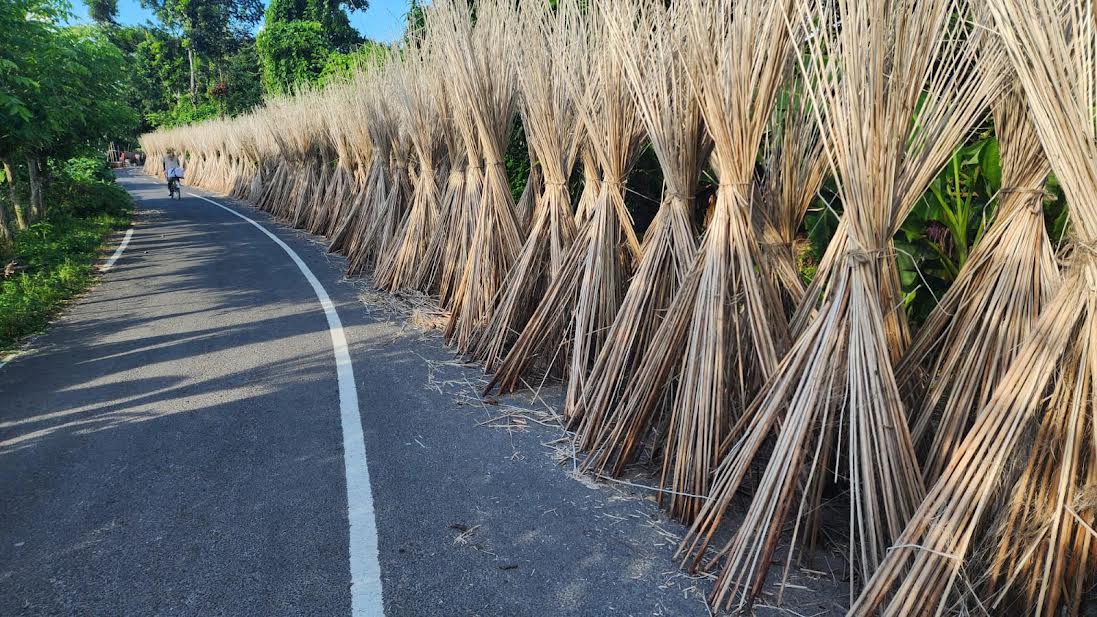
MEHERPUR, Sept 5, 2026 (BSS) - Once considered a neglected by-product left behind after harvesting jute, the jute sticks are now emerging as an important source of additional income for farmers in Meherpur as their use and market demand continue to grow.
Traditionally, the sticks were mainly used as firewood in rural households and had little economic value. However, their growing use for fencing, cattle sheds and other purposes has created a market for the product, allowing farmers to earn additional money alongside selling jute fiber.
Although farmers’ expectations are not always met by the prevailing prices of jute fiber, the sale of jute sticks enables them to recover a significant portion of their production costs. In some cases, farmers are earning more from jute sticks than from jute fiber.
The increased demand for jute sticks is also encouraging farmers to cultivate jute again despite their experiences of losses in previous years.
In Meherpur, farmers spend around Taka 20,000-25,000 to cultivate jute on one bigha of land. On average, they harvest around 10 maunds of jute from the land. At the current market price of around Taka 3,000 per maund, they earn about Taka 30,000 from selling the jute fiber.
At the same time, jute sticks from the same area can fetch Taka 10,000-15,000, depending on their quality. As a result, although the profit from selling jute fiber remains limited, the additional income from jute sticks significantly increases farmers’ overall earnings.
Jute farmer Mahatab Hossain of Sadar upazila told BSS that it costs him around Taka 26,000 to cultivate jute on one bigha of land.
“After selling the jute, there is not much profit left after deducting the production costs. But we can earn additional money by selling the jute sticks. This helps us recover a substantial portion of the cultivation cost,” he said.
The oldest use of jute sticks is as fuel. In rural areas, dried jute sticks have long been used for cooking in traditional clay stoves. Although they were previously considered a supplementary source of fuel, many rural households still use them for cooking.
Their use, however, has expanded significantly. Jute sticks are now used for making household fences, cattle sheds and temporary enclosures. Farmers also use them to fence the boundaries of croplands and protect vegetable and other crop fields from livestock.
Abul Hasan, a farmer from Pirojpur village in Sadar upazila, told BSS that jute sticks can be used to make fences around houses and croplands.
“They can also be dried and stored for use as fuel. So jute sticks are no longer something to be simply discarded,” he said.
Jute sticks are also easy to dry and store. After collecting them from the fields, farmers dry the sticks in the sun beside roads, in fields or in their yards. Once properly dried, they are tied into small bundles and stored for future use or sale when market prices are favourable.
The demand for jute sticks is no longer confined to rural areas. Traders are also selling the product door-to-door in Meherpur town, taking farmers’ produce directly from rural areas to urban consumers.
Businessman Zahidul Islam, who has been involved in the jute-stick trade for the past five years, said demand for the product has increased as its uses have expanded.
“The jute-stick business was not so active before. Now demand has increased because the sticks are being used for various purposes. We buy jute sticks from farmers at Taka 10,000-15,000 per bigha, depending on quality, and then sell them door-to-door in different rural and urban areas. By selling them in small bundles, we can generate Taka 25,000-30,000 in sales,” he said.
According to Zahidul, although the jute-stick trade is a small-scale business, it involves farmers, collectors and sellers, creating income and employment opportunities at the local level.
Beyond their traditional uses, jute sticks have greater economic potential if properly processed. They can be used to manufacture products such as particle boards and fibreboards, while there is also potential for their use in paper production.
Jute sticks can also serve as raw materials for handicrafts and various environmentally friendly products.
Experts said utilising these opportunities could turn jute sticks from merely a source of additional income for farmers into an important raw material for rural industries. This would help expand the market for jute sticks and create new opportunities for farmers to receive fair prices for their produce.
Deputy Director of Department of Agricultural Extension (DAE) in Meherpur Sanjib Mridha told BSS that jute has been cultivated on 16,630 hectares of land in the district during the current season.
“Farmers are able to recover a significant portion of their production costs by selling jute sticks alongside jute fiber. The growing demand and good prices for jute sticks are encouraging farmers to cultivate jute,” he said.
He added that expanding the diversified use of jute sticks could make them an important source of additional income for farmers while also creating opportunities for local businesses and small industries based on jute sticks.