Tuesday
08 September, 2026
News Flash
News Flash
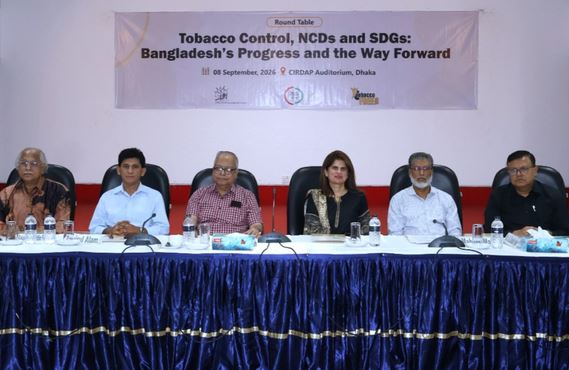
DHAKA, Sept 8, 2026 (BSS) – Experts at a roundtable discussion today said Bangladesh needs stronger legislation and effective enforcement against tobacco and nicotine products to meet its Sustainable Development Goal (SDG) health targets.
They also noted nearly 71 percent of all deaths in the country are attributable to non-communicable diseases (NCDs) such as cardiovascular diseases, stroke and cancer.
The roundtable discussion, titled "Tobacco Control, NCDs and SDGs: Bangladesh's Progress and Way Forward," was organised by PROGGA (Knowledge for Progress) and the Anti-Tobacco Media Alliance (ATMA) at the CIRDAP Auditorium, said a press release.
The discussants said around 200,000 people die each year from tobacco-related diseases in Bangladesh, making tobacco use a major obstacle to achieving SDG 3, the health-related goal.
They added that tobacco also poses a significant barrier to achieving almost all other SDGs, from poverty eradication and food security to quality education, gender equality, environmental protection, climate action and biodiversity conservation.
National Professor Dr. Mahbub Ullah, who chaired the event, said, "Tobacco control goes beyond the health sector and is directly linked to the country's development, economy, and the protection of future generations. Translating political and institutional commitments to tobacco control into action would help accelerate progress toward achieving the SDGs."
President of Bangladesh Cancer Society Professor Dr. Golam Mohiuddin Faruque said, "The woes of cancer patients reveal the terrible consequences of tobacco use. Tobacco control measures must be strengthened to protect people from the poison of tobacco."
The discussants also described the government's recent amendment to the tobacco control law as a laudable initiative. However, they expressed deep concern that the finalised law leaves e-cigarettes, vapes, nicotine pouches and other emerging tobacco and nicotine products outside its span.
They stressed that appropriate legal measures are urgently needed to address the threats posed by such products and safeguard public health, noting that a number of countries have already banned e-cigarettes and vaping products given their harmful impact on health.
Speakers also urged the government to formulate the necessary Rules under the amended law at the earliest and to implement Article 5.3 of the FCTC to protect tobacco control policies from industry interference.