Monday
24 August, 2026
News Flash
News Flash
By Ridwan Ahmed
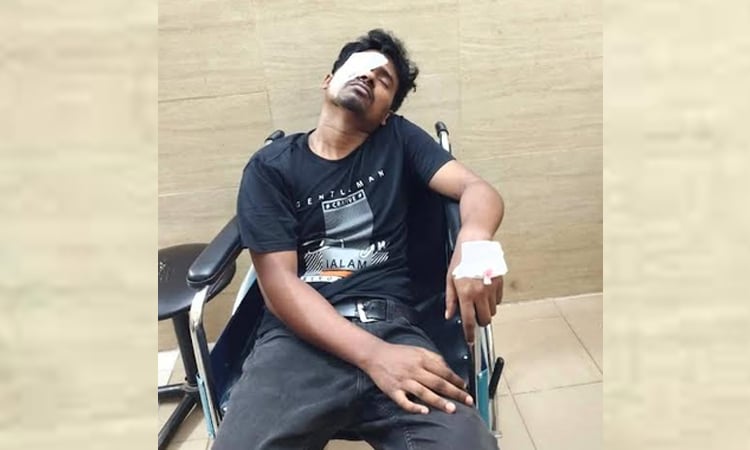
CHITTAGONG UNIVERSITY, Aug 2, 2026 (BSS) - He has lost the sight in his right eye, but not his hope. Shuvo Mahmud, who once dreamed of becoming a police officer, is now a wounded fighter. Although he lost his right eye to gunfire during the July mass uprising, his determination remains unshaken.
Shuvo, a student of Bangla Department at Chittagong University (CU), hails from Lakshmipur. On the afternoon of July 16, he was shot in his right eye while taking part in the movement in Muradpur. The bullet severely damaged the eye, including the cornea and retina.
Two surgeries were performed, but the eye could not be saved. Doctors told him clearly, "You will never be able to see this eye again." Yet Shuvo still hopes that, by the grace of Allah, he may one day regain sight in that eye.
That terrifying afternoon still haunts him every moment. He was shot during clashes with Chattra League, Jubo League activists and police in Muradpur. "While I was turning back, I suddenly heard a sound and felt something hit my eye and I fell down. I asked someone to hold me, but nobody came forward," Shuvo recalled.
Blood was pouring from his eye. When he gently rubbed it to understand what had happened, something sticky came out. He then realized the situation was extremely serious.
He wanted to go to a hospital immediately, but the roads were blocked by barricades. Terrified people were unwilling to take him. Eventually, he set off on foot toward the hospital with several unknown injured youths. After repeatedly requesting a rickshaw driver, he managed to head toward Chittagong Medical College Hospital (CMCH).
"I did not know the people who were with me. After reaching CMCH, they became busy with their own treatment. Then I was trying to stop the blood from my eye with one hand and moving forward with the other. I kept asking people, "Brother, please take me to a doctor," Shuvo said.
After receiving initial treatment at CMCH, he was referred to the National Institute of Ophthalmology in Dhaka. After reaching the institute the next morning (17 July), another struggle began.
"Blood was still coming from my eye, but they were saying they could not admit me. After many requests, they finally admitted me. But they neither examined me nor provided any treatment. They simply left me on a bed," he said.
At the end of the day without treatment, a doctor finally came in the evening and performed surgery. During the operation, Shuvo heard a doctor say, "What a pity, such a young boy and he will never be able to see again." The words remain etched in his memory.
Fifteen days later, after being discharged, Shuvo went to another eye hospital. After one and a half months of treatment, doctors advised him to have the eye removed, warning that otherwise it could become infected and decay. But Shuvo refused and continued searching for alternatives.
Later, with the help of a guardian of one of his students, Shuvo was admitted to the Combined Military Hospital (CMH) in Dhaka. He is still receiving follow-up treatment there.
"The condition of my eye fluctuates. Every few weeks, it gets worse and then improves again. I will have to use eye drops for the rest of my life and undergo follow-up every one to one and a half months. This is not to restore my eyesight, but to prevent the eye from having to be removed," he said.
Initially, vision in his healthy eye deteriorated by as much as 70 percent. Although it remains somewhat blurred, he can now see. "My only wish now is that my left eye remains healthy," Shuvo said.
But the damage was not only physical. After losing his eye, Shuvo developed post-traumatic stress disorder (PTSD) and even had suicidal thoughts. He received counselling under a psychiatrist at Chattogram Metropolitan Hospital and Chattogram Red Crescent.
"After losing my eye, I lost not only light but many other things. Wherever I look, I see obstacles. But I am trying to adjust slowly," Shuvo said softly.
However, his friends and departmental teachers stood beside him at every step. To prevent academic difficulties, he was allowed to sit for examinations with the assistance of a scribe. "These forms of support taught me how to live again," Shuvo said.
Shuvo's biggest dream had been to become a police officer. He had always been conscious about his health, regularly used eye drops and never rubbed his eyes. Today, that very eye is gone.
"I had planned to buy a stylish pair of sunglasses. Now even that dream is gone. But I now want to become a teacher so that I can help shape future police officers. I want to steer students away from wrongdoing committed in the name of politics," Shuvo Mahmud said.
Shuvo wants to remain in the competition, without receiving any special advantage or quota. "We protested against quotas. If a quota is introduced for us, it would be a betrayal of the movement. We want merit-based rehabilitation, not a quota," he said.