News Flash

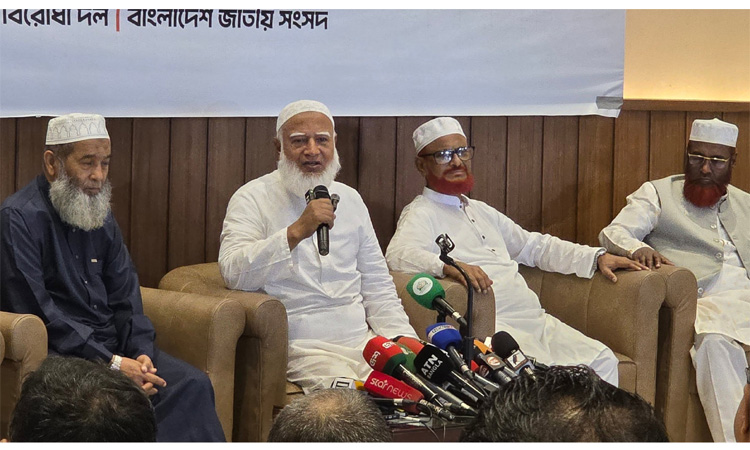
DHAKA, July 1, 2026 (BSS) - Leader of the Opposition in Parliament and Bangladesh Jamaat-e-Islami Ameer Dr. Shafiqur Rahman today called for making the Jatiya Sangsad (JS) responsible and accountable, saying the parliament should serve as the principal forum for resolving people's problems rather than becoming a venue for political confrontation or "entertainment."
Speaking at a post-budget view-exchange meeting with journalists at the LD hall of Jatiya Sangsad complex, he said the opposition would continue to support every government initiative that benefits the country while firmly opposing any measure that undermines people's rights or democratic values.
"We want a responsible parliament where public problems are discussed and solutions are found. Parliament should not become a place for entertainment. It should reflect the aspirations of the people," he said.
Referring to the recently passed national budget for FY27, Dr. Shafiqur Rahman said several proposals put forward by the opposition had been reflected in the final budget.
He welcomed the withdrawal of the proposed provision for whitening undisclosed money, saying the opposition had taken a firm stand against it.
He also appreciated the removal of the proposed advance tax on small and marginal traders, describing it as a positive step for low-income businesspeople.
The opposition leader further welcomed the government's assurance to reduce duties on imported bicycle parts through a Statutory Regulatory Order (SRO), arguing that the bicycle industry generates employment, supports exports and primarily serves low-income people.
At the same time, he expressed disappointment that several key opposition proposals were not accepted. Among them was changing Bangladesh's fiscal year from July-June to January-December to better match the country's weather conditions and reduce the year-end rush in development spending.
He alleged that a large portion of development expenditure is typically concentrated during the final months of the fiscal year, resulting in waste, inefficiency and misuse of public funds during the monsoon season.
Dr. Rahman also proposed introducing periodic budget evaluations every three to four months instead of relying solely on supplementary budgets at the end of the fiscal year. Such a system, he said, would strengthen parliamentary oversight and improve accountability in public expenditure.
The opposition leader stressed that the country's biggest challenges were not merely preparing large budgets but ensuring their proper implementation and preventing corruption.
"A large budget is not a problem if there is a national vision. The real challenges are implementation capacity and corruption. Unless these are addressed, people will not receive the actual benefits of the budget," he said.
Turning to constitutional issues, Dr. Rahman said the opposition would continue its campaign to implement the reform agenda through peaceful democratic means.
"We gave our commitment to the people and we will stand by that commitment. Our movement will continue in a classical, methodical and non-violent manner," he said.
The opposition leader said political stability could only be achieved through cooperation between the treasury and opposition benches.
"No government alone can build a stable society. The government and the opposition must work together," he added.
Commenting on parliamentary practices, Dr. Rahman called for greater opportunities for opposition lawmakers to participate in debates, saying procedural imbalances should be addressed to ensure meaningful parliamentary democracy.
He also urged equal treatment of ruling and opposition MPs in development allocations, saying public resources belong to all citizens irrespective of political affiliation.
Dr. Rahman said his party had honoured its election commitment by refusing to avail itself of duty-free vehicle facilities and government residential plots for personal ownership, while clarifying that the official accommodation allocated to lawmakers during the tenure of parliament was different from permanent ownership.
He also criticised the absence of adequate allocations in the budget for institutions related to the July movement, including the July Museum and the July Foundation, saying their contributions should receive due recognition.
Highlighting migrant workers' issues, the opposition leader called for reducing migration costs, particularly for workers travelling to Malaysia, and demanded strict legal action against recruitment syndicates exploiting overseas job seekers.
"We will continue to raise our voice inside parliament and outside for the rights of migrant workers. We will not remain silent while poor people are exploited," he said.
Dr. Rahman also voiced strong support for implementation of the Teesta Master Plan, saying millions of people living in the river basin have suffered for decades and deserve a permanent solution.
On foreign policy, he said Bangladesh should implement projects based solely on national interests while maintaining mutual respect with neighbouring countries and adhering to an independent foreign policy.
The opposition leader reiterated that his party would continue to pursue democratic politics peacefully and responsibly, rejecting violence and confrontation.
"Our politics will be logical, responsible and peaceful. We want to establish a democratic, corruption-free, discrimination-free and humane Bangladesh through constructive politics," he said.
Dr. Rahman also described the media as one of the four essential pillars of the state alongside the legislature, executive and judiciary, urging journalists to continue performing their watchdog role with fairness and independence.
He expressed hope that the media would continue to highlight both the government's and the opposition's constructive contributions in strengthening parliamentary democracy. Senior leaders of Bangladesh Jamaat-e-Islami were present on the occasion.