Tuesday
08 September, 2026
News Flash
News Flash
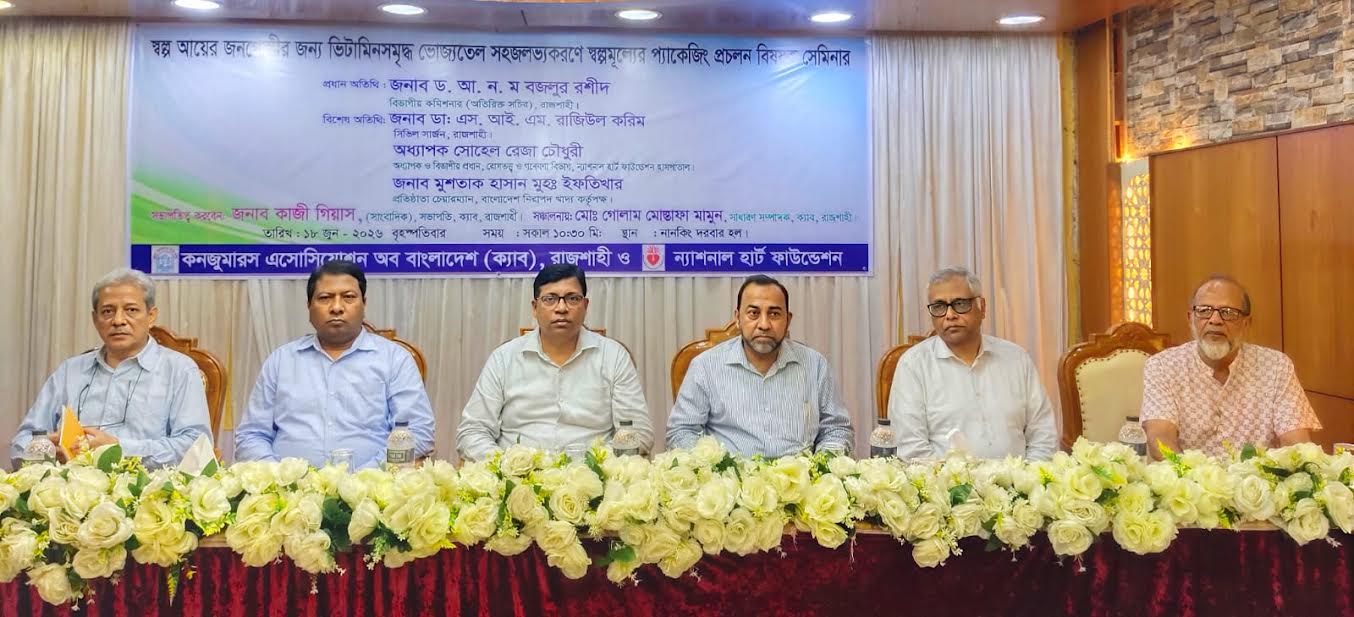
RAJSHAHI, June 18, 2026 (BSS) - Experts have called for making safe edible oil readily available through affordable, light-resistant packaging to reduce health risks for low-income populations.
They said packaging plays a crucial role in maintaining the quality of edible oil, and cost-effective, efficient packaging technology is essential to ensure safe food for low-income people.
The remarks came at a seminar titled "Introducing Low-Cost Packaging to Make Vitamin-Enriched Edible Oil Available for Low-Income Populations", held today at Nanking Darbar Hall in the city.
The seminar was organized by the Consumers Association of Bangladesh (CAB) Rajshahi and the National Heart Foundation.
Speakers also said that around 70% of edible oil in the country is still sold loose or open form, which poses serious health risks.
Containers used for these open oils are often not food-grade, allowing dust, insects, and various contaminants to easily mix with the oil.
As a result, consumers unknowingly ingest hazardous substances on a regular basis. They added that while bottled oil has comparatively lower peroxide values than loose oil, open oil still dominates the market.
Mohammad Habibur Rahman, Additional Divisional Commissioner, was present as the chief guest at the event.
He said, "Ensuring safe food management is crucial to protecting public health. If quality control cannot be ensured for essential commodities like edible oil, health risks will continue to rise. If safe, affordable packaging technology is introduced, low-income people will also come under the coverage of safe food."
The keynote paper was presented by Mushtaq Hasan Muhammad Iftikhar, founding chairman of the Bangladesh Food Safety Authority.
He said light destroys the effectiveness of Vitamin A and increases oxidation in edible oil, raising peroxide values and causing the oil to spoil quickly. This changes the oil's color, taste, and smell, causing long-term harmful effects on the human body. Using light-resistant packaging can significantly reduce these damages.
He further said, "Control is needed at every stage, from production to packaging, to maintain the quality of edible oil. Exposure to light and oxygen degrades oil quality. Therefore, using affordable light-resistant packaging technology can ensure safe edible oil."
In his opening remarks as chair, Golam Mostafa Mamun, General Secretary of CAB Rajshahi, said, "The unregulated market for loose oil is creating major risks for consumers. Transparency and quality control in the market are urgent. We want affordable, safe packaging systems to be introduced so that quality edible oil is made available to the general public."
Others who spoke at the seminar included Dr S. I. M. Rezaul Karim, Civil Surgeon of Rajshahi; Professor Sohel Reza Choudhury, Head of the Department of Epidemiology and Research at the National Heart Foundation of Bangladesh; and Liaquat Ali, Joint General Secretary of the National Heart Foundation, Rajshahi.
The speakers said ensuring safe edible oil is not possible without coordinated efforts from the government, producers, and consumers.
They expressed optimism that introducing affordable packaging systems would reduce edible oil waste, lower health risks, and give low-income people access to safe, quality edible oil.