Saturday
22 August, 2026
RAJSHAHI, Dec 16, 2025 (BSS) - Experts at a meeting unanimously said bilateral coordination and realistic decisions can be the crucial means of water management and sustainable solutions of agriculture production in the drought-prone Barind area.
Adverse impact of climate change has been posing a serious threat to the living and livelihood conditions of people in the water-stressed area so there is no way but to integrate efforts to overcome the odd situation.
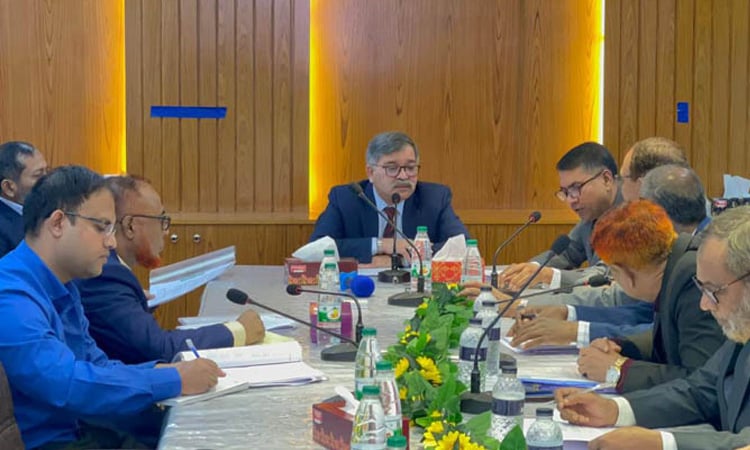
The remarks were revealed in a meeting between the officials of Water Resources Planning Organization (WARPO) and Barind Multipurpose Development Authority (BMDA) held at BMDA office conference hall here on Monday.
Additional Secretary to the Ministry of Water Resources Khondoker Aziz Ahmed and WARPO Director General Lutfor Rahman addressed the meeting as resource persons, while BMDA Executive Director Tariqul Alam was in the chair.
BMDA Additional Chief Engineer Dr Abul Kashem and Superintending Engineers Iqbal Hossain,Nazirul Islam and Abdul Latif also spoke.
Lutfor Rahman said WARPO aims and objectives center on ensuring integrated planning and sustainable management. "We need better coordination between departments to mitigate the water crisis in the Barind area," he added.
The meeting was told that a gazette has recently been published declaring 4,911 villages in 25 upazilas under Rajshahi, Naogaon and Chapainawabganj districts as water-stressed.
As per the decision of the 18th meeting of the National Water Resources Council (NWRC), the area has been declared water-stressed for 10 years.
Restrictions have been imposed on the extraction of underground water for any other purposes, excluding only drinking water.
According to the gazette notification, no more extracted water will be used for irrigation and other industrial purposes in the restricted area.
In his remarks, Tariqul Alam said the contributions of the BMDA have been multifaceted, leading to significant advancements in agricultural productivity, water resource management, and overall socio-economic development.
It has significantly contributed to socio-economic development in 135 upazilas under all 16 districts in the Rajshahi and Rangpur divisions through various initiatives, primarily focusing on agricultural development and water resource management.
The BMDA's work has helped transform the region into a more productive agricultural area and improve the livelihoods of its people.
In the 2024-25 fiscal year, the state-owned entity re-excavated 122 kilometers of canals and 56 ponds, alongside constructing 22 cross-dams and installing two river pontoons and 56 irrigation machines driven by solar power.
"We have also installed 450 deep tube wells, 1,305 kilometers of underground pipelines, and six foot-over bridges, besides producing 500 tonnes of seeds and imparting training to 550 farmers," said BMDA Executive Director Tariqul Alam.
Since its inception in 1987, it has so far re-excavated 2,649 kilometers of canals and 4,313 ponds, constructed 800 cross-dams and 15,348 underground pipelines, rehabilitated 4,790 deep tube wells, produced 8,500 tonnes of seeds, and provided training to 1,58,302 farmers.
At present, BMDA has been providing irrigation to 6,28,567 hectares of land by operating 15,560 DTWs and 991 low-lift pumps, producing around 70.60 lakh metric tonnes of food crops annually.
BMDA has been instrumental in developing irrigation infrastructure, particularly through the installation of deep tube wells (DTWs) and the re-excavation of ponds and canals. This has enabled increased agricultural production by providing water for irrigation during dry periods.