Sunday
13 September, 2026
News Flash
News Flash
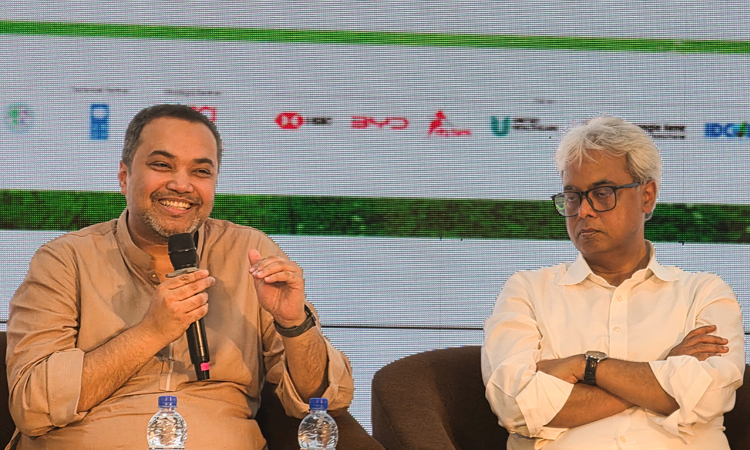
DHAKA, Sep 12, 2026 (BSS) - Prime Minister's Education and Primary and Mass Education Adviser Mahdi Amin has said the government is bringing about a revolutionary change in the country's education system to produce world-class skilled human resources and a technology-driven future generation.
"From the next academic year, modern subjects such as artificial intelligence (AI), robotics, machine learning and cybersecurity are being given special priority in textbooks for grades six to ten. At the same time, technical education is being institutionally integrated with mainstream education and made compulsory for all students," he said.
He made the remarks while speaking at a plenary session of 'Bangladesh Innovation Fair 2026', organised by the Ministry of Science and Technology at Novo Theatre in the capital today.
Mahdi, also Prime Minister's Office spokesperson said, "The government is giving the highest priority to STEM (science, technology, engineering and mathematics) education to keep pace with the technology-driven and rapidly changing global framework. The Prime Minister has given direct instructions to give equal priority to STEM education not only at the secondary and higher secondary levels but also at the tertiary level."
Outlining the details of the curriculum reform, he said necessary reforms are underway at every stage from primary to higher education to overcome the limitations of theoretical education and reduce the gap between book-based learning and practical application.
He said two new subjects, 'Sports' and 'Culture', will be introduced at the primary level in the fourth grade from the next academic year. Meanwhile, 'Learning with Happiness' will be introduced in the sixth grade, which will help students acquire interpersonal and transferable skills necessary for real life.
The adviser said, "At present, technical education is not compulsory for all students. However, it will be introduced in the sixth grade from the next academic year, and gradually, completing technical education will be made compulsory for students from grades six to ten in schools of all regions and all levels across the country. The government's objective is to integrate technical education with mainstream education, without treating it as a 'taboo', as in developed countries."
Emphasizing the need to link higher education with the demands of real life, Mahdi Amin said work is underway to determine how technical and vocational education can be integrated into the curricula of around 2,500 affiliated institutions of the National University across the country.
Praising the calibre of Bangladeshi youth by international standards, the Prime Minister's adviser said Bangladeshi young people are working with distinction on the global stage. If provided with appropriate resources and platforms, they are capable of conquering the world. The government wants to prevent 'brain drain' and transform it into 'brain circulation'.
In this regard, he said the government plans to build a strong industry-academia ecosystem by utilising endowment funds, CSR funds and the experience of Bangladeshi alumni, as is done at world-class universities, while also involving Bangladeshi experts working abroad in the country's curriculum and industrial development through special fellowships.
The seminar, titled 'STEM for a Future-Ready Bangladesh: Building the Backbone of the Innovative Economy', was moderated by Science and Technology Ministry Secretary Md Anwar Hossain. Also participating in the discussion were National University Vice-Chancellor Professor Dr ASM Amanullah, UNESCO Dhaka Office Chief of Education S Kyung Ko, senior official of a leading telecommunications company in the country Tanvir Mohammad, Independent University, Bangladesh (IUB) Vice-Chancellor Professor Dr M Tamim, among others.