Wednesday
02 September, 2026
News Flash
News Flash
DHAKA, Sept 2, 2026 (BSS) - Adviser to the Prime Minister on Finance and Planning Prof Dr Rashed Al Mahmud Titumir today said that the country's ongoing electricity and energy crisis is the result of the fallen government's flawed energy policies, excessive dependence on imports and failure to build national capacity.
"People must be clearly informed that the ongoing electricity and energy crisis has no connection with the present government. A major part of the crisis is the result of past wrong policies and decisions," he said.
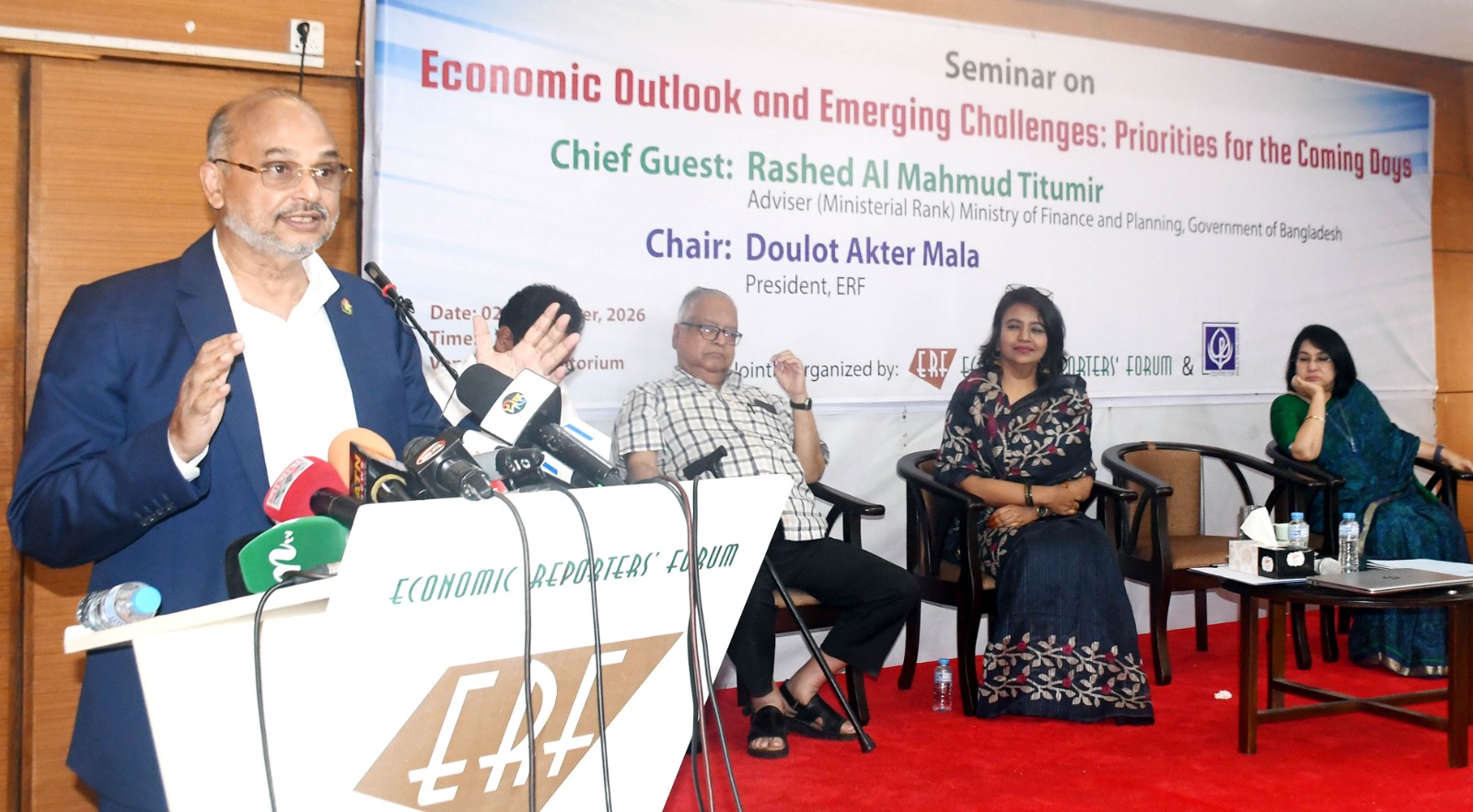
Titumir was speaking as the chief guest at a seminar titled "Economic Context and Emerging Challenges: Priorities for the Future", jointly organised by the Economic Reporters' Forum (ERF) and the Centre for Policy Dialogue (CPD) in the capital.
He said the uncertainty over global fuel prices and supplies caused by the current situation in the Middle East is also affecting Bangladesh.
"Bangladesh is currently spending around $11 per unit to import LNG from Qatar. If the country had adequate domestic gas supplies and exploration capacity, energy could have been supplied at a much lower cost," he said.
The adviser said the previous government had increased dependence on imports instead of ensuring national energy security.
"Insufficient gas exploration, lack of development of domestic energy resources and inadequate initiatives to achieve renewable energy targets, including solar power, have contributed to the present situation," he added.
Titumir stressed the need to assess the economic cost of past failures in the energy sector, including the "cost of inaction" and the "cost of wrong doing".
He also called for an assessment of money siphoned out of the country and liabilities and debts accumulated in the energy sector.
"These four issues-the cost of inaction, cost of wrong doing, siphoned-off money, and debts and liabilities imposed on the present and future generations-need to be considered together in a comprehensive study," he said.
He urged the Bangladesh Economic Association, universities, think tanks and relevant professional organisations to undertake such research, saying accountability in government spending would be difficult without determining the economic cost of misuse of public money and wrong policies.
The adviser said a structure of oligarchic influence had developed in the country due to past patronage, excessive import dependence and failure to build national capacity in the energy sector.
He said the present government is working not only to address the problems inherited from the past but also to ensure future energy security.
"Steps have been taken to increase solar power generation, with a target of generating 4,000 megawatts of solar electricity," he said.
Titumir said initiatives had also been taken to turn electricity consumers into producers through net metering.
Under a recently issued notification, he said, arrangements are being made to purchase electricity from solar power producers, while various incentives, including VAT and advance income tax exemptions, are being considered for solar power and related equipment.
On healthcare, he stressed ensuring proper utilisation of budgetary allocations, saying health services were being expanded at the upazila level.
He said the government plans to develop 150-bed upazila health complexes as well as kidney dialysis centres and coronary care units at the district level.
"Simply increasing allocations for health and education will not be enough. We must also ensure that the allocated funds are properly utilised," he said.
Regarding inflation, Titumir said looting, corruption and irregularities in import and supply systems had previously created pressure on prices.
"Although inflation is currently slightly above 8 percent, the target is to gradually bring it down to 6 percent," he said.
He said a package worth around Tk 60,000 crore had been announced to reopen closed factories.
"Agreements have been signed with the concerned banks and financing for these closed industries will begin from September," he said.
Titumir also said Chattogram Customs House had collected a record amount of revenue in the last fiscal year.
He urged the media to examine the revenue collection figures, particularly those from mid-February to June 30, to assess the actual performance.
He said the government would present to the public, based on actual results, how achievable its revenue targets were.
"After completion of the first quarter of the government's activities, detailed information and progress will be presented around mid-October," he added.
Titumir said the government's objective in energy, electricity, revenue, education, healthcare and employment is to overcome past losses and establish an accountable, effective and sustainable state system.
ERF President Daulat Akter Mala chaired the seminar.
National Professor Dr Mahbub Ullah, FBCCI Administrator Fazlul Hoque and CPD Distinguished Fellow Dr Fahmida Khatun attended the seminar as special guests.