Tuesday
01 September, 2026
News Flash
News Flash
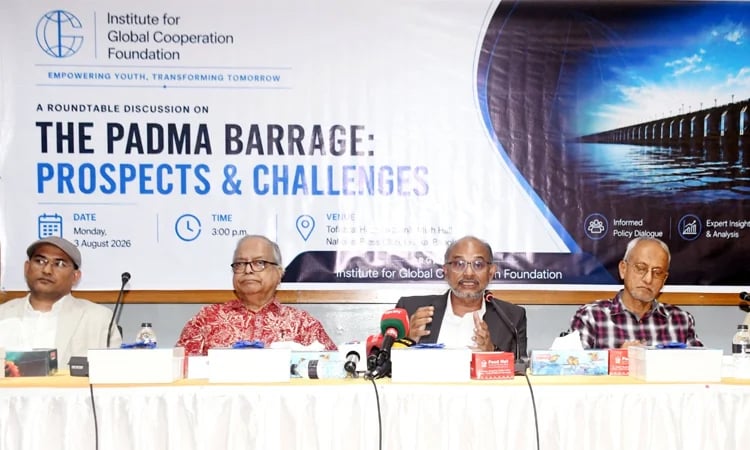
DHAKA, Aug 3, 2026 (BSS) - Policy analysts, academics and water management experts today described the proposed Padma Barrage as a strategic national project that could strengthen Bangladesh's water security, boost agricultural productivity and enhance climate resilience.
They made the observations at a high-level roundtable discussion titled "The Padma Barrage: Prospects & Challenges", organised by the Institute for Global Cooperation Foundation (IGCF) at the Tofazzal Hossain Manik Miah Hall of the National Press Club in the city.
The participants agreed that the project would play a crucial role in combating salinity in the country's southwest, ensuring sustainable irrigation, safeguarding food security and promoting integrated, data-driven water management.
Prime Minister's Adviser on the Ministries of Finance and Planning Dr. Rashed Al Mahmud Titumir said Bangladesh's fundamental water challenge lies in the paradox of having too much water or too little water.
He said the 1977 Ganges Water Sharing Treaty remained the country's only historic milestone in water management, but subsequent initiatives had suffered from weak implementation.
Titumir said the government, under the direct guidance of the Prime Minister, has redesigned the Padma Barrage project in line with public aspirations and modern requirements, ending decades of policy stagnation.
He expressed optimism that the project would add between 0.5 and 1.0 percent to the country's Gross Domestic Product (GDP), while significantly expanding irrigation coverage and agricultural production.
Prime Minister's Environment, Forest and Climate Change Affairs Special Assistant Dr. Md. Saimum Parvez said the Padma Barrage was one of the government's priority mega projects included in its election manifesto.
He reaffirmed the government's commitment to implementing the project swiftly under the Prime Minister's direction, stressing that Bangladesh would pursue a "Bangladesh First" policy in managing its water resources.
"We will not accept any external interference regarding our water management. The government will take every necessary step to resolve water-related challenges and disasters for the welfare of our people," he said.
Chairman of the Foundation for Strategic and Development Studies (FSDS) Major General (Retd) Fazle Elahi Akbar highlighted the project's geopolitical significance, saying transparent management and effective cost control would be essential for its successful implementation.
He also referred to China's large-scale upstream hydropower project on the Brahmaputra River, expected to generate 65,000 megawatts of electricity, saying such regional developments underscored the strategic necessity of the Padma Barrage to safeguard Bangladesh's downstream interests.
IGCF Chairman Mahmudur Rahman Shaon said the government approved the first phase of the project on May 13 at an estimated cost of Tk 34,497 crore, to be financed entirely from domestic resources.
He said the project would benefit four divisions and 19 districts, directly improving the lives of nearly 70 million people.
Besides strengthening irrigation, the barrage would help control salinity in the southwest, manage siltation and protect the biodiversity of the Sundarbans, he added.
Moderating the discussion, Dr. Bulbul Siddiqi, Professor of Political Science and Sociology at North South University, said outdated infrastructure currently prevents adequate water flow from the Padma to the Gorai River, even during periods of sufficient water availability.
He stressed the need for scientific planning to modernise water infrastructure, conserve water during the dry season and restore river connectivity to combat salinity and environmental degradation.
Among others, National Press Club General Secretary Ayub Bhuiyan, Dhaka Central University Vice-Chancellor Dr. Nurul Islam, National Professor Dr. Mahbub Ullah, North South University Vice-Chancellor Dr. Abdul Hannan Chowdhury and NSU Professor Dr. Md. Sirajul Islam, were present on the occasion.
The participants concluded that the Padma Barrage is vital for ensuring Bangladesh's long-term water security, environmental sustainability and climate resilience, and called for continued policy dialogue and science-based planning to address the project's technical and diplomatic challenges.