Monday
24 August, 2026
News Flash
News Flash
RAJSHAHI, June 1, 2026 (BSS)- Professor Dr. S M Abdul-Awal, Chief Coordinator
for SDG Affairs at the Prime Minister's Office (PMO), said that under the
Prime Minister's directives, field-level administration officials must be
proactive to ensure the successful implementation of his signature projects.
He said failure to properly implement government projects at the grassroots
is one of the main causes of government ineffectiveness.
Therefore, vigilant oversight is required to ensure that these special
projects, undertaken for public welfare, are not obstructed in any way.
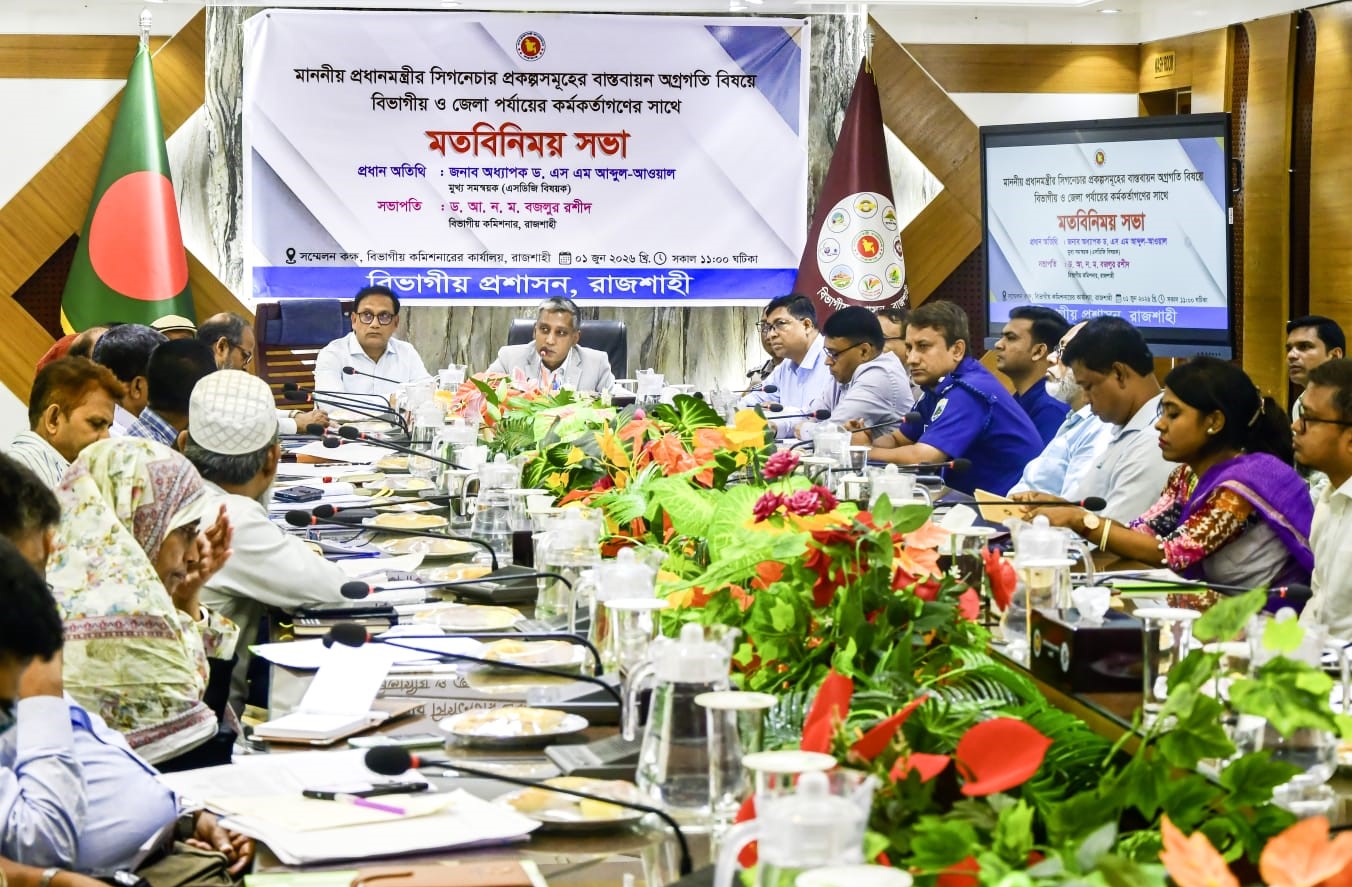
He made these remarks as the chief guest at an exchange meeting with
divisional and district-level officials on the progress of the Prime
Minister's signature projects, held today in the conference hall of the
Rajshahi Divisional Commissioner.
In his speech, Dr. S M Abdul-Awal said he had come to Rajshahi on the Prime
Minister's instructions to conduct special monitoring of the signature
projects under implementation.
These projects include: Family Card and Farmer Card, Canal excavation,
Recruitment of 100,000 health workers, Youth employment, Planting 250 million
trees, Providing allowances to khatibs, imams, muezzins and heads of other
religious institutions, Establishing sports as a profession and livelihood,
Reviving cooperatives, Establishing regional e-commerce hubs, Establishing an
agricultural export zone in the northern region, Development of livestock and
fisheries, Entrepreneurship-startup projects and an agricultural entrepreneur
platform- along with several other programmes of public importance.
He said the current government's conviction is "Bangladeshi nationalism".
Hindus, Buddhists, and Christians in this country are all citizens of
Bangladesh.
He stressed that it is crucial to monitor these projects to ensure they run
successfully in order to uphold everyone's rights.
Regarding the allowance for khatibs, imams, muezzins and other religious
leaders, he instructed Upazila Nirbahi Officers (UNOs) to work with
responsibility and sincerity so that no problems arise.
He also urged the preparation of social and economic reports on the
indigenous communities of the division.
The problems facing the canal excavation programme will require more detailed
discussion in the future, he added.
Speaking on the recruitment of health workers at the union and field levels
and the development of health complexes, he said these institutions are
essential for delivering healthcare at the grassroots.
Highlighting the importance of the Family Card, he said, "It is not just a
card. When a family is given Taka 2,500 through it, their tendency to save
increases and their purchasing power grows. This creates demand for products
in the market and gradually plays a major role in creating employment."
He further noted that each signature project was adopted after deep
consideration for improving people's quality of life.
Citing Malaysia as an example of development, the Chief Coordinator said
there is only a 14-year gap between the independence of Bangladesh and
Malaysia. "But we must reach the level Malaysia has achieved today," he
added.
He assured officials that problems related to PKSF or the NGO Affairs Bureau
would be resolved through coordination at the highest level.
The meeting was chaired by Rajshahi Divisional Commissioner Dr. ANM Bazlur
Rashid. Special guests included Rajshahi Range Deputy Inspector General (DIG)
of Police Mohammad Shahjahan and Deputy Commissioner Kazi Shahidul Islam.
Also in attendance were RMP Additional Police Commissioner Md. Al Mamun,
Rajshahi Superintendent of Police Mohammad Naimul Hasan, all Upazila Nirbahi
Officers of Rajshahi, and senior officials from various government
departments.