Monday
24 August, 2026
News Flash
News Flash
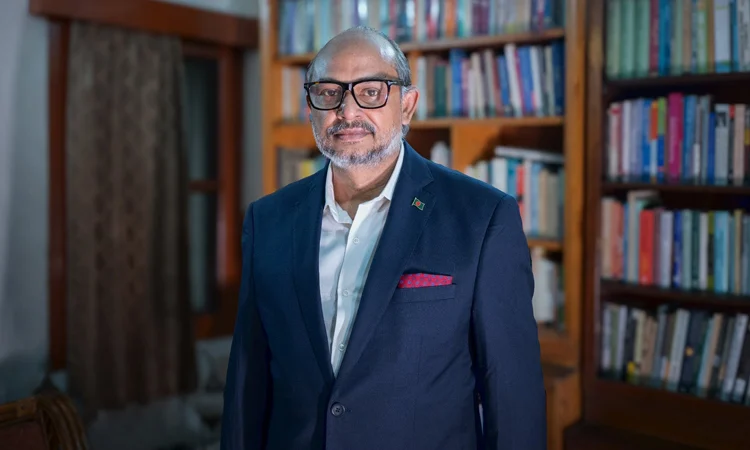
DHAKA, May 7, 2026 (BSS) - Adviser to the Prime Minister on the Ministries of Finance and Planning Dr. Rashed Al Mahmud Titumir today stressed that Bangladesh must move towards a humane, democratic and welfare-oriented state to effectively ensure inclusive and sustainable development.
“We need a humane, democratic, welfare-oriented government. That is the vision guiding our efforts,” he said.
The Prime Minister’s Adviser said this while addressing a seminar, titled “Re-thinking Unmet Healthcare Needs and Dynamics of Out-of-Pocket (OOP) Expenditure in Bangladesh,” as the chief guest organized by the Bangladesh Institute of Development Studies (BIDS) at its conference room in the capital today.
Former adviser to the interim government and noted economist Dr Wahiduddin Mahmud chaired the seminar while Professor Dr. A. K. Enamul Haque, Director General of the Bangladesh Institute of Development Studies (BIDS), also spoke.
Highlighting current economic pressures, Dr. Titumir noted that prolonged inflation and slow growth in real income have worsened the conditions of low-income groups. “The number of poor people is rising again. In such a situation, moving towards a comprehensive social protection system is no longer optional—it is essential,” he added.
He emphasized that social protection must be universal, rights-based and designed across the life cycle. “From the womb to the end of life, the state has a responsibility. This is not charity; this is a rights-based, life-cycle approach,” he said.
Dr. Titumir identified reducing inequality and strengthening state capacity as central to reform efforts. “Equitable socio-economic development and sustainable state capacity must go together,” he noted, adding that the vision of a welfare state must be grounded in democratic and human-centered governance.
He also underscored the importance of women’s empowerment, stating that development must be measured through the advancement of women. “Without empowering women, Bangladesh cannot move forward,” he added.
On healthcare, Dr. Titumir called for increased public expenditure with a strong focus on primary healthcare. “If we want to reduce inequality, we must increase health spending and ensure primary healthcare for all,” he said, stressing the importance of preventive care and awareness to reduce disparities.
He further pointed out governance challenges in social safety net programmes, including exclusion and inclusion errors. “Those who should not be listed are included, while deserving individuals are left out—this must be corrected,” he said.
Calling for systemic reforms, he highlighted the need for improvements in programme design, implementation, monitoring and accountability through open data governance. He also noted that the government is working on a five-year strategic reform framework aimed at broader macroeconomic and institutional transformation.
Urging collaboration, he called on researchers to provide evidence-based insights and support in building structural macroeconomic models. Reaffirming academic freedom, he said, “We believe in independent research and seek constructive engagement.”
Titumir said that despite notable progress in socio-economic indicators, structural disparities remain a challenge.
“Despite advancements, there are still constraints in expressing our position—particularly regarding inequality, the tax-GDP ratio and equitable distribution of resources,” he said.
Chairing the session, noted economist and former caretaker government Adviser Dr. Wahiduddin Mahmud emphasized that increasing public expenditure on healthcare is critical to reducing inequality.
“The higher the share of out-of-pocket spending in total healthcare expenditure, the greater the inequality,” he said, noting that healthcare costs rise disproportionately with income, widening disparities.
He observed that public healthcare spending plays a vital role in ensuring equitable access, particularly through primary healthcare services, which tend to benefit lower-income groups more.
However, disparities persist in higher-level services such as specialized and medical college facilities.
Drawing international comparisons, he said countries with higher public health expenditure achieve better outcomes, citing examples where stronger public financing improved health indicators.
Dr. Mahmud also highlighted that unmet healthcare needs are influenced not only by availability of services but also by awareness, education and socio-cultural factors, particularly affecting women.
He identified institutional capacity constraints as a major challenge, noting that allocated funds—especially in health education—often remain underutilized due to weak implementation.
Referring to policy trade-offs, he said governments must balance investment between primary healthcare and expensive advanced treatments. “With limited resources, we must choose between saving many lives through basic care and providing costly life-saving treatments,” he observed.
He warned that increasing reliance on private healthcare and out-of-pocket payments would exacerbate inequality, while greater public investment would help mitigate it.
The seminar featured a keynote presentation by Dr. Abdur Razzaque Sarker, Senior Research Fellow of BIDS, who highlighted that out-of-pocket expenditure remains the dominant mode of healthcare financing, placing a disproportionate burden on poorer households and contributing to unmet healthcare needs.
Participants at the event expressed optimism that coordinated efforts between policymakers, researchers and institutions would help Bangladesh build a more inclusive, equitable and resilient economy.