Tuesday
25 August, 2026
News Flash
News Flash
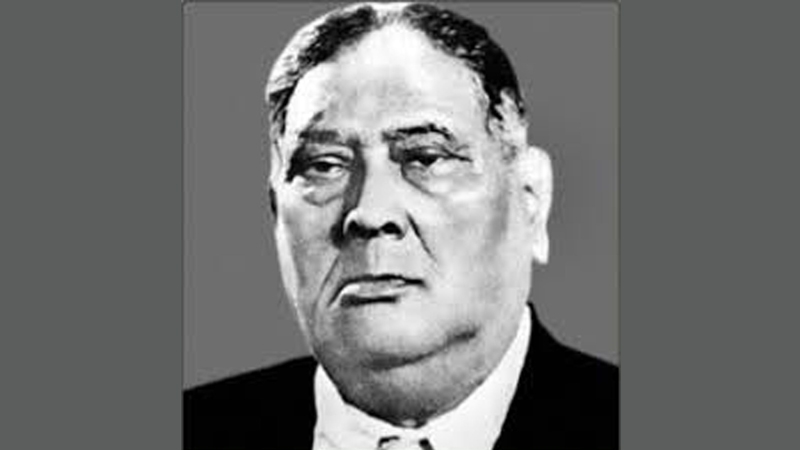
DHAKA, April 26, 2026 (BSS) - The 64th death anniversary of Sher-e-Bangla Abul Kashem Fazlul Huq will be observed across the country in a befitting manner tomorrow.
AK Fazlul Huq, extensively known as Sher-e-Bangla (Tiger of Bengal) or Huq Saheb, died on April 27 in 1962 in Dhaka.
He was born on October 26, 1873 at his maternal uncle's house at Saturia, the then remote and obscure sleepy little hamlet now in southern part of the then Bakerganj, Jhalakathi, a district of Barishal Division. But his ancestral house was at Chakhar, a village 14 miles away from Barisal town.
Huq was an eminent public leader who had held many high political posts, including the Mayor of Calcutta (1935), Prime Minister of undivided Bengal (1937-1943) and Chief Minister of East Bengal (1954), Home Minister of Pakistan (1955) and Governor of East Pakistan (1956-58).
To mark the day, different socio-political and cultural organizations have taken elaborate programmes including placing of wreaths at the grave of the deceased leader and offering fateha at the Mausoleum of Three Leaders (Tin Netar Mazar) near Doyel Chhatar in the capital, milad mahfil and discussions.
On the eve of the day, President Mohammed Shahabuddin and Prime Minister Tarique Rahman issued separate messages paying glowing tribute to Sher-e-Bangla AK Fazlul Huq.
President Shahabuddin in his message said Fazlul Huq was an extraordinarily wise, courageous and prudent statesman who held many important positions during his illustrious political career.
He served as a member of the Bengal Legislative Council, President of the All-India Muslim League (1916–1921), Mayor of Calcutta (1935), the first Prime Minister of undivided Bengal (1937–1943), Chief Minister of East Bengal (1954), and Governor of East Bengal (1956–1958).
Highlighting his lifelong commitment to public welfare, the President said Fazlul Huq worked for more than half a century for the wellbeing of the common people as a dedicated politician and social reformer.
He described him as a precursor of the political arena of undivided Bengal and a leader of farmers, workers and the masses. He founded the Krishak Praja Party (KPP) in 1936 and the Sramik-Krishak Dal in 1953.
Prime Minister Tarique Rahman, in his message, said Fazlul Huq ushered in a new chapter in subcontinent’s politics by presenting the Lahore Resolution in 1940.
He said the resolution remains an important subject of discussion among historians even today and reflects Huq’s visionary leadership.
Tarique Rahman emphasized Fazlul Huq’s commitment to the welfare of the farmers, describing him as a true representative of Bengal’s farmers.
The Prime Minister said Fazlul Huq was among the first leaders to recognize the deep connection between politics and the agriculture-based economy of Bengal, and he worked to ensure farmers’ interests and representation in the governance.