Sunday
13 September, 2026
News Flash
News Flash
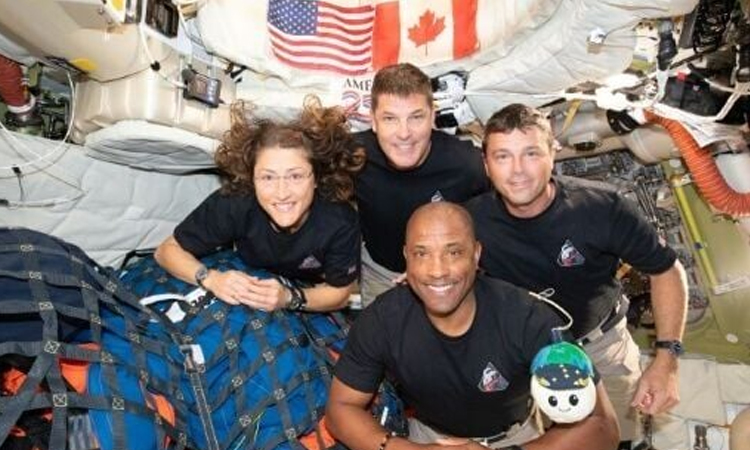
WASHINGTON, United States, April 11, 2026 (BSS/AFP) - Donald Trump on Friday praised the Artemis astronauts just after they splashed down in the Pacific and capped their journey around the Moon, as the US president looked ahead to the eventual goal of sending missions to Mars.
"Congratulations to the Great and Very Talented Crew of Artemis II. The entire trip was spectacular, the landing was perfect and, as President of the United States, I could not be more proud!" Trump said on Truth Social.
"I look forward to seeing you all at the White House soon. We'll be doing it again and then, next step, Mars!"
e said following a voice check from mission control in Houston.
NASA and the US military will now help them leave the bobbing capsule, after which they will be flown to a recovery ship off the Pacific coast near San Diego.
As the astronauts returned to Earth their spacecraft reached maximum speeds more than 30 times the speed of sound, and faced searing temperatures around half as hot as the surface of the Sun. It was a key test of their heat shield, which in an earlier trial mission had faced complications.
But the Artemis II re-entry went off without a hitch.
"This was a textbook entry and a textbook touchdown," said Navias.
NASA administrator Jared Isaacman called the voyage "a perfect mission."
"We're back in the business of sending astronauts to the Moon," he said, and "this is just the beginning."
"We are going to get back into doing this with frequency, sending missions to the Moon until we land on it in 2028 and start building our base."
Historic journey -
From liftoff to splashdown, the trip clocked in at nine days, one hour, 31 minutes and 35 seconds -- though NASA rounds up and calls it a 10-day mission.
It began with a dramatic launch from Florida on April 1, and was studded with firsts, records and extraordinary moments.
It was the inaugural crewed mission of NASA's program aiming to install a sustained presence on the Moon, including, as administrator Isaacman emphasized, the eventual construction of a base.
The second phase of the Artemis program was a test mission to verify the reliability of the Orion capsule, which before now had not carried humans.
The voyage also broke a record: the four astronauts become the humans to travel furthest away from the Earth, at 252,756 miles (406,771 kilometers).
While hurtling through deep space and zipping around the Moon the astronauts took thousands of photographs, amassing a stunning portfolio of images that captivated people on Earth.
They also witnessed a solar eclipse along with extraordinary meteorite strikes on the lunar surface, which left NASA scientists awe-struck.
Several achievements added to the voyage's historic nature: Glover was the first person of color to fly around the Moon, Koch was the first woman, and Canadian Hansen the first non-American.
Vital heat shield -
The Orion capsule passed a key test: the re-entry stakes were particularly high given concerns that arose during Artemis I, when an uncrewed 2022 test flight to the Moon and back saw a crucial heat shield erode in unexpected ways.
To minimize risks this time around, NASA shifted the re-entry path they had used in the test mission, after determining it had played a role in the complications.
The astronauts returned at a steeper and thus shorter trajectory, which NASA officials in discussion with the astronauts concluded would reduce risk to an acceptable degree.
Still, the heat shield situation prompted uneasy comparisons to the Challenger and Columbia space shuttle disasters of 1986 and 2003 respectively, when astronauts died after warning signs were set aside.
The Orion capsule will now be painstakingly examined to assess how it fared.
But to the relief of NASA, the astronauts and their families along with the public at large, Artemis II completed a successful trip home, returning four still-healthy astronauts.
Loved ones were watching the descent from mission control in Houston, where the astronauts are due to reunite with their families, likely this weekend.