Thursday
03 September, 2026
News Flash
News Flash
By Selina Shiuly
DHAKA, Feb 20, 2026 (BSS) - The date 'February 21' in 1952 stands as a defining moment in the history of the Bengali nation. On that day, students and political activists defied Section 144 to demand Bangla as a state language of the then Pakistan.
Police opened fire on peaceful demonstrators where Salam, Rafique, Jabbar, Barkat and many others embraced martyrdom.
Their sacrifice was not merely for linguistic recognition; it was a struggle to safeguard a nation's cultural identity and self-dignity.
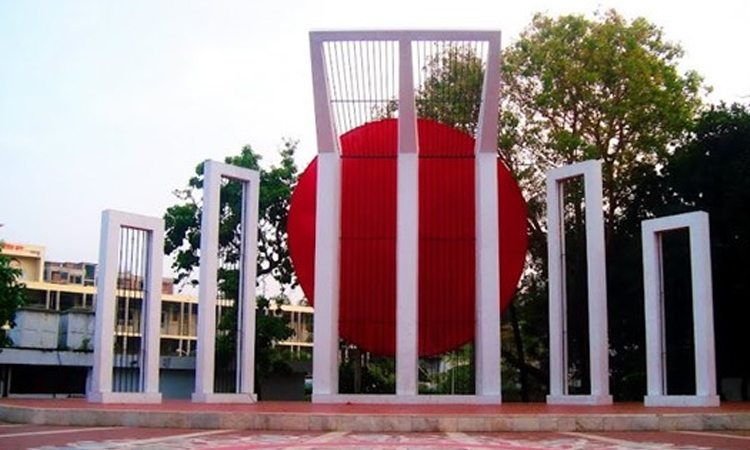
The architectural embodiment of that historic resistance is the Central Shaheed Minar - today a solemn altar of remembrance and a proud symbol of Amar Ekushey.
Emergence of the First Shaheed Minar:
The first Shaheed Minar was constructed on February 23, 1952, at the premises of Dhaka Medical College by students in memory of the martyrs.
The makeshift structure, however, was demolished within days by the then Pakistani authorities.
Undeterred by repression, the movement continued. On February 21, 1956, the foundation stone of a permanent monument was laid. The present structure was formally inaugurated on February 21, 1963, by Hasina Begum, mother of language martyr Abul Barkat.
The main pillars, rising about 14 meters (46 feet), symbolize a mother standing with her martyred children - an enduring metaphor of sacrifice for the mother tongue.
Design, Evolution and Historical Debate:
The Shaheed Minar was designed by artist Hamidur Rahman in collaboration with sculptor Novera Ahmed under the guidance of Shilpacharya Zainul Abedin. Over the years, discussions have continued regarding the evolution of the original design.
Researchers say the initial concept included murals and broader artistic elements, many of which were later modified due to political sensitivities of the time. Despite debates, the contribution of the designers remains firmly embedded in the nation's artistic and architectural history.
Ekushey Padak-winning architect Marina Tabassum told BSS that available writings and personal accounts indicate the current structure may not fully replicate the original design.
She observed that in a politically charged environment, monuments and public sculptures often face alterations and constraints.
Today, the Shaheed Minar is recognized not only as a memorial but also as a milestone in the architectural expression of modern Bangladesh.
Rajshahi's Secret Tribute:
The Language Movement quickly resonated beyond the capital. Students of Rajshahi College and Rajshahi Medical College constructed a makeshift memorial on the night of February 21, 1952, using mud, bamboo and bricks at the Muslim Hall premises.
Police demolished it shortly after tributes were paid the next morning.
In 2009, a commemorative plaque was installed at the site, preserving the memory of that historic initiative.
Language Movement veteran Mosharraf Hossain Akunji has claimed that the Rajshahi memorial, built on the night of February 21, predates the Dhaka monument and deserves state recognition as the country's first Shaheed Minar.
From National Mourning to Global Recognition:
Since 1952, February 21 has been observed as Shaheed Day. In 1999, UNESCO proclaimed the day as International Mother Language Day, elevating the significance of the Language Movement to global prominence.
Today, replicas of the Shaheed Minar stand in different parts of the world. Observances of the day highlight the importance of linguistic diversity and the protection of cultural heritage across nations.
The Tallest Shaheed Minar:
The country's tallest Shaheed Minar is located at Jahangirnagar University.
Designed by architect Rabiul Hussain, the 71-foot monument symbolizes the Liberation War of 1971.
Its 52-foot circular base represents the Language Movement, while eight steps signify the phases of struggle from 1947 to 1971. The tripartite column reflects language-literature-culture; land-people-struggle and independence-sovereignty-democratic spirit.
Architecture of a Nation's Conscience:
The Shaheed Minar is not merely a physical structure of concrete and stone. It embodies the spirit, resilience and cultural consciousness of the Bengali nation.
Every year, as the clock strikes midnight on February 21, thousands of barefoot citizens carrying flowers gather at its altar in solemn tribute.
The scene reaffirms a timeless truth - the blood shed for the mother tongue was not in vain.
Standing tall against the skyline of Dhaka, the Central Shaheed Minar remains an enduring emblem of sacrifice, pride and the unyielding spirit of Amar Ekushey.