Wednesday
26 August, 2026
News Flash
News Flash
Nowshin Anjum
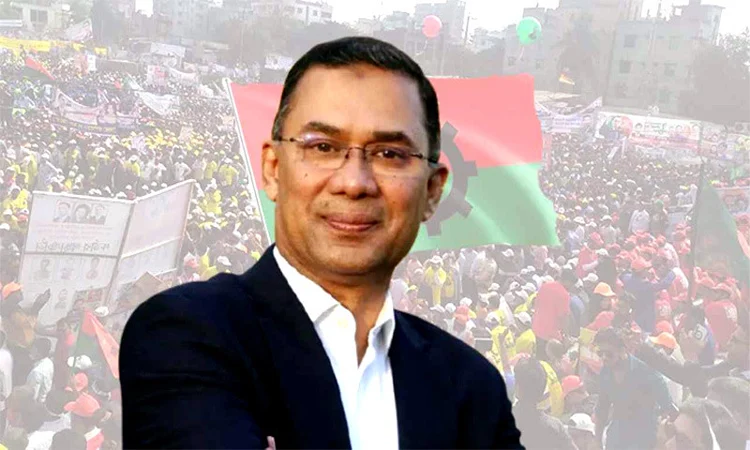
DHAKA, Feb 17, 2026 (BSS)- Tarique Rahman, a persona of hope, calm and connection, has captured the imagination of millions across Bangladesh. On 12th February, his party, the Bangladesh Nationalist Party, scored a historic victory, winning 209 seats on its own and Tarique Rahman emerged at the centre of this wave, set to become the country’s Prime Minister.
After 17 years away from the centre of power, he returned with a message many people were ready to hear. To supporters, he came as a symbol of hope. They welcomed him, trusted him and voted for him to lead the nation.
On 25th December, Tarique Rahman returned to Bangladesh. Soon after landing, he went straight to the people. There was no sign of fatigue. He greeted supporters and spoke about his plans to reshape and develop the country.
Travelling in his red-and-green Bangladesh-themed campaign bus, he continued that connection nationwide. Over the course of the campaign, he visited districts from Sylhet to Feni, from Chittagong to Bogura, meeting people face to face and turning each stop into a conversation about the nation’s future.
Throughout the campaign, Tarique Rahman returned again and again to the language of hope and positivity. He spoke about rebuilding, about participation, about making citizens feel that the state belonged to them. After years of political bitterness, the simplicity of that message felt powerful.
Whether it was day laborers, rickshaw pullers or residents of Korail, Tarique Rahman interacted with people in a noticeably humble and polite manner. He greeted them with a warm smile, listened carefully and spoke with courtesy. These everyday encounters became an important part of how many voters came to understand his public character.
His care was visible beyond human interaction as well. He is known to be fond of his pet, Jebu, a companion often mentioned in conversations about his personal life. He also established a free animal clinic to provide treatment at no cost. Together, these details contributed to an image of compassion and sensitivity, reinforcing the broader narrative of a leader who values empathy alongside politics.
Inclusivity was another pillar of his message. He frequently highlighted women’s empowerment and the need for greater participation of women in every sphere of national life. He engaged with young people, listened to their ideas and invited them to imagine how they would help reshape the country. He also spoke about minority communities, emphasizing that everyone in Bangladesh belongs to this land and has a stake in its future.
His way of thinking also carried a strong cultural dimension. Tarique Rahman repeatedly emphasized the importance of preserving and practicing the country’s cultural traditions. In speeches and interactions, he highlighted literature, music and heritage as forces that unite people beyond political divisions.
All of this was delivered in a style many described as intellectual yet gentle. Equally striking was his tone. He did not campaign in anger. His speeches were measured, often brief, rarely explosive. When challenged, he responded without visible irritation. Supporters interpreted this humbleness, along with his down-to-earth attitude, as signs of maturity and self-control, qualities they associated with someone preparing for responsibility rather than confrontation.
Then came the imagery.
His public appearances consistently projected restraint. He often wore simple clothing, usually in light colors, especially white, which conveyed transparency, tranquility and calm. There was little to no extravagance. The visual message perfectly matched his words: stability over drama, simplicity over showmanship.
But perhaps the strongest element of his appeal was proximity.
Voters repeatedly saw him leaning in to listen, shaking hands warmly, exchanging smiles with elderly citizens, acknowledging children. Moments with his wife and daughter reinforced a picture of a family man, someone grounded in ordinary relationships. In politics, familiarity can build trust faster than ideology.
Mobility also became a metaphor. Travelling across regions, meeting communities face to face, he cultivated the sense of a leader willing to go to the people. Each appearance added another layer to the narrative that momentum was building and that history might be turning.
His rhetoric helped widen that feeling. References to national unity, respect for different opinions and a forward-looking democracy suggested openness. Even those who were unsure about him could recognise the effort to sound less divisive.
Another important factor was practicality. Instead of abstract theory, he emphasised daily realities, employment, opportunity, dignity, inclusion of women and youth. By grounding ambition in everyday life, he made large promises feel reachable.
Day after day, Tarique Rahman presented a consistent version of himself: soft-spoken but firm, traditional yet contemporary, confident yet approachable.
By election night, many supporters believed they were not simply casting a vote for a party banner. They felt they were choosing a temperament — a way of governing, a style of listening, a promise of calmer politics.
Even after securing a landslide victory, Tarique Rahman drew attention by reaching out to meet leaders of opposition parties. The move was widely discussed as a notable gesture in the country’s political culture. It signaled a willingness to maintain dialogue and showed respect for all stakeholders in the democratic process, even those on the other side of the aisle. For many, the visit reinforced the image of a leader emphasizing courtesy, communication and coexistence in politics.
Together, these moments built a clear image of Tarique Rahman — calm, inclusive and close to the people. His words, behavior and gestures helped turn support into victory.
Now a new chapter begins, as the persona that won the election moves toward the responsibility of leading the nation.