Wednesday
15 July, 2026
News Flash
News Flash
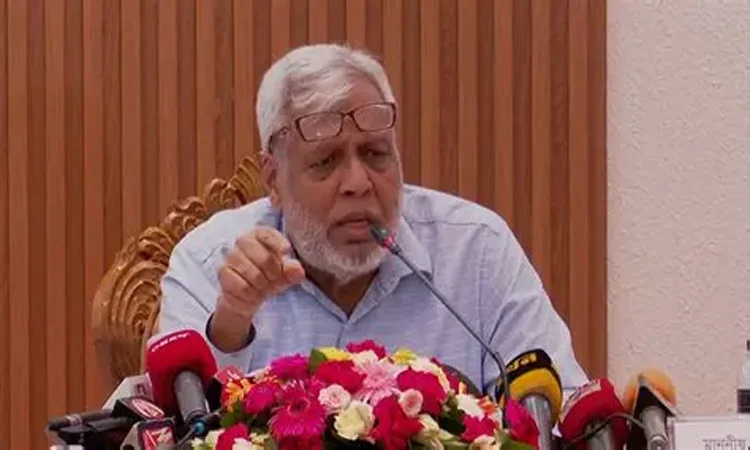
DHAKA, Jan 27, 2026 (BSS) - Power, Energy and Mineral Resources Adviser Muhammad Fouzul Kabir Khan today said the government had only received the Pay Commission’s report and is yet to take any decision to enforce it.
He also stressed that the matter has been left for further scrutiny.
Fouzul Kabir made the remarks while responding to queries of reporters after attending two separate meetings on the Advisers Council Committee on Economic Affairs and the Advisers Council Committee on Government Purchase held at Bangladesh Secretariat today.
When asked whether announcing a pay scale would create financial pressure on the next administration, he said, “There seems to be some misunderstanding regarding the pay scale issue.”
He went on saying, “For the last 10 to 13 years, government employees had been demanding the formation of a Pay Commission. Normally, a pay commission is constituted every five years. That process has now been completed, and the commission has only submitted its report.”
He clarified that acceptance of the report does not mean implementation. “There has been no decision to enforce the recommendations. We don’t intend to take such a major policy decision at this stage,” he added.
To examine the recommendations, he said the government has formed a review committee, headed by the Cabinet Secretary, following established practice. The committee will assess the feasibility of the proposals, including their fiscal impact.
Fouzul Kabir Khan said the report itself leaves room for flexibility. “It has been clearly stated that the next government will be free to change, modify or reject any decision. The incoming administration will have full authority to act as it sees fit,” he said.
Responding to questions on whether inflation was considered while preparing the pay structure, the adviser said the commission, led by Zakir Ahmed Khan, was an independent body that took all relevant macroeconomic indicators into account.
“All issues, including inflation, were duly considered by the commission,” he said.
However, he acknowledged concerns about the potential financial burden if the recommendations were implemented in full and at once. “That is a valid question. But from experience, pay commission recommendations are never implemented in one go. They are usually enforced in phases,” he said.
He added that the review committee would examine issues such as budgetary capacity, financing sources and phased implementation, if the recommendations are eventually approved.
When asked whether the move could create pressure on the next government, Fouzul Kabir Khan rejected the notion, saying the interim administration was working in the interest of future governments as well.
“We are a limited-time government, but that does not mean we should stop planning for the future,” he said, citing initiatives such as the Power and Energy Sector Master Plan and a multimodal transport sector plan, which may not be implemented by the current administration but would benefit the next one.
“The Pay Commission was formed with the same objective—to ensure that the next government does not face unrest or administrative paralysis,” he said adding, “We wanted to ensure that the incoming government can begin its journey smoothly, without facing immediate protests or deadlock.”
Ruling out fears of a rise in commodity prices due to the pay scale, the Adviser said such concerns were misplaced. “There will be no impact on prices because nothing is being implemented. Only a report has been received, and a committee has been formed to examine it,” he said.
He urged the media to report the issue accurately, reiterating that no gazette notification or implementation decision has been issued.