Thursday
20 August, 2026
News Flash
News Flash
By Md Aynal Haque
RAJSHAHI, Jan 9, 2026 (BSS) – Arable land in the region—particularly in the Barind tract—is gradually shrinking due to various factors, posing a serious threat to food security.
According to sources close to the Department of Agricultural Extension (DAE), around 90,000 hectares of triple-cropping land have been lost across the Rajshahi, Chapainawabganj, Naogaon and Natore districts over the past 17 years.
Prof Bidhan Chandra Das, who recently retired from the Department of Zoology at Rajshahi University, said arable land is shrinking due to drought, declining groundwater levels, climate change and land degradation, forcing farmers to convert farmland into fruit orchards and urban developments.
The increasing frequency and intensity of droughts are depleting soil fertility, while over-reliance on deep tube wells has caused a significant drop in the groundwater table, making traditional crop cultivation unsustainable.
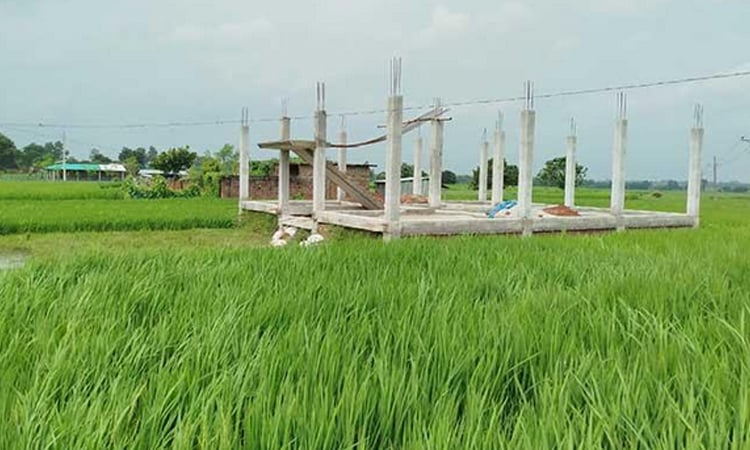
He said fertile cropland is rapidly disappearing as commercial fish ponds and concrete structures expand unchecked, raising serious concerns about food security, soil degradation and sustainable land use amid weak regulatory oversight.
Referring to official data, Prof Das said Rajshahi district alone lost 16,159 hectares of arable land between 2015 and 2024. However, he alleged that the actual figure could be significantly higher due to a large number of unregistered and illegal ponds in the district.
In the past fiscal year, Rajshahi produced 84,803 tonnes of fish against a local demand of 52,063 tonnes, underscoring the massive expansion of aquaculture in the area.
Inland water bodies expanded sharply, while built-up areas including housing, roads and commercial structures also increased, permanently removing large tracts of cultivable land from agriculture.
Prof Das warned that indiscriminate pond excavation removes fertile topsoil and spreads infertile subsoil over adjoining land, rendering fields unsuitable for cultivation even if farming later resumes.
Shahidul Islam, Regional Coordinator of the Bangladesh Resource Centre for Indigenous Knowledge (BARCIK), who is actively involved in organising meetings and events on life and nature protection, said much of the lost high-yield arable land has been converted into commercial fish ponds.
He attributed the shift largely to economic compulsions, as commercial aquaculture offers faster and significantly higher returns than traditional crops such as Boro rice.
Islam added that illegal pond excavation has surged in recent years in Natore, Naogaon and Chapainawabganj, while Rajshahi has experienced a steady rise over a longer period.
Unplanned digging also disrupts natural drainage, alters the local microclimate and increases crop disease risks, he said, noting that fish traders from Rajshahi are increasingly shifting operations to neighbouring districts where land lease costs are much lower.
Dr Azizur Rahman, Additional Director of the DAE, said integrated efforts by the administration and all concerned departments have become crucial to stop pond excavation on arable land.
Under existing regulations, pond excavation on cropland requires prior approval from the deputy commissioner’s office following verification by the upazila agriculture officer and the Soil Resource Development Institute to ensure the land is not highly fertile.
Deputy Commissioner and District Magistrate Afia Akhtar said pond excavation requires approval based on reports from an upazila-level committee comprising agriculture and fisheries officials. However, she said mobile courts and night-time drives are conducted regularly to curb illegal activities.