Saturday
12 September, 2026
News Flash
News Flash
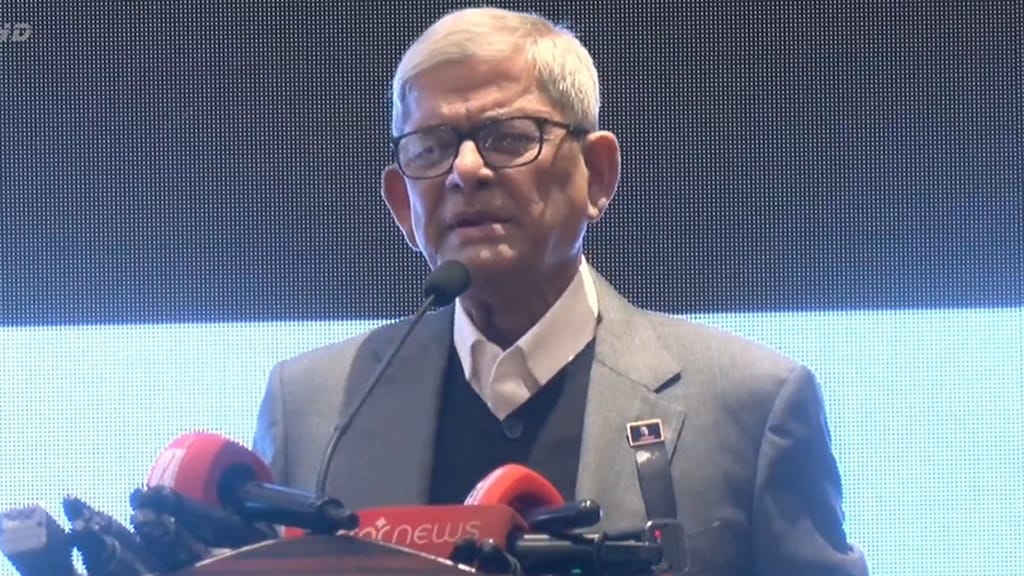
DHAKA, Jan 5, 2026 (BSS) — BNP Secretary General Mirza Fakhrul Islam Alamgir today described Begum Khaleda Zia as the nation's undisputed and uncompromising leader who dedicated her life to the restoration of democracy.
“The BNP has faced immense persecution, including six million false cases against its members and the enforced disappearance of approximately 1,700 activists,” he said.
He said this while speaking at a memorial and doa mehfil for Begum Khaleda Zia, Former Prime Minister and BNP Chairperson at a hotel in the city.
In his speech, Fakhrul highlighted what he termed the baseless legal battles Zia faced, specifically mentioning a case where a trial judge’s five-year sentence was increased to ten years by the High Court.
He asserted that the judicial system at the time was focused on pleasing authorities rather than delivering justice.
The Secretary General provided a harrowing account of Zia's time in captivity, stating that she entered prison in good health but was eventually forced into a wheelchair due to being held for two years in an abandoned, rodent-infested building without proper medical care.
"I find no comparison to her," Fakhrul stated, emphasizing that she was not just a party leader but a leader of the entire nation who refused to succumb to narrow-mindedness.
Recalling the moments following the student-led mass uprising on August 5, 2024, Fakhrul shared that despite her critical illness, Zia delivered a message of hope for the nation.
“Her directive was clear. The new Bangladesh must be built on unity and love, not revenge or malice,” he added.
He said that this message was instrumental in stabilizing the country during a period of potential lawlessness.
Fakhrul reiterated his stance that Begum Khaleda Zia was the country’s first female freedom fighter, citing her 1971 arrest by Pakistani forces while her husband, Ziaur Rahman, was fighting on the front lines.
He connected her struggle to the legacy of Ziaur Rahman, who he credited with introducing multi-party democracy and a free press to Bangladesh after 1975.
He called upon the people to transform their grief into strength to resist ongoing conspiracies and to build the Bangladesh envisioned in line with the spirits of War of Liberation in 1971 and movements of 1990 and 2024.
"We must stand up again," Fakhrul urged, noting that fulfilling her dreams for a democratic future is the only true way to show respect to her memory.