Sunday
23 August, 2026
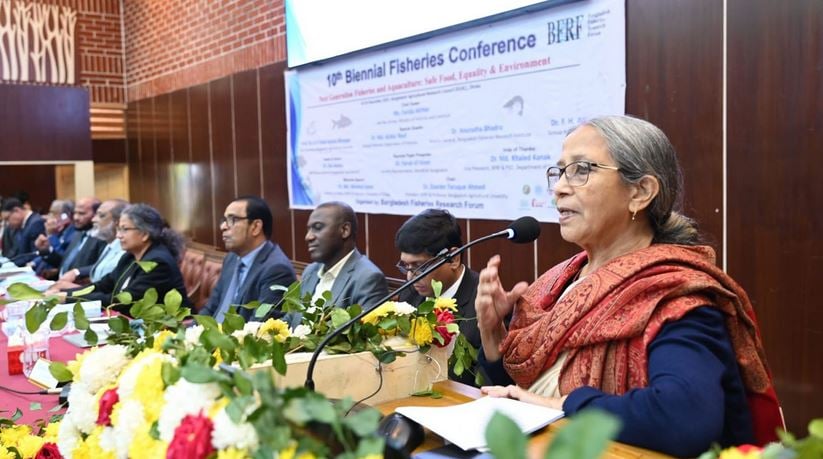
DHAKA, Dec 23, 2025 (BSS) - Fisheries and Livestock Adviser Farida Akhtar
today said the increase of fish production will become useless until its food
safety is ensured.
"Although the expansion of agro-based production has increased the supply of
fish in the country . . . It has also created some new challenges, one of
which is food security at present," she told the inaugural session of the
10th Biennial Fisheries Conference organised by the Bangladesh Fisheries
Research Forum at the Bangladesh Agricultural Research Council Auditorium
here today.
"If fish produced in aquaculture is not safe, then it cannot be called fish
in the true sense - we must keep this in mind," she said, mentioning that
fish is not just food to fill the stomach; it is an important source of
special nutrition as it provides essential micronutrients, calcium and other
nutrients which are helpful in eye, bone and intellectual development.
Noting that the fish-based diet has played a major role in the intellectual
development of Bengalis, the adviser said only about 30 percent of the
country's marine fishery resources are being utilized with various problems.
The artisanal trawlers and industrial trawlers are fishing in different ways
and some of the technologies used in industrial trawlers are creating new
concerns at present, she mentioned.
The fisheries adviser said it has recently been learned that out of 223
industrial trawlers, about 70 are using sonar technology, a technology that
uses sound waves to detect objects, map underwater environments, and
navigate, especially in water where light and radar are limited, which has
increased the risk of overfishing in the sea.
The adviser put emphasis on formulating effective policies to address these
problems and for this purpose, the government has decided to update the
National Fisheries Policy as an important initiative.
Some reforms have already been made to the Fisheries Act, but some more
issues need to be added, she added.
Expressing grave concern over the use of harmful fishing gear, she said the
gears used earlier are now being changed to be harmful to the environment and
biodiversity; even electric shocks are being used to catch fish, which is
unacceptable in any way.
Referring to the Hilsa production issue, she said, "Hilsa is not just a fish,
it is our national asset; just like protecting dolphins, protecting Hilsa
should also be part of a global movement."
The combined effects of reduced river navigability, pollution and climate
change are severely disrupting the reproduction and migration of Hilsa as
well, Farida Akhter added.
Identifying the obstacles of Hilsa's migration route, the adviser requested
all concerned for necessary dredging activities in coordination with the
Bangladesh Inland Water Transport Authority (BIWTA).