Saturday
22 August, 2026
MYMENSINGH, Dec 17, 2025 (BSS) - A research team at Bangladesh Agricultural
University (BAU) has developed nano-biochar-enriched nano urea fertilizer for
the first time, aiming to increase crop productivity, reduce fertilizer
wastage, and cut economic and environmental losses in the country's
agricultural sector.
Urea is the most widely used fertilizer in Bangladesh, but only 30-40 percent
of conventional granular urea is effectively utilized by crops, while the
rest is lost through ammonia volatilization, leaching, runoff, and
denitrification. This inefficiency not only reduces yields but also causes
significant financial losses and environmental pollution.
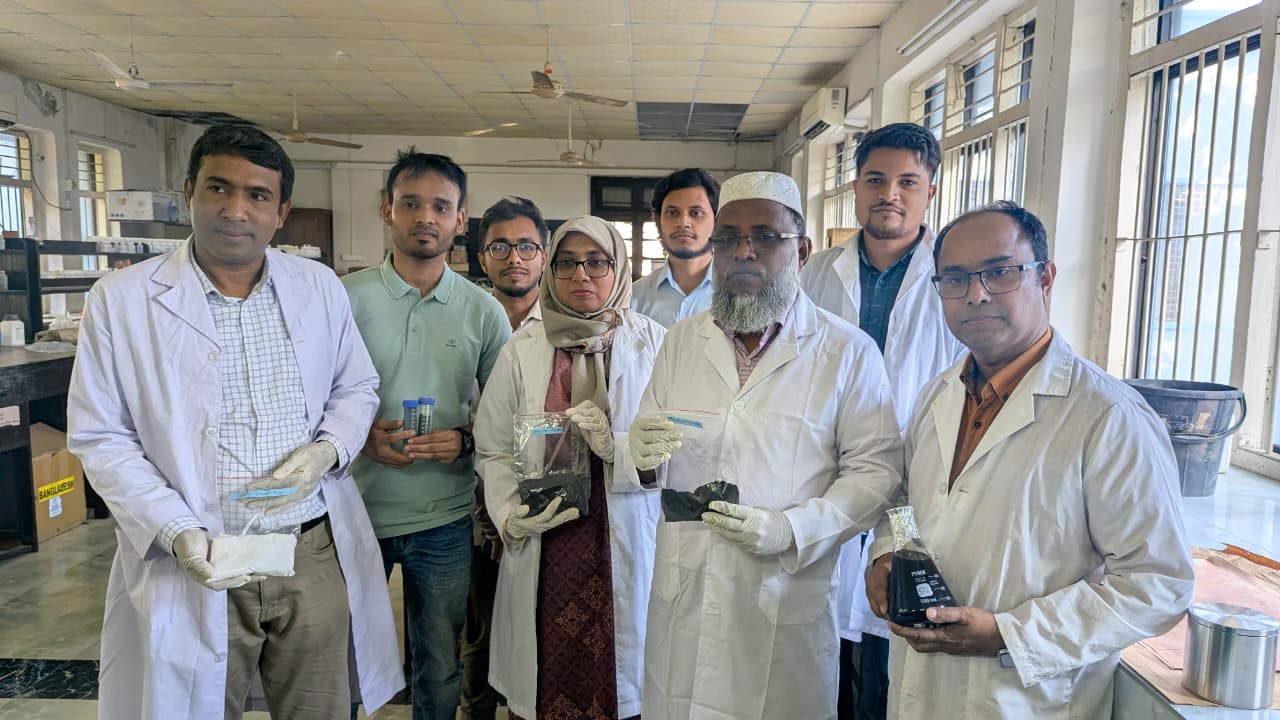
To address the problem, a group of researchers led by Professor Dr. Ahmed
Khairul Hasan, head of the Department of Agronomy at BAU, has developed
nano-sized urea fertilizer enriched with nano biochar (carbon). The research
has been conducted since 2023 with financial support from the Agricultural
Research Foundation (ARF).
Speaking on Wednesday, Prof Khairul Hasan said the newly-developed nano urea
particles range between 20 and 50 nanometers and are coated with nano carbon,
which slows the release of nitrogen. "This controlled release ensures
nitrogen availability according to crop demand, significantly reducing
wastage. Laboratory results indicate that urea use can be reduced by at least
25 percent," he said.
He added that nano urea improves nitrogen use efficiency to 75-85 percent,
compared to only 30-40 percent with conventional urea. The innovation is also
environmentally friendly, as it reduces ammonia loss by 80-90 percent,
nitrate leaching by 65-75 percent, and nitrogen oxide emissions by 40-50
percent. This contributes to lower greenhouse gas emissions and improved soil
quality.
According to the research findings, three nano-hybrid materials-
hydroxyapatite-urea, urea-nano biochar, and hydroxyapatite-urea-nano biochar-
have been successfully synthesized in the laboratory. FTIR analysis confirmed
strong chemical bonding and functionalization, while TEM analysis showed
particle sizes of 30-32 nanometers, small enough to enter plant cells.
The research team includes Prof Dr. Muhammad Khorshed Alam of BUET, Dr.
Shakhe Manzura Haque of the Bangladesh Atomic Energy Commission (BAEC), Prof
Dr. Tahsina Sharmani Haque of BAU's Soil Science Department, PhD fellow Md.
Amjad Hossain, and BUET scholar Md. Rokunuzzaman Ropin.
PhD student Md. Amjad Hossain said that while several liquid nano urea
products from India exist, this is the first nano biochar-rich nano urea
synthesized locally. "If field trials are successful, it will be a milestone
for Bangladesh," he said.
Field trials are yet to be conducted and are expected to begin in different
regions after the next Boro season. Preliminary laboratory results suggest
that nano urea application could increase rice yield by 10-25 percent and
protein content by 8-12 percent, enhancing both productivity and crop
quality.
Chairman of the Bangladesh Agricultural Research Council, Dr. Md. Abdus
Salam, said that about 2.7 million metric tons of urea fertilizer are used
annually in Bangladesh, contributing to rising greenhouse gas emissions and
high production costs. "If nano urea can be introduced successfully,
fertilizer use will decrease, production costs will be reduced, and the
environment will be protected," he said.
He emphasized the need for extensive field research to determine crop- and
region-specific application rates and to provide clear guidance to farmers.
"With proper dissemination, farmers and the country as a whole will benefit,"
he added.
The researchers hope that the innovation will help reduce government
expenditure on urea imports while ensuring sustainable and profitable
agriculture in Bangladesh.