Thursday
11 June, 2026
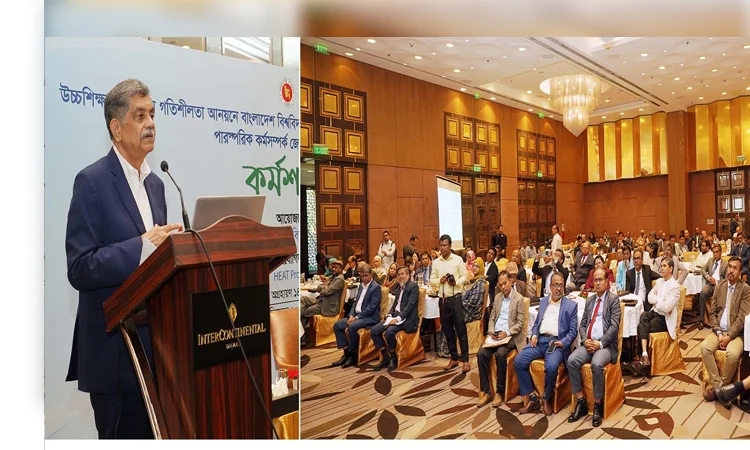
DHAKA, Dec 15, 2025 (BSS) - Education Adviser Prof Dr. Chowdhury Rafiqul Abrar today stressed on integrated approach to address the existing challenges in the country’s higher education.
“The responsibility of education administration has become extremely complex and challenging as the administration has to continuously deal with ongoing crises in various universities, madrasas and technical educational institutions,” he said
He made the remarks while presiding over a stakeholder’s workshop on ‘Strengthening the working relationship between the University Grants Commission (UGC) and Public Universities to bring dynamism to higher education at a city hotel.
In this context, he said following the recent developments, students’ expectations have increased, leading to changes in the mental outlook of young generation.
UGC Chairman Prof Dr S M A Fayez spoke at the workshop as the chief guest while Education Secretary Rehana Parveen delivered the address of welcome.
The adviser expressed gratitude to all those involved in education administration for handling the situation with utmost responsibility and patience during this difficult time.
Noting that the recommendations provided by participants at the meeting have been carefully documented, he said that issues that can be implemented immediately will be made effective through coordination with the relevant departments.
Besides, long-term issues will be preserved as recommendations for future governments, he added.
The adviser added that such dialogues should have taken place earlier and emphasized that regular discussions and communication must continue in the future to develop the education sector.
Sharmina Nasreen, Joint Secretary of the Secondary and Higher Education Division of the ministry, presented the concept paper at the workshop.
UGC Member Prof Dr Mohammad Tanzimuddin Khan, Vice-Chancellor (VC) of Bangladesh University of Engineering and Technology (BUET) Prof Dr Abu Borhan Mohammad Badruzzaman, VC of Khulna University of Engineering and Technology (KUET) Dr Md Maksud Helali, VC of Jagannath University Prof Dr Md. Rezaul Karim, VC of Chittagong University Prof Dr Mohammad Abu Taher and Pro-Vice-Chancellor of Dhaka University Prof Dr Saima Haque Bidisha took part in the open discussion.
Among others, Vice-Chancellors of Mawlana Bhashani Science and Technology University Prof Dr Anwarul Azim Akhand, Noakhali Science and Technology University (NSTU) Prof Dr Muhammad Ismail, Jashore University of Science and Technology (JUST) Prof Dr Md Abdul Majid, Sher-e-Bangla Agricultural University Prof Dr Md Abdul Latif, Bangladesh Agricultural University Prof Dr A K Fazlul Haque Bhuiyan and Gazipur Agricultural University (GAU) Prof Dr G K M Mostafizur Rahman also addressed the function.
In addition, officials from the Secondary and Higher Education Division, members of the University Grants Commission, vice-chancellors of public universities, and registrars were present at the workshop.
The participants emphasized the need to address delays in improving university quality, budget constraints for research and infrastructure development, enhancing the capacity of the University Grants Commission, freeing teachers from partisan political affiliations, introducing an integrated admission process and ensuring transparency in university teacher recruitment.
Bangladesh’s higher education sector plays a crucial role in developing human resources and ensuring sustainable, knowledge-based socio-economic development.
Currently, out of 56 established universities, 51 public universities are operational. Among them, there are 20 general universities, eight agricultural and veterinary universities, 15 science and technology universities and eight engineering and technology universities.