Thursday
27 August, 2026
News Flash
News Flash
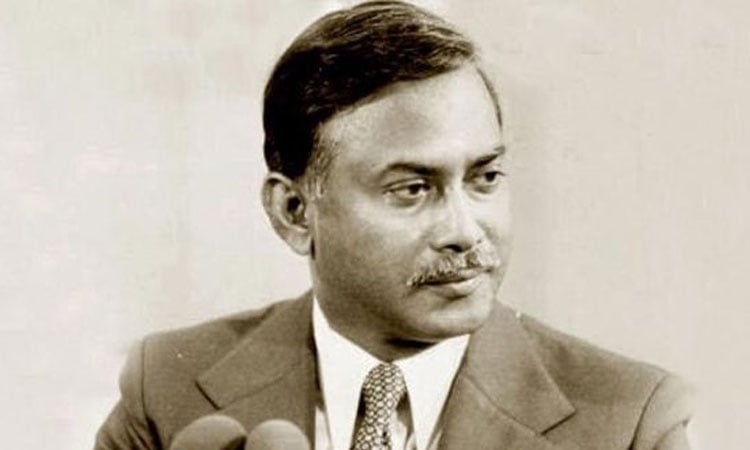
BY G M Rajib Hossain
Dhaka, Jan 19, 2026 (BSS) - "I, Major Ziaur Rahman,... do hereby declare the independence of Bangladesh,"-this was the clarion message of the then Major Ziaur Rahman during the crucial time Bangladesh endured as the Pakistan occupation force unleashed a barbaric genocide on its unarmed people turning it into a sea of blood making the countrymen confused, helpless and shell-shocked.
Ziaur Rahman appeared to be 'voice of 1971' as he revolted for independence on March 25 night that saw Pakistan army's inhumane cruelties on the people of Bangladesh who woke up in the middle of the night hearing indiscriminate gunshots, roaring of the canon and screams of victims.
His announcement of independence-first in front of his own Battalion after midnight of March 25 and then through Kalurghat Radio Station on March 27, 1971 in Chattogram-had an electrifying effect on people prompting them to joining arms resistance against Pakistan crackdown clearing off all confusions and chaos.
Major Ziaur Rahman's declaration removed ambiguity by clearly announcing that Bangladesh was an independent state, not merely protesting and demanding autonomy. It reinforced the legitimacy of the liberation struggle, boosting people's morale at the time of fear and uncertainty, inspiring confidence and courage among the people and thus helped transform a scattered resistance into a structured armed struggle.
Since early age of his life, Ziaur Rahman posed himself as a freedom loving person. From his school life, the outlook of Pakistanis used to hurt him. Since then, he cherished a single dream deep in his heart that had he get a chance any day, he would hit in the core of existence of Pakistanis. As a true patriot, he transformed his dream into a reality by declaring independence and initially leading the 8th Battalion of the then East Bengal Regiment to revolt against the Pakistan military as it started "Operation Searchlight" taking the scorching soil policy to kill innocent Bangladeshi people on the fateful night of March 25, 1971.
Even, during the service in the Pakistan army, Ziaur Rahman felt Bangladesh and its people with hearts as she never tolerated any kind of insult and ignorance by any Pakistani to his beloved motherland. In 1954, after a humiliating defeat of pro-Pakistan political party Muslim League to the United Front of Bangladesh's political party, Bangladeshi soldiers stationed at Pakistan's Abbottabad, were celebrating the victory. At that time, Ziaur Rahman was a cadet of Pakistan army staying there. He was also thrilled at the massive victory of the United Front. The Bangladeshi cadets staying in the remote mountainous area of Abbottabad became hugely excited.
At that time, Some Pakistani cadets hurled abusive words about Bangladesh's national leaders and heroes. They called them traitors. Ziaur Rahman led the Bangladeshi cadets to protest it and got into a heated argument. It occurred that verbal argument was not enough to resolve the issue. It was decided that the two parties would take part in a boxing contest.
Ziaur Rahman put on the boxing gloves to establish the birthrights of the Bengalis. In support of the Pakistanis' adamant position, a Pakistani cadet came forward. His name was Latif. Latif swore a pledge that he would teach Ziaur Rahman a lesson.
A good audience gathered to watch the boxing fight on that day. The duel began amid profused clapping: a fight between a Bangali and a Pakistani. Latif and his companions verbally abused Bangali cadets many times. But the boxing fight lasted no more than 30 seconds. Latif fell on the ground defeated and called for a peaceful solution of all the disputes.
That was Ziaur Rahman who exposed his patriotism in every spear of his life. He became a true patriot through his courageous role in the 1971 Liberation War, his declaration of independence and his lifelong commitment to Bangladesh's sovereignty. His journey is defined by success, and during the nation's most crucial transition, Shaheed Zia appeared to be a frontrunner and a beacon of hope for the nation.
Shaheed Zia was both a brave soldier, a sector commander during the Liberation War, and ultimately a leader who brought stability in the country emerging as a nation's savior and a great leader in his life. In the post-liberation period, amidst coups during the then Awami League's regime and later coups and counter-coups, Ziaur Rahman reemerged as a guide of the country on November 7 through the sepoy-people's revolution.
After the great Liberation War, Ziaur Rahman retook the responsibility of the country on November 7 as his sacred duty, stalling him at the helm of Bangladesh politics from a military man. After August 15, 1975, changeover, Bangladesh entered a period of severe political and military turmoil. But, on November 7, Ziaur Rahman emerged as a comet, resorted order in the country, posing himself as a unifying and charismatic leader by ultimately saving national sovereignty.
This earned him acceptance from overall military, bureaucrats, politicians and foreign governments. His popularity considered to the peak at his time gradually helped him become a civilian legitimate president of Bangladesh.
Ziaur Rahman was touted as a nation builder as he made pioneering role in building the nation and help Bangladesh to stand on a solid foundation. Recognizing the need for both long-term planning and coordinated efforts to advance a newly independent nation, Ziaur Rahman demonstrated remarkable foresight, adopting a 19-point political philosophy.
Until today, the economy of Bangladesh stands on three pillars...agriculture, garment industry and foreign remittances... all were initiated by Ziaur Rahman. During his period, Bangladesh's agriculture became self reliant, doubling agricultural production and increasing intensity of cultivation.In order to develop the garment factories, he invited various foreign industries like Korean Daewoo Company to Bangladesh and to develop manpower export, he made strong relations with Middle Eastern countries from where Bangladesh earns a huge portion of remittance by now.
He returned the nation to multiparty democracy from one-party rule formed by Sheikh Mujibur Rahman, becoming a prudent politician and a true nationalist leader. The revival of multi-party politics marked a significant transformation in the country. He gave the people of Bangladesh a clear identity- Bangladeshi nationalism, emphasizing that Bangladesh is a nation of diverse communities with different beliefs and religions as their cultures and lifestyles are different. He thought nationalism should be based on geographical identity of the country, not solely on language or culture.
Ziaur Rahman restored freedom of press, put an end to corruption and lawlessness and led the country towards self-sufficiency in food production. By initiating canal excavation, he brought about a revolution in agriculture.
Through BADC (Bangladesh Agricultural Development Corporation), Ziaur Rahman ensured the proper distribution of fertilizers, seeds, and pesticides to farmers. Alongside reopening shuttered industries, he also spearheaded the creation of new ones, and this initiative helped turn the unemployed population into a productive workforce. Thus, Ziaur Rahman pursed a politics of production aimed at the development of farmers and workers and also worked to empower the youths and women of the country.
Ziaur Rahman also eyed diplomatic relations with foreign countries, spreading Bangladesh foreign policy from India and the then Soviet Union to America and China. Bangladesh relations with Muslim world became closer. Zia played a leading role in the formation of the SAARC, an alliance of South Asian countries. During his rule, Bangladesh was elected as a non-permanent member of the UN Security Council.
Ziaur Rahman is not merely a name or an ordinary political leader, he appeared to be a savior at every critical moment of national crises. He saved the country from collapsing by declaring independence in 1971, again saved independence and sovereignty on November 7, 1975, and then started gradual work to build a prosperous Bangladesh after transferring it into a multi-party democratic country. So, he is said to have "save the country time and again". His glorious work and contribution to the nation earned him the title "a true patriot and a great nation builder".