Wednesday
03 June, 2026
News Flash
News Flash
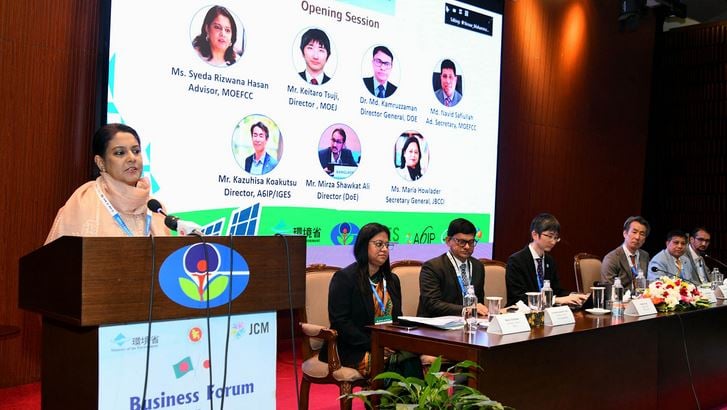
DHAKA, Dec 7, 2025 (BSS) - Environment, Forest and Climate Change Adviser Syeda Rizwana Hasan today said carbon trading mechanisms must function simultaneously as investment channels, technology transfer instruments, and mitigation tools.
“Even if we receive full adaptation financing, we cannot guarantee protection of our coastal regions unless mitigation is strengthened,” she stated, adding that adaptation has clear limits, making mitigation the ultimate pathway to long-term resilience.
Rizwana made the remarks while addressing a workshop titled 'Business Forum on Joint Crediting Mechanism (JCM) Project Matchmaking and Advancing Article 6 Implementation in Bangladesh' at the Department of Environment, organised in collaboration with the Ministry of the Environment, Japan.
She welcomed the revised JCM rules aligned with Article 6 of the Paris Agreement and noted Bangladesh’s pre-launch of its first national carbon market framework during COP30.
The adviser said the framework provides regulatory clarity, guidance on authorisation procedures, and a predictable platform for international investors.
She called for further stakeholder consultations ahead of finalisation, emphasising that vulnerable communities must not be left outside policy and project decision-making.
Highlighting Bangladesh's updated NDC commitments—6.39% unconditional emission reduction and an additional 13.92% conditional reduction by 2035— she urged the Department of Environment to promptly develop an implementation roadmap.
“Submitting NDCs is not enough; an action plan must support them,” she stressed, asking relevant ministries to deliver sector-specific execution plans.
Calling for strong private sector participation, she noted that export-oriented industries accelerate sustainability transformation when supply-chain requirements demand compliance.
Rizwana urged private entities to develop innovative solutions that look beyond tree-plantation CSR and support renewable energy expansion, energy efficiency, resilient agriculture, and nature-based solutions.
She also advised caution regarding waste-to-energy projects, underscoring the need for advanced technology, strict third-party monitoring, compliance assurance, proper site selection, and public disclosure of performance data.
Commenting on the prolonged nature of global climate negotiations, she said Bangladesh—being repeatedly affected by climate-induced disasters—cannot wait indefinitely for meaningful cooperation.
She remarked that inadequate support from developed countries undermines developing nations’ adaptation capacity.
In contrast, she described Japan as an exception, acknowledging its sustained commitment to climate action, partnerships, technology cooperation, and support to Bangladesh.
The adviser also expressed admiration for various attributes of Japanese life—including cleanliness, humane urban design, and community-friendly open spaces—and noted that such inspiration should be reflected in Bangladesh’s environmental transition.
During the programme, Rizwana Hasan and Keitaro Tsuji, Director, JCM Office, Ministry of the Environment, Japan, jointly launched the Article 6 Guidebook for Private Sector, developed with technical support from IGES.
The guidebook will help businesses identify bankable mitigation opportunities, access international partnerships, and participate in emerging carbon markets.
She further informed that Bangladesh and Japan are preparing to sign a Memorandum of Cooperation under which Japan will support Bangladesh’s environmental initiatives.
She described the upcoming agreement as a significant milestone toward long-term bilateral environmental cooperation.
Mohammad Navid Shafiullah, Additional Secretary (Climate Change), Ministry of Environment, Forest and Climate Change; Dr. Md. Kamruzzaman, Director General, Department of Environment; Keitaro Tsuji, Director, JCM Office, MOEJ; Koakutsu, Director, A6IP/IGES; Maria Howlader, Secretary General, JBCCI; and Mirza Shawkat Ali, Director (Climate Change), DoE, also spoke at the event.
The forum brought together government officials, private sector leaders, financial institutions and Japanese organisations for matchmaking discussions on renewable energy deployment, green technologies, energy efficiency solutions, and other Article 6-aligned investment areas.