Tuesday
30 June, 2026
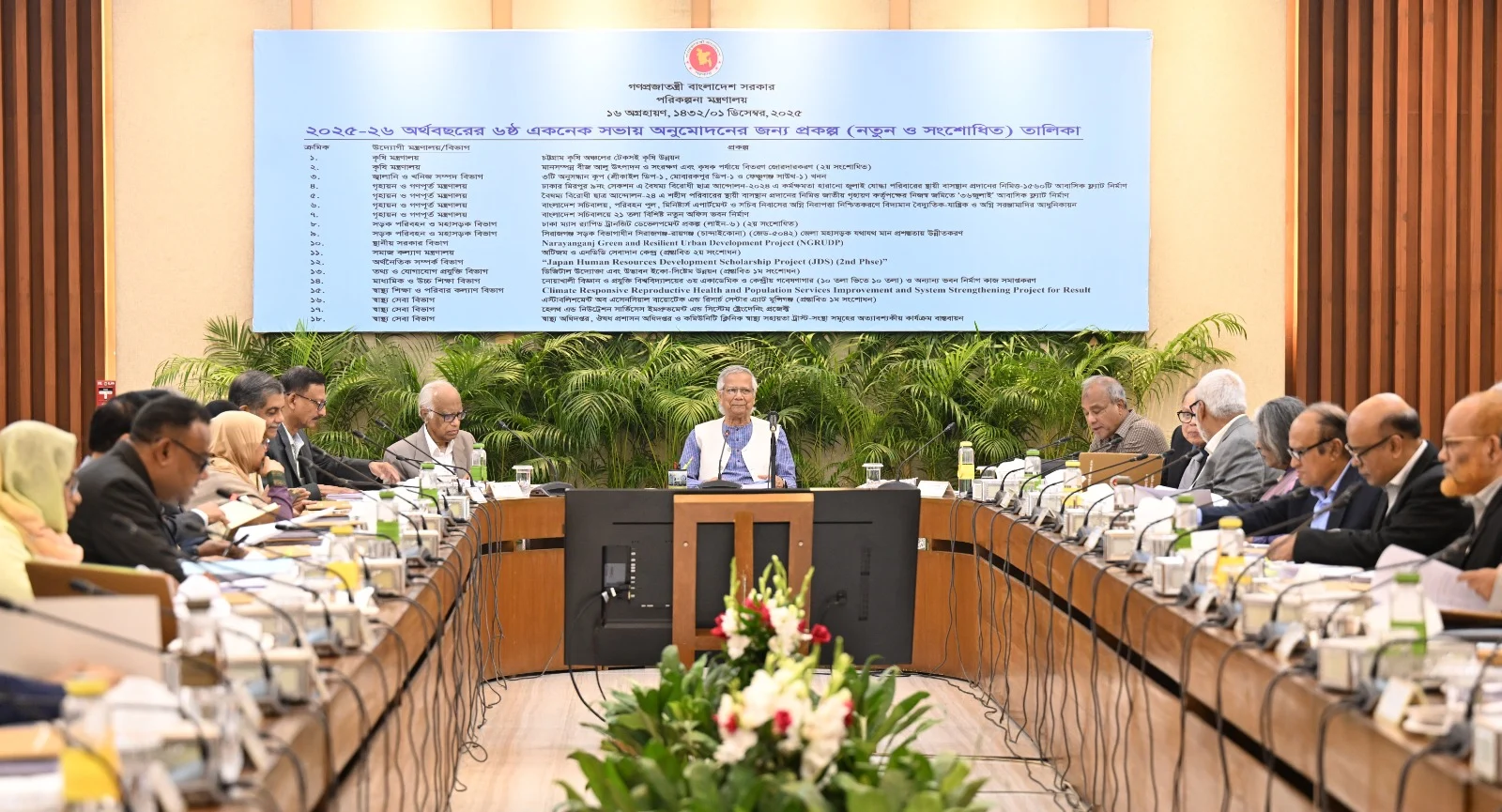
DHAKA, Dec 1, 2025 (BSS) - The government has moved forward with two major housing initiatives aimed at rehabilitating families affected during the 2024 Anti-Discriminatory Student Movement.
The Planning Commission recommended approval of both schemes by the Executive Committee of the National Economic Council (ECNEC). In continuation of this, the two projects were approved by the ECNEC in its meeting today.
Out of the two schemes, the Ministry of Housing and Public Works had proposed a project to construct 1,560 residential flats for families of July warriors who lost their ability to work during the 2024 movement.
The scheme, to be implemented by the National Housing Authority (NHA) on its own land adjacent to Mirpur DOHS, carries an estimated cost of Tk 1,344.4142 crore, fully funded by the government.
The project is planned for execution from July 2025 to June 2029, comprising 15 residential buildings, each rising 14 storeys including a basement. Each floor will accommodate eight flats, each measuring 1,250 sq ft. Parking facilities will be provided in the basements and ground floors.
Major project operations include land development, building construction, boundary walls and gates, installation of bed and passenger lifts, 1000 kVA substations, 150 kVA generators, pump-motor sets, solar systems, fire hydrant systems, intercom systems, insulation facilities, CCTV systems, load sanction and electrical connections, and coverage of electricity bills until flat handover.
The PEC meeting held on July 7, 2025 evaluated the proposal and recommended it for ECNEC approval, noting that the project would honour the sacrifices of those who were permanently disabled by providing safe, modern, and free housing.
The Ministry of Housing and Public Works, through the National Housing Authority (NHA), proposed another scheme on the construction of the “36 July” residential complex on 5.08 acres of NHA-owned land in Mirpur Section-14, Dhaka North City Corporation.
The project, intended to provide permanent housing for families of the movement’s martyred students, carries an estimated cost of Taka 761.1607 crore, entirely funded by the government.
Scheduled for implementation between January 2026 and December 2029, the project includes six 14-storey buildings with common basements and twelve 10-storey buildings, delivering a total of 804 flats, each measuring 1,355 sq ft.
The buildings will feature parking facilities on basement and ground floors and earthquake-resistant designs approved by the Public Works Department.
Key construction components include RCC boundary walls, internal RCC roads and drains, passenger and bed lifts, 1000 kVA and 250 kVA substations, 150 kVA and 40 kVA generators, solar systems, fire hydrant systems, and CCTV installations.
The proposal was placed before ECNEC on July 27, 2025, where it was directed for further scrutiny and alignment with the Ministry of Liberation War Affairs.
Following the restructuring of the DPP and subsequent revisions to cost components, a second Project Evaluation Committee (PEC) meeting was held on October 19, 2025.
Once implemented, the initiative is expected to help grieving families return to a stable and dignified life by providing secure and modern accommodation.
Commenting on these two projects, Planning Adviser Dr Wahiduddin Mahmud explained that the two projects had been placed on separate implementation timelines based on the nature of support required by the affected families.
He said the construction of 1,560 residential flats in Mirpur Section-9 for families of July warriors who lost their ability to work during the 2024 Anti-Discrimination Student Movement will commence in July 2025 and continue until June 2029.
He noted that the second scheme—construction of the “36 July” residential complex in Mirpur Section-14 for the families of those killed during the movement—will run from January 2026 to December 2029.
Dr Mahmud pointed out that extending support to families of those permanently disabled is comparatively straightforward, as eligibility is clear and can be verified directly.
However, providing state-supported permanent housing to the families of those who were killed involves more sensitive legal considerations, particularly concerning inheritance rights.
He added that the government would follow the established policy framework, already documented and approved, to ensure fairness and legal consistency while allocating the flats.
The Planning Commission emphasised that both projects will play a crucial role in rehabilitating affected families of the 2024 Anti-Discriminatory Student Movement.
The Planning Commission also noted that ensuring dignified housing not only reflects national gratitude for their sacrifices but also enables families to regain stability and security.