Saturday
09 May, 2026
News Flash
News Flash
By Tausiful Islam
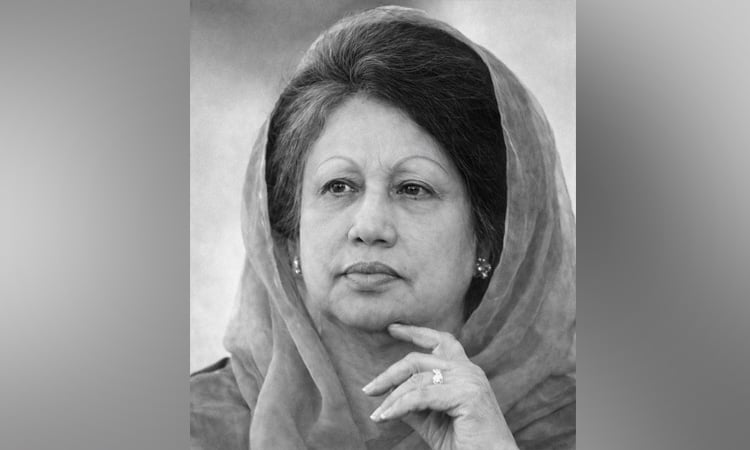
DHAKA, Dec 30, 2025 (BSS) - Bangladesh's turbulent political history evoked few figures as much reverence, controversy and resilience as Begum Khaleda Zia did.
Decades ago she earned the repute of being "the uncompromising leader" -- a title rooted in her repeated stance against dictatorship, and persistent advocacy for democracy and national sovereignty.
In a career spanning over four decades, she stumbled, triumphed, imprisoned, revived and remained a potent symbol for many Bangladeshis who believe in democracy, dignity and accountability.
Khaleda Zia's entry into national politics was shaped by a personal tragedy and sudden vacuum in leadership. According to her biographer journalist Mafuz Ullah she remained mostly uninterested in politics while her husband Ziaur Rahman served as the President. But his 1981 assassination changed everything. In 1984 she assumed leadership of the Bangladesh Nationalist Party (BNP) and soon became the focal point for opposition to military rule under Hussain Muhammad Ershad.
By mid 1980s when Ershad attempted to institutionalize his dictatorship through 'elections', a question occurred if the opposition parties should take part in the polls.
Begum Zia made a defining choice: she refused. In 1986, deeming the electoral environment unfair and tainted by martial law, she refused to participate in the election and rather presented a five-point demand - which analysts later called a bold move that set her apart even from seasoned politicians.
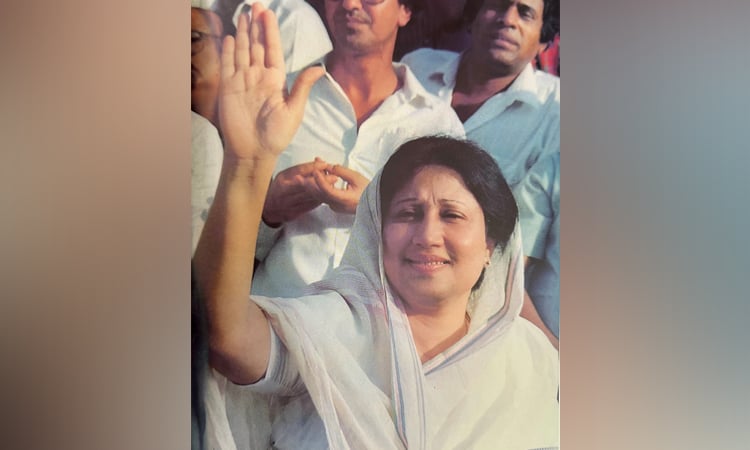
Her refusal deepened when she was placed under house arrest on 13 October 1986, just before the presidential election. Yet even after release, instead of conceding defeat, she launched a renewed protest campaign by staging rallies, general strikes, public meetings, hunger strikes and calling for non-cooperation with the regime.
When the regime held a one-sided parliamentary election in March 1988 -- boycotted by all major opposition parties - Begum Zia again stood firm. The ruling Ershad-led Jatiya party declared victory but she called it illegitimate.
Her persistence paid off. On 6 December 1990, after years of growing civil unrest and mass protests, Ershad resigned. The country returned to parliamentary democracy. Many analysts attribute this turnaround chiefly to the tenacious, unyielding leadership of Begum Zia and her refusal to compromise with authoritarianism.
With the 1991 general election -- the first free election after Ershad's fall - Begum Zia turned her revolutionary credentials into electoral power. The BNP won 140 of 300 seats; she contested five constituencies, won all five, and became Bangladesh's first woman prime minister.
In office, she initiated several constitutional and policy reforms that would shape Bangladesh's democratic future. She oversaw the enactment of the 12th Amendment, restoring the parliamentary system. Then, in 1996, through the 13th Amendment, she introduced the non-party caretaker government system for election oversight -- a move designed to ensure free and fair elections beyond the reach of partisan influence.
Under her administrations, Bangladesh saw expansion in education, women's empowerment, infrastructure and public welfare. Her governments passed the Compulsory Primary Education Act, supported madrasa education integration, backed science and technical universities, and boosted private and distance learning institutions including institutions like the Asian University for Women.
She strengthened social safety nets, took functional steps to protect environment as part of which polythene bags were banned, took infrastructure projects alongside taking landmark steps for job creation and agricultural reforms.
For Begum Zia herself, leadership had a moral dimension. As one tribute put it, once she made a decision, she rarely wavered -- "even when faced with false charges, imprisonment or abuse." Her stated motto -- "If Bangladesh thrives, so do I" and "This country is my only home" -- reflects a self--image of personal sacrifice for national welfare.
But being uncompromising also came at a cost. Her political career is marked by repeated arrests, trials, house arrests -- often under successive regimes.
In 2007, during the military-backed "One-Eleven" caretaker government, she was arrested. There was even an attempt to forcibly send her abroad -- which resulted in her imprisonment.
Later, her long-time residence at Moinul Road in Dhaka Cantonment -- filled with memories of her late husband and children -- was confiscated by the state.
The One Eleven regime filed a number of cases most of which were enthusiastically persuaded by the subsequent Awami League government. She was convicted in high-profile cases -- the Zia Orphanage Trust case and Zia Charitable Trust case -- and sentenced to long prison terms. Critics and international observers often described these prosecutions as politically motivated.
Despite serious illness including frail health and repeated hospitalizations, she maintained her defiant political posture. Rather than requesting leniency or exile again, she reportedly urged her party workers to stay united and continue the struggle for democratic rights.
Even after such adversity, she retained her influence: after her release, she refused back-door deals and instead led her party into the December 2008 elections -- despite little chance of victory.
Even now, decades after she first entered national politics, Begum Zia continued to cast a long shadow over Bangladesh's political landscape until her death. Observers say that her stance has become more relevant than ever -- especially in times of democratic uncertainty.
In a recent statement, Nahid Islam, convener of the National Citizen Party (NCP), hailed Begum Zia as "a unique inspiration for the democratic struggle of Bangladesh". He praised her "steadfast morale and uncompromising stance despite the constant torture of a fascist state clique, cycles of false cases and political vengeance".
Similarly, student leaders -- always sensitive to authoritarianism, dictatorship and suppression -- have paid tribute to her. One former student activist, reflecting on their meeting with her on Armed Forces Day, wrote: "Your uncompromising stance will always remain an inspiration to us".
For many across generations, Khaleda Zia symbolised a political conscience: a reminder that for many in Bangladesh, democracy is not just a system of government but a cause worth enduring jail, exile, social ostracism -- even personal suffering.
Khaleda Zia has often articulated her political philosophy in no uncertain terms. On one occasion she said: "It is impossible to practice parliamentary politics without having patience, decency, politeness and courtesy."
At another point, emphasizing her nationalist vision, she warned: "If Bangladesh succumbs to the rule of one family, it would be a major step backward for the region."
Her defining motto, often quoted by supporters: "If Bangladesh thrives, so do I," and "This country is my only home."
Such statements capture what many see as her moral core: a desire to serve the nation over party, principle over expediency, duty over convenience.
To call Khaleda Zia "uncompromising" is not to flatter her uncritically. It is to recognise a reality. In a political culture often shaped by shifting alliances, power politics and expediency, she repeatedly chose the harder path -- street protests, election boycotts, imprisonment, house arrest, public humiliation -- over compromise with authoritarian or unfair regimes and rejection of unjust political deals.
Her journey, with its victories and defeats, reveals the complexity of political leadership in a fragile democracy. Her achievements -- constitutional reforms, focus on education, empowerment of women, institutional strengthening -- laid important groundwork for Bangladesh's democratic trajectory.
For many Bangladeshis -- especially those who believe in democracy as a living struggle -- Khaleda Zia remains a towering figure.
Whether or not one agrees with every decision she made, few can deny that she helped keep alive the idea -- sometimes the hope -- that Bangladesh could be governed by the people, for the people.
The legacy of Khaleda Zia -- the uncompromising leader -- continues to resonate.