BSS
  11 Jun 2026, 15:59
Update : 11 Jun 2026, 16:24

Govt prioritises macroeconomic stability, revenue reforms in FY27 budget

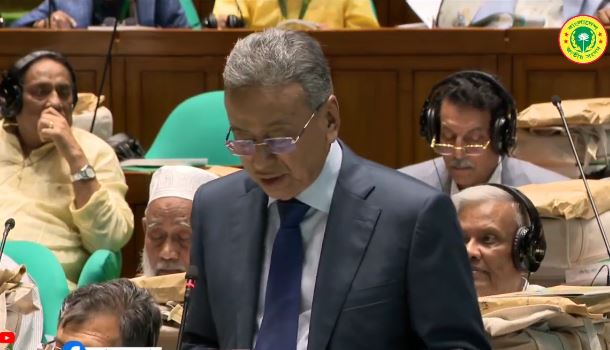
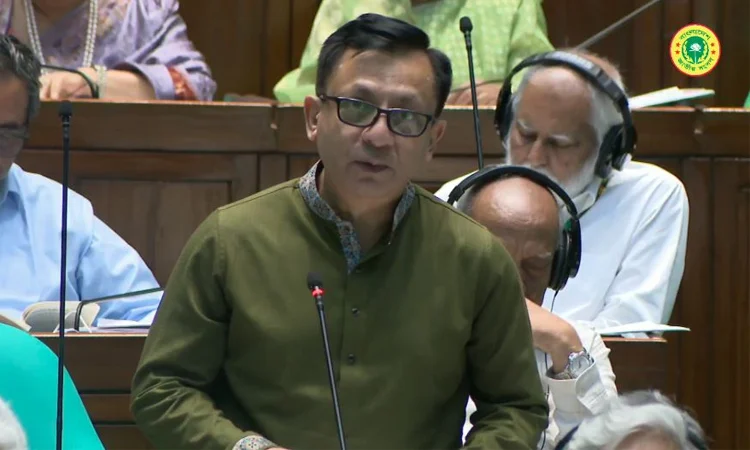
Photo: Video Screenshot

SANGSAD BHABAN, June 11, 2026 (BSS) - Finance Minister Amir Khosru Mahmud 
Chowdhury has outlined a comprehensive strategy to restore macroeconomic 
stability, strengthen public finances and support sustainable economic growth 
through the proposed national budget of around Taka 9.38 lakh crore for 
FY2026-27 (FY27).

"Persistent inflation over the past several years has significantly eroded 
household purchasing power and weakened the country's economic foundations," 
he said.

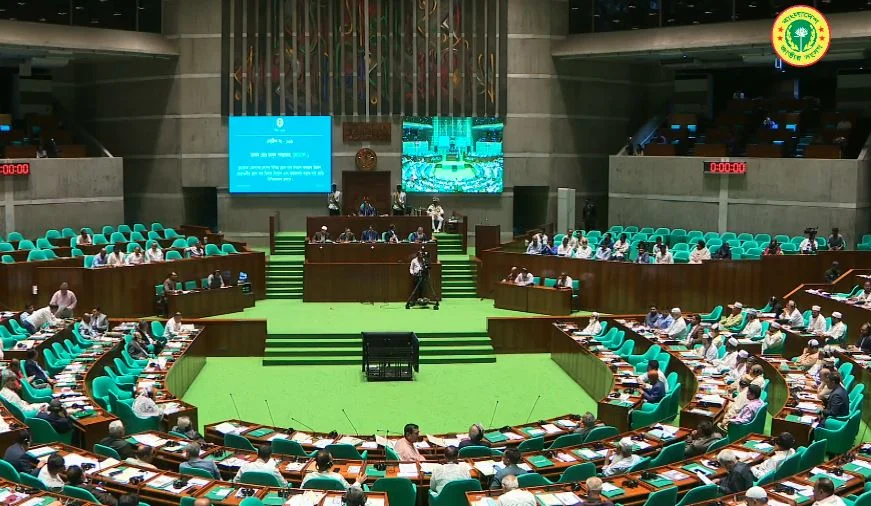
The finance minister today expressed the views while placing around Taka 9.38 
lakh crore national budget for FY27 at Jatiya Sangsad (JS) here this 
afternoon.

While global developments have contributed to inflationary pressures, Amir 
Khosru Mahmud Chowdhury noted that domestic challenges, including supply-
chain inefficiencies, market distortions, limited competition and structural 
bottlenecks, have further intensified price increases.

He said the government remains committed to protecting citizens from the 
adverse impacts of inflation and will place special emphasis on rebuilding 
foreign exchange reserves, strengthening external sector resilience and 
ensuring greater stability in the foreign exchange market. 

Given Bangladesh's import dependence, he observed that depreciation of the 
Taka against major foreign currencies has substantially increased domestic 
prices.

The minister said close coordination between monetary and fiscal policies 
will be maintained to contain inflation while ensuring adequate credit 
support for productive sectors. 

Measures to strengthen the external sector will include export expansion, 
promotion of remittance inflows and prudent management of non-essential 
imports. 

Together with improved expenditure efficiency and sound fiscal management, 
these initiatives are expected to keep the budget deficit within sustainable 
limits, restore market confidence and create a more favourable environment 
for investment and production.

A key element of the government's fiscal strategy is strengthening domestic 
resource mobilisation. 

As part of institutional reforms, the government has initiated the separation 
of revenue policy formulation from revenue administration. Future tax 
policies will be developed through a dedicated framework based on 
professional expertise, evidence-based analysis and stakeholder consultation.

Under the medium-term revenue strategy, the government plans to broaden the 
tax base, improve compliance and enhance transparency and efficiency in 
revenue administration. 

Initiatives include expanding the taxpayer base, digitising tax registration 
and return filing, modernising VAT administration, strengthening withholding 
tax compliance and introducing risk-based audit systems. 

Taxpayer services will also be expanded and procedures simplified to 
encourage voluntary compliance.

The government is simultaneously reviewing tax expenditures and exemptions to 
improve transparency, efficiency and accountability. 

Future tax incentives will be subject to stronger scrutiny and clearer 
justification, while reforms in tax and customs administration are expected 
to enhance the state's capacity to finance priority development programmes.

The finance minister said Bangladesh currently has a revenue-to-GDP ratio of 
about 8 percent and a tax-to-GDP ratio of 6.8 percent.

The government aims to raise these figures to 11 percent and 9.6 percent 
respectively by FY2030-31 through a combination of policy and administrative 
reforms.

Referring to concerns over debt sustainability, he said extensive borrowing 
for poorly planned projects undertaken by the previous regime has increased 
fiscal pressure. 

The government now aims to restore Bangladesh's debt risk rating from the 
current "moderate" category to a "low" risk category through stronger revenue 
mobilisation, sustainable deficit management and modernised debt management 
practices.

He said the government intends to move away from a debt-driven growth model 
and build a self-sustaining economy based on production, employment 
generation and private-sector investment.

The minister announced that public investment in education and health will be 
gradually increased over time to 5 percent. 

Future development projects will undergo rigorous economic appraisal, cost-
benefit analysis and implementation-readiness assessments to ensure value for 
money and stronger development outcomes, he added.

Khosru said that the government will continue efforts to improve expenditure 
efficiency by reducing non-priority spending and strengthening fiscal 
discipline across public institutions. 

Subsidy programmes will be made more targeted and efficient, while support 
for agriculture, food security and energy supply will be maintained, he 
continued.

The finance minister also highlighted reforms aimed at improving social 
protection programmes through the use of technology, digital beneficiary 
databases and stronger monitoring systems to reduce leakages and improve 
service delivery. 

Technology-based systems will also be expanded in public procurement, project 
implementation and budget management to enhance transparency, accountability 
and efficiency, he added.

He said future public spending on education, healthcare, energy security, 
agricultural productivity and employment generation will increasingly be 
linked to measurable outcomes and performance indicators, helping build a 
more productive, resilient and sustainable economy.