Thursday
06 August, 2026
News Flash
News Flash
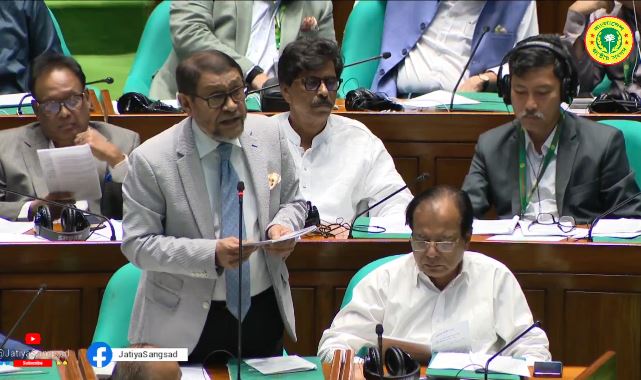
SANGSAD BHABAN, June 10, 2026 (BSS) - Health and Family Welfare Minister
Sardar Md. Sakhawat Husain today said in Jatiya Sangsad (JS) that the
government has implemented a series of measures, including tannery
relocation, waste treatment facilities and strict enforcement drives, to
prevent the use of hazardous tannery waste in poultry and fish feed
production.
Responding to a written question from ruling party lawmaker Nilufar Chowdhury
Moni (women seat-10) during the question-answer session in the Parliament
today, the minister said the use of tannery waste in poultry and fish feed
poses a serious threat to public health.
The day's sitting began with Speaker Hafiz Uddin Ahmad, Bir Bikram, in the
chair.
"The issue is entirely true, and evidence from various studies and reports
supports it," he told the House.
The minister said large quantities of chromium and other heavy metals are
used during leather processing, while unscrupulous traders often use toxic
tannery waste to produce low-cost protein feed for poultry and fish.
"As a result, highly toxic Hexavalent Chromium (Cr-VI) accumulates in chicken
meat and eggs. This hazardous substance is not destroyed even by cooking
temperatures," he said.
He warned that consumption of contaminated poultry or fish could expose
people to severe health complications, including cancer, liver cirrhosis,
ulcers and kidney failure.
Highlighting government initiatives to tackle the problem, Sakhawat Husain
said the relocation of tanneries from Hazaribagh in Dhaka to the Leather
Industrial City at Hemayetpur in Savar was one of the most significant
measures.
"Considering public health and environmental concerns, the tannery industry
was shifted from Hazaribagh to Savar. In 2017, following a High Court
directive, utility connections to the Hazaribagh tanneries were disconnected
to ensure the relocation was fully implemented," he said.
The minister said a Central Effluent Treatment Plant (CETP) has been
established at the Savar Leather Industrial City to properly treat chemical
waste generated by tanneries.
"The primary objective of the CETP is to ensure that hazardous tannery waste
is treated appropriately so that it can't spread indiscriminately or be
illegally used in the production of poultry feed," he added.
Referring to enforcement efforts, the minister said the Rapid Action
Battalion (RAB) and the Department of Environment (DoE) have been conducting
regular mobile court drives against illegal factories producing poultry and
fish feed from tannery waste in Hazaribagh and surrounding areas.
"Many of these illegal factories have been permanently shut down through
enforcement actions," he said.
Sakhawat Husain said the cancer risk associated with poultry feed produced
from tannery waste is a scientifically established fact and noted that the
government's visible and effective interventions have significantly
contributed to reducing the threat.
He said the measures taken by the government include tannery relocation,
establishment of modern waste-treatment facilities and continuous law-
enforcement activities against illegal operators involved in producing feed
from tannery waste.