Sunday
23 August, 2026
News Flash
News Flash
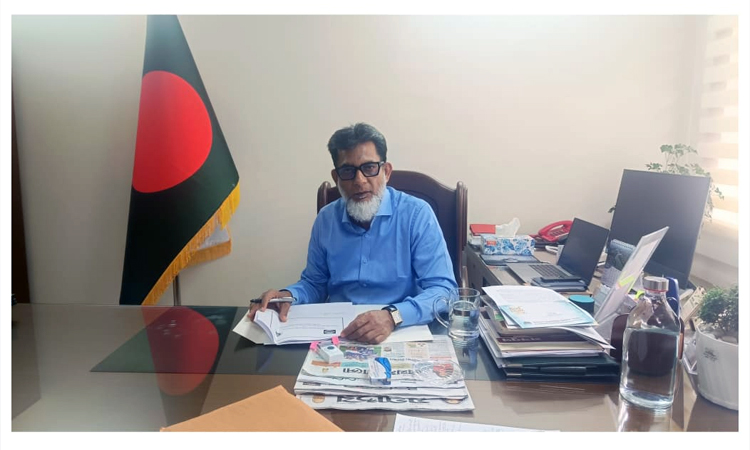
DHAKA, July 2, 2026 (BSS) - State Minister for Railways Habibur Rashid has said the government has taken initiatives to increase the number of locomotives and coaches of Bangladesh Railway to meet the growing demand of passengers.
Alongside the construction of new railway lines, the government is working under an integrated plan to expand the passenger services by procuring adequate locomotives and carriages, said the state minister in an exclusive interview with Bangladesh Sangbad Sangstha (BSS) at his office in the secretariat here today.
He said the present government is giving top priority to the development of health, education and transport infrastructure. As part of this, various short, medium and long-term plans are being implemented to transform the railway into a modern, safe and people-friendly transport system, he added.
The biggest limitation of the railway at present is the shortage of locomotives and carriages, due to which it is not possible to operate trains according to passenger demand, he said, adding that even where new rail lines are being constructed, shortage of adequate engines and coaches are hampering expected services there.
To overcome this limitation, feasibility studies, international cooperation and procurement processes for new locomotives and coaches are being advanced, he said.
As part of the initiatives, Habibur Rashid said steps has already been taken to bring around 200 broad-gauge coaches and locomotives from India, which is expected to significantly ease the pressure on the broad-gauge network once they arrive. However, he noted that the meter-gauge network still faces major pressure and significant improvement will not be possible there until new meter-gauge locomotives are procured.
He expressed hope that procurement of new locomotives would be implemented within the next one to two years to address the crisis.
Habibur Rashid said future locomotive and coach procurement will be aligned with new rail line construction so that full passenger services can be ensured as soon as new routes are opened.
Regarding new railway projects, he said that a feasibility study for Narayanganj–Cumilla cord line is underway and preparations for implementation are being made. Work is also ongoing on Sirajganj–Bogura new rail line project, which, once completed, will significantly reduce travel time and distance between the northern districts.
He further said that new plans have been taken to strengthen rail communication between Dhaka and surrounding districts. Commuter train services are being expanded to areas such as Gazipur, Munshiganj, Narshingdi, Narayanganj and Bhanga so that people can travel to Dhaka in the morning and return in the evening after work.
The state minister said the government is reconsidering the future use of previously imported DEMU trains and is exploring the possibility of making them operational through private investment instead of government-funded repairs.
Plans are being made to further develop the major railway stations, including Dhaka, Chattogram and Sylhet, through private investment, with improved passenger facilities, waiting areas, commercial amenities and better station management, he said.
He added that preparations are being made to introduce internet facilities in new locomotives and coaches in the future. There are also plans to generate solar power using unused railway land and infrastructure through private investment, initially to meet railway demand and later to supply excess electricity to the national grid under a revenue-sharing arrangement, he added.
On safety, modernization of railway level crossings has begun, with several meetings held with experts from Bangladesh University of Engineering and Technology (BUET), the minister said, adding that plans are also underway to construct underpasses and overpasses at key crossings to reduce traffic congestion.
Regarding the rail gauge system, he said the government’s long-term goal is to gradually convert the entire railway network to broad gauge, while maintaining dual gauge where necessary, in order to reduce operational costs and improve efficiency.
On standing tickets in intercity trains, he said the government does not support the practice, but it is sometimes unavoidable due to excessive passenger pressure. He stressed that standing passengers are not desirable in any way, but demand pressure has made it necessary in some cases.
He expressed hope that with more locomotives, coaches and trains, passenger pressure will ease, services will expand and the need for standing tickets will gradually decrease, while passenger complaints will also reduce significantly.
He concluded that the government’s goal is not only to construct new railway lines but also to transform Bangladesh Railway into a modern, reliable and efficient public transport system through advanced technology, adequate rolling stock, improved stations and safe infrastructure.