Friday
07 August, 2026
News Flash
News Flash
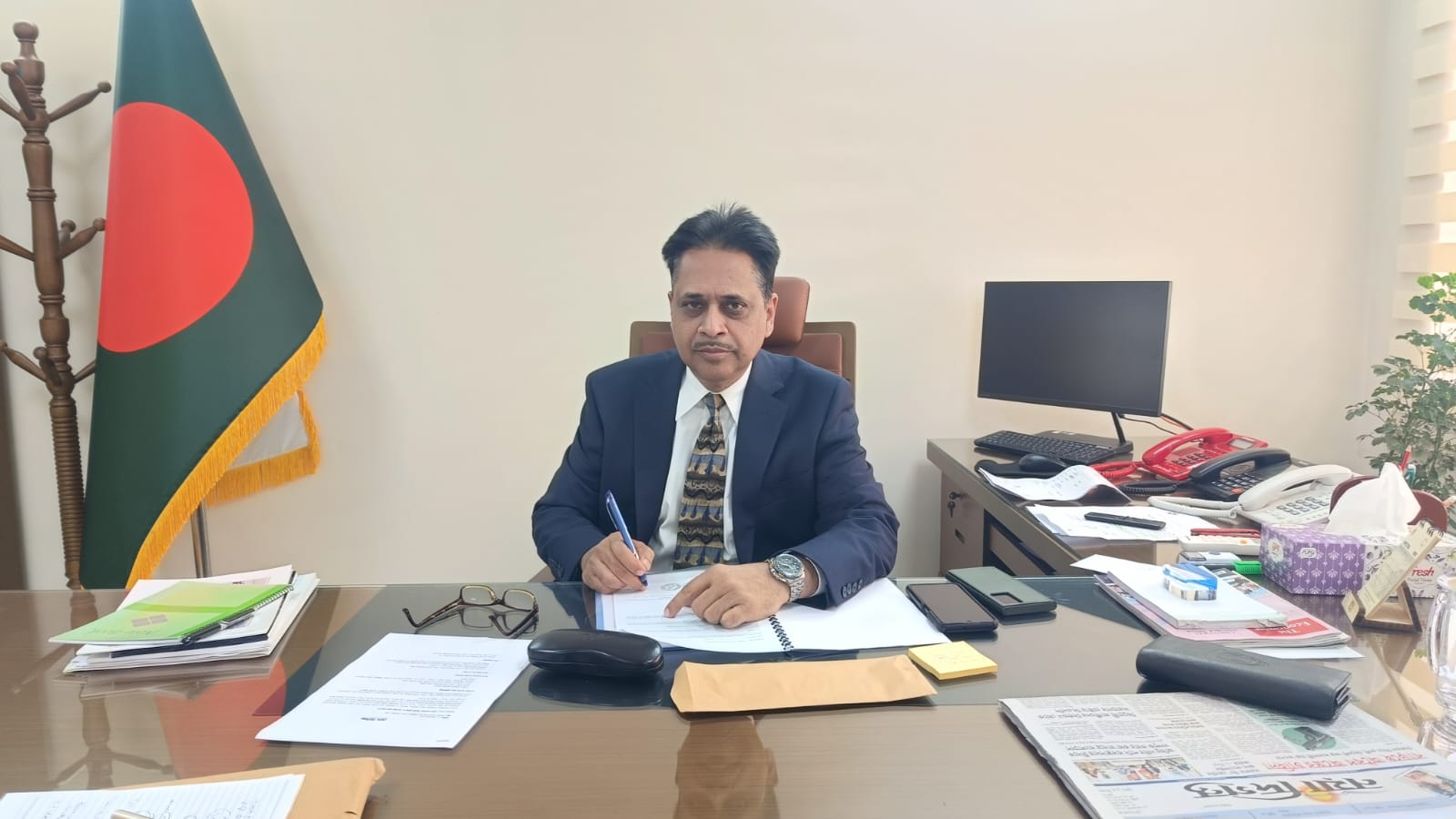
By Moshtak Ahmed
DHAKA, Jan 12, 2026 (BSS) – Dr. Sheikh Moinuddin, Special Assistant to Chief Adviser for the Ministry of Road Transport and Bridges, has said that the long-standing syndicate in the Roads and Highways Department (RHD) has been dismantled.
“From now on, genuine contractors will be able to participate in government development projects,” he said in an exclusive interview with the national news agency BSS at his office at Bangladesh Secretariat today.
He said that over the past 17 years, it was observed that a handful of construction firms alone carried out around 75 to 80 percent development works of the RHD across the country. “That syndicate system has now been broken,” he said.
The Special Assistant said a new system has been introduced for awarding the contracts under the RHD where no contractor can say in advance with certainty that they will get a particular project.
He said the new method has been implemented since November 28 last year. The system includes a clearly defined index. No matter how large a company participating in the tender process is, the index will determine its work orders, he said, adding that as a result, there is no longer any scope for a specific company to receive multiple projects monopolistically.
Dr Moinuddin said that alongside bringing discipline to road construction works, the government is also moving to bring toll collection from bridges and ferries across the country under a specific system.
He said that from now on, automated machines will be installed at all bridge toll plazas. Each vehicle will be equipped with a SIM linked to the software. As the vehicles pass through the toll plazas, a specified amount will be automatically deducted from the vehicle owner’s b-kash or online bank account through the software. However, if there is insufficient balance in the owner’s account, the vehicle will be stopped.
Dr Sheikh Moinuddin said that in the past, most of the projects may have gone into the hands of only a few entities. “But now we are working on several issues, including assessing who already has excessive amounts of work. If too many projects go to one contractor, we will try to redistribute the work among others,” he added.
He explained that it is often seen that a single contractor takes on eight to 10 projects but ultimately fails to make progress on any of them. The quality of work also begins to decline, as every contractor has a certain capacity, he said, adding, “We are trying to avoid this,” he added.
He said if someone already has too much work in hand, efforts are being made to bring in others. “This has two benefits. First, we can diversify the construction industry so that it does not remain confined to seven or eight entities. Second, overall project progress improves at the same time,” he said.
He noted that large projects are challenging, as small companies cannot handle them without sufficient capacity and large projects require large companies.
He claimed that the condition of country’s construction industry is currently poor and has further deteriorated since August 5. As a result, some limitations remain. However, the government is trying to ensure that small and medium-sized works are awarded to new industries so that they can gradually build their capacity and eventually move on to larger projects.
He said several obstacles still remain. Since August 5, it has been observed that in many places there are no contractors, while in some areas contractors have fled. In many cases, contractors are burdened with such heavy debt that even if payments are made to them, the money is immediately taken by banks due to their loan defaults.
He said efforts are going on to ensure that running projects are completed by existing contractors as far as possible and government officials are continuing their efforts in this regard.
Despite these challenges, he said two or three projects are still problematic, although many projects have already started. Delays are occurring in areas where full land acquisition has not yet been completed, he said.
Dr Moinuddin said that after August 5, the construction industry went through a very difficult period, which the government has tried to stabilize. “If the next government follows our path, I hope discipline will return to this sector,” he opined.