Friday
04 September, 2026
News Flash
News Flash
BEREHOVE, Ukraine, Sept 4, 2026 (BSS/AFP) - Ukrainian veteran Sergiy Lazarenko takes extra care not to tempt fate: whenever he describes his home region of Zakarpattia as "quiet", he superstitiously spits three times to ward off bad luck -- and Russian attacks.
Nestled in the foothills of the Carpathian mountains and tucked between Slovakia, Hungary and Romania, Ukraine's westernmost region of Zakarpattia has been relatively unscathed by the invasion launched in February 2022.
Fighting has been raging in the east, and Russian drones and ballistic missiles regularly rain down on other parts of the country, killing civilians and forcing thousands into shelters.
While Zakarpattia's residents have seen an influx of internally displaced people and lost neighbours on the front, the region relishes its nights without air-raid sirens or explosions.
"It's all calm here, thank God," Lazarenko, propped up on a crutch, told AFP as he ambled through the centre of Berehove, a tranquil town with a pre-war population of 23,000 people.
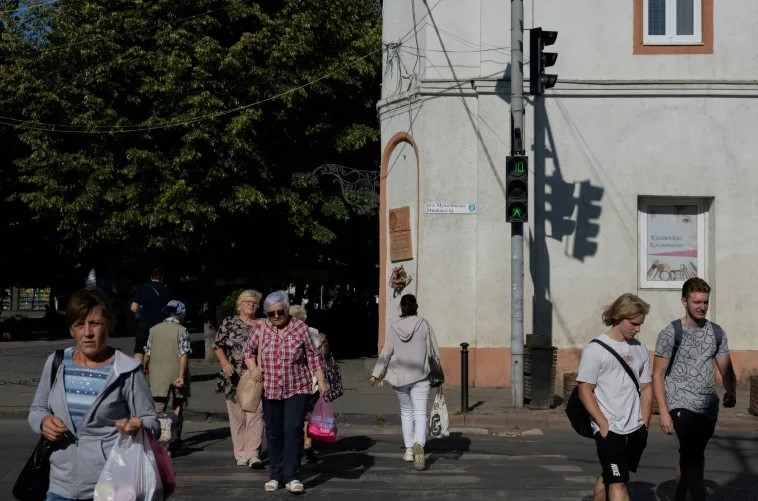
In the streets of Berehove -- located five kilometres (three miles) from the border with Hungary but an 11-hour drive from Kyiv -- languages mix as residents stroll around, getting groceries and running errands.
Lazarenko, a 54-year-old Berehove native, joined the fight against Russia at the onset of the invasion.
Seriously wounded in the battle for the town of Bakhmut, one of the bloodiest of the war, he returned home to the town -- now sheltering many Ukrainians fleeing bombs or occupation.
"Sometimes when I go into town, I hardly see my own people anymore compared to how many have come here," he said, adding that the newcomers got along well with the locals.
Among the refugees was Lyubov Kyreyeva, who moved to Zakarpattia from the northeast Kharkiv region in 2022 with her family and colleagues. The company she works for -- a major producer of metal products -- has relocated to Berehove, rebuilt an abandoned factory and re-started production there.
"Here, naturally, you feel the war very little," Kyreyeva told AFP. Power outages plaguing the rest of the country as Russia targets infrastructure with air strikes have been rare, and there has been no war curfew.
As for air-raid alerts, "we practically don't hear them," the 41-year-old said, adding: "I sort of ... had even forgotten that there are regions that still have curfews".
Zakarpattia -- known for a temperate climate and vineyards stretching across its hills -- "has already become a second home" for Kyreyeva, who praised the local residents as "friendly, kind, sincere".
- 'It's depressing' -
Tetyana Dub, 41, a local living in the Berehove region, said it is "where people can find some respite at the moment." "I believe that our fellow Ukrainians can come here safely and find peace of mind, as well as emotional and psychological relief."
She spoke as local authorities and relatives prepared to hold a ceremony commemorating Ukrainians from Berehove who died defending the country at the front line.
A blue-and-yellow flag was displayed by a monument honouring the fallen soldiers and a bouquet of sunflowers -- Ukraine's national flower and a symbol of hope -- were placed in a vase next to it.
During the ceremony, a plaque was installed in honour of one of the region's residents who died in Bakhmut and whose body never returned home. A smell of incense filled the air as priests sang a prayer for the souls of the fallen: "Lord, have mercy on our defenders". About 100 residents gathered at the main square in the scorching late summer heat.
There was no immediate threat of a strike that would send them ducking for cover -- but the war has still left its mark on the town. "Physically it's not here with us, but emotionally it's depressing, because you can't understand how to move forward, what will happen next, and how long this will last," Tetyana Dub said.
"But I see that our people are holding on and not giving up -- and that's why we believe that everything will be fine," she added.