Saturday
05 September, 2026
News Flash
News Flash
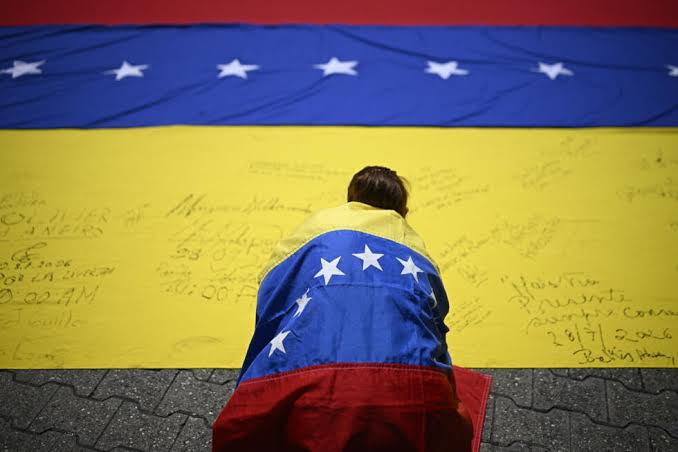
CARACAS, July 31, 2026 (BSS/AFP) - Venezuela is gearing up for the launch of US-backed political transition talks on Saturday, but the absence of Nobel Peace Prize-winning opposition figure Maria Corina Machado has left her base skeptical.
Leftists are meanwhile distrustful of a process, announced earlier this month, that only includes Washington-approved representatives.
Both political camps have been protesting ahead of the negotiations, which according to the US State Department, will focus on rebuilding democratic institutions, strengthening the electorate and guaranteeing political participation.
Even before last month's devastating earthquakes that killed over 5,500 people, Venezuela was in a state of flux after US forces deposed president Nicolas Maduro in January.
Interim leader Delcy Rodriguez, who formerly served as Maduro's vice president, has been governing under Washington's watchful eye since then.
In a leafy eastern district of the capital on Tuesday, around 300 pro-Machado demonstrators reiterated their demand for a popular vote to be held.
"The people are hopeful that... we will arrive at free and democratic elections," said former political prisoner and ex-lawmaker Williams Davila, 74.
Venezuela's last ballot in 2024 culminated in then-incumbent Maduro's disputed electoral victory, with the opposition claiming that its candidate Edmundo Gonzalez Urrutia had won.
Gonzalez Urrutia's exiled political ally Machado has promised to return to Venezuela but was not invited to the upcoming talks.
The Panama-based Nobel laureate has said that she does not oppose the negotiations going ahead, stating that she would not attend.
Her decision to gift her Nobel prize to US President Donald Trump has not appeared to advance her return home, with some commentators believing that Washington has vetoed the move.
The Trump administration denies the allegation.
The US president, who views Venezuela as an American dominion, has repeatedly expressed satisfaction with Rodriguez.
- 'Fundamental leader' -
"They cannot exclude Maria Corina Machado, because she is a fundamental leader for all of us," declared Davila amid a sea of placards and flags.
National Assembly chief Jorge Rodriguez -- the interim leader's brother -- will head the talks alongside opposition figure Dinorah Figuera.
Figuera leads the opposition bloc that won a parliamentary majority in 2015, which was backed by Washington but rejected by Maduro.
She and Jorge Rodriguez held their first public meeting several days before the 7.2 and 7.5 magnitude quakes struck Venezuela on June 24.
Details of the process due to begin Saturday, including location, agenda and layout, have not been disclosed other than the talks will be held in the capital Caracas.
Washington is pushing for dialogue to ensure "some basic agreements that will allow the country to reinstitutionalize itself," said Pedro Benitez, a political analyst and professor at the Central University of Venezuela.
The current government is "not the result of the free will of Venezuelans, but of electoral fraud," he said.
- 'Unease' -
Chavistas, as supporters of Maduro's late mentor Hugo Chavez are known, oppose the process spearheaded by the US.
Socialist lawmaker Francisco Arias denounced negotiations "approved only by those who run the US government."
"It must be a negotiation that is then submitted to the country, to the people of Venezuela," Arias said on X.
Hundreds of Chavistas gathered on Tuesday in western Caracas, where public servant Noel Urbina, 45, voiced "very strong unease" after the US "invasion" of Venezuela.
Urbina noted that the January 3 operation to abduct Maduro had killed around 100 people, and questioned how there could be dialogue with an opposition "who promoted invasions."
He does not believe Chavistas would propose a candidate if elections were to occur, nor would they support Rodriguez.
Seventy-year-old retiree Carmen Montes defended the interim government.
Rodriguez "has a gun to her head, that is something that must not be ignored," she said.