Saturday
12 September, 2026
News Flash
News Flash
History is littered with hundreds of conflicts over the future of a community, group, location or business that were "resolved" when one of the parties stepped ahead and destroyed what was there. With the original point of contention destroyed, the debates would fall to the wayside. Archive Team believes that by duplicated condemned data, the conversation and debate can continue, as well as the richness and insight gained by keeping the materials. Our projects have ranged in size from a single volunteer downloading the data to a small-but-critical site, to over 100 volunteers stepping forward to acquire terabytes of user-created data to save for future generations.
The main site for Archive Team is at archiveteam.org and contains up to the date information on various projects, manifestos, plans and walkthroughs.
This collection contains the output of many Archive Team projects, both ongoing and completed. Thanks to the generous providing of disk space by the Internet Archive, multi-terabyte datasets can be made available, as well as in use by the Wayback Machine, providing a path back to lost websites and work.
Our collection has grown to the point of having sub-collections for the type of data we acquire. If you are seeking to browse the contents of these collections, the Wayback Machine is the best first stop. Otherwise, you are free to dig into the stacks to see what you may find.
The Archive Team Panic Downloads are full pulldowns of currently extant websites, meant to serve as emergency backups for needed sites that are in danger of closing, or which will be missed dearly if suddenly lost due to hard drive crashes or server failures.
To use ArchiveBot, drop by #archivebot on EFNet. To interact with ArchiveBot, you issue commands by typing it into the channel. Note you will need channel operator permissions in order to issue archiving jobs. The dashboard shows the sites being downloaded currently.
There is a dashboard running for the archivebot process at http://www.archivebot.com.
ArchiveBot's source code can be found at https://github.com/ArchiveTeam/ArchiveBot.
KATHMANDU, Nepal, June 15, 2026 (BSS/AFP) - Nepali tea producers temporarily shut down dozens of processing factories on Monday following stiffer quality
testing requirements by India, causing disruptions to the country's exports.
About 86 percent of Nepal's tea exports are sent to India, according to the National Tea and Coffee Development Board.
In May, India made quality testing mandatory for Nepali tea imports, stopping sales until samples are inspected. The move created a backlog, meaning that
storage is full at many sites.
"This new situation impacts on Nepal's tea export cycle, affecting everyone from farmers and factory workers to the broader country's economy," said
Deepak Khanal, director of the National Tea and Coffee Development Board.
Gopal Kattel, general secretary at the Suryodaya Orthodox Tea Producers Association, told AFP that more than 50 factories were forced to close
because sales have paused and storage facilities had reached maximum capacity.
"More than 200,000 kilograms (440,000 pounds) of Nepali tea already shipped in India are stranded in warehouses because of prolonged testing procedures,
and over 900,000 kilograms are piled in the factories here," Kattel said.
Kattel said that other factories may also have to close.
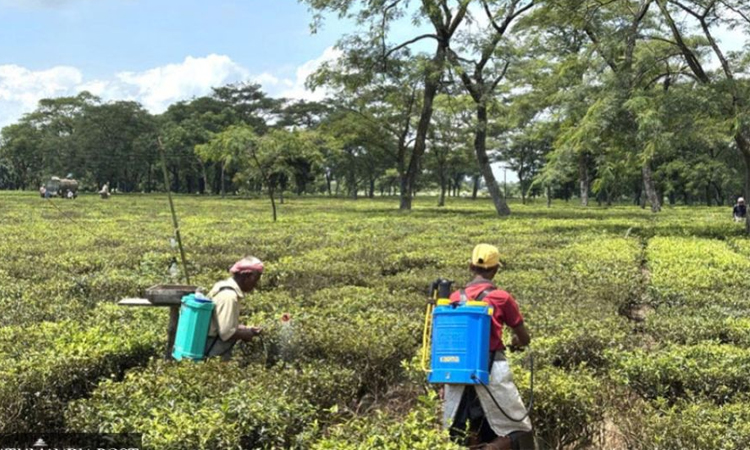
The eastern Himalayan foothills, particularly Ilam, is one of the country's oldest and most important tea-growing regions.
The association warned that the disruption could have a significant financial impact on more than 3,000 families in Ilam district who depend on tea farming
for their livelihoods, as well as hundreds of labourers involved in picking across the region.
Netra Prasad Subedi, a spokesperson at the Ministry of Industry, Commerce and Supplies, said Nepal's government "is looking for a diplomatic solution for
this issue".
The Himalayan nation exports approximately 15,600 metric tons of tea annually to India, generating around $27 million in revenue, according to the board.
India has not publicly responded to the complaints by Nepali tea producers.
Nepal, a landlocked Himalayan nation of 30 million people, must ensure a delicate diplomatic balance between its two giant neighbours, India and
China.
India has long considered Hindu-majority Nepal as a traditional ally, with open borders along the plains.
India is also Kathmandu's largest trading partner, accounting for 63 percent of imports, or $8.6 billion, followed by China at 13 percent, or $1.8
billion, according to World Bank figures.