Sunday
13 September, 2026
News Flash
News Flash
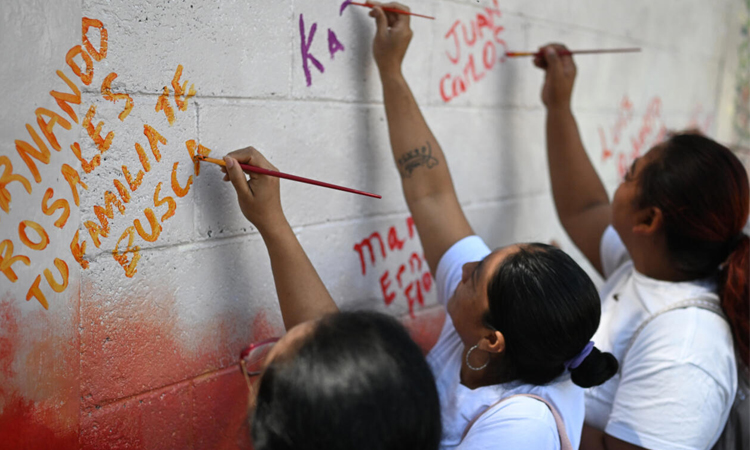
MEJICANOS, El Salvador, April 21, 2026 (BSS/AFP) - Entering the San Salvador district of Mejicanos no longer means taking your life in your hands, like it did a decade ago when Kathya Quintanilla left home to meet a friend at a local park.
The 16-year-old never came home, one of tens of thousands of people to go missing in the gang wars that throttled El Salvador for decades until President Nayib Bukele began his crackdown four years ago.
Standing at the edge of a ravine on the outskirts of Mejicanos, Kathya's mother Tomasa Lopez points to suspected mass graves below where she thinks her daughter might be buried.
"The worst part is not knowing where she is," said Lopez, 46, who wore a t-shirt featuring her daughter's face and hass her name tattooed on her shoulder.
Bukele pacified the gangs by imposing a state of emergency used to indefinitely detain tens of thousands of men in the Central American nation on suspicion of gang membership.
The campaign resulted in a dramatic decrease in crime but has brought little relief to families of the missing, and their pleas for help have fallen on deaf ears.
- 'Not knowing' -
Light pours from Lopez's bare-bones home on a dirt street lined with abandoned houses whose habitants years ago fled the brutal Mara Salvatrucha (MS-13) gang, one of the most powerful in Central America.
Candles flicker in front of a dozen pictures of Kathya pasted to an unpainted wall, Lopez's shrine to her daughter, who stares out from the pictures with brown, almond-shaped eyes and a serene smile.
All information about missing persons in El Salvador -- whether victims of gangs, the civil war, or missing migrants -- is classified.
In June 2025, Bukele claimed, without providing proof, that around 90 percent of the people who disappeared had been murdered by gangs.
He said that adding the disappeared to the estimated 120,000 people killed by gangs since the end of the country's 1979-1992 civil war would take the death toll to 200,000 -- a colossal figure in the country of six million, equivalent to the population of a large town.
The mass incarceration of suspected gang members initially sparked hope among the families of the missing for information about their loved ones.
But those hopes have been dashed.
"It's been ten years of searching, of waiting for answers from the police, the prosecutor's office, or the medical examiner's office. But, for them, those who disappear cease to exist," Lopez said.
AFP reached out to the government, the public prosecutor's office, and pro-government members of parliament for comment, but received no responses.
- Disappeared while buying candy -
In another part of Mejicanos that has paved streets and more robust housing, MS-13's arch-rival, the Barrio 18 gang, killed Carmen Armero's husband and disappeared her son.
Herber, a student who spoke four languages and was planning to get married and travel, disappeared one night when he went out to buy candy.
"There are only two possibilities: he's alive or he's dead. What I want is to find him. I don't want to hear about who's responsible anymore," Armero said, her voice breaking with emotion.
Armero, who is president of the Search Bloc for Disappeared Persons, a group representing several dozen families, believes the existence of mass graves is being silenced by officials because it would damage Bukele's campaign to rebrand El Salvador.
"If you want to see how safe El Salvador is, go to the ugliest, darkest place, sit on a rock, and wait for dawn," the president wrote recently on social media.
Fernando, a 36-year-old street vendor, disappeared in 2022 in the coffee-rich northwestern Salvadoran department of Santa Ana.
Sandra Gallegos, his 53-year-old mother, wishes she could "grab a pickaxe and shovel" every morning to go and search for his remains.
But to do so would mean being branded a gang member herself.
"If the police arrive, they'll say we're collaborating with the gangs because we know about the grave," Esmeralda Rosales, Fernando's 40-year-old sister, explained.