Sunday
13 September, 2026
News Flash
News Flash
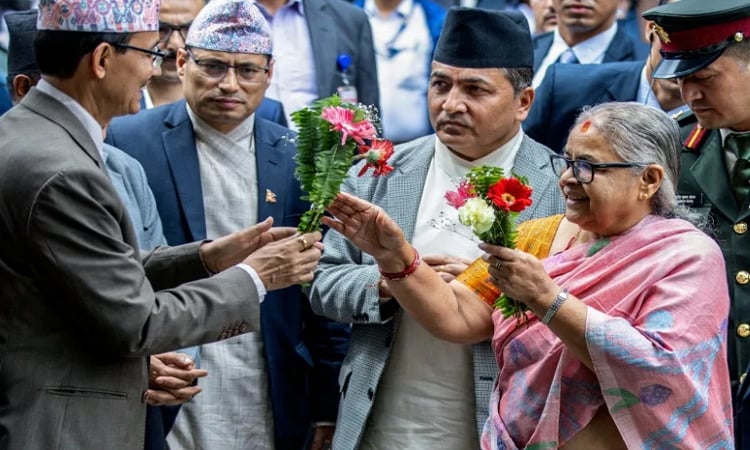
KATHMANDU, Nepal, March 27, 2026 (BSS/AFP) - Nepal's first female chief justice, Sushila Karki, reluctantly left retirement for her biggest task -- leading the nation as prime minister after deadly anti-corruption protests toppled the government.
She leaves her post praised for guiding the Himalayan nation of 30 million through one of its most tumultuous periods since the end of its bitter civil war in 2006.
"When I assumed this responsibility... I was filled with fear and uncertainty," the 73-year-old said in a farewell broadcast to the nation, her grey hair swept back in a bun and peering through thick glasses.
"But I came here with the confidence that I could light some lamp of hope at a time when the country was in crisis."
She led a nation bitterly at odds with itself, taking office as interim leader with the prime minister's office in ruins.
Like parliament itself, and a swathe of government buildings, it was torched during the September 2025 violence in which 77 people were killed.
Karki repeatedly said she never wanted the job -- her name was put forward by the Gen Z protest movement who started the protests, via the online platform Discord.
But she was selected, becoming Nepal's first female prime minister.
"At the request of the young generation working for change, I accepted this role with the aim of completing the elections," she said on Thursday night.
"Now, I am asking for leave, with some satisfaction -- and a lot of hope."
- 'Job well done' -
One of her first acts was to establish a commission to investigate the violence, which has recommended that her predecessor, ousted four-time prime minister KP Sharma Oli, be prosecuted.
Balendra Shah, the 35-year-old rapper who becomes the new prime minister, posted a photograph of Karki after he voted on March 5. "Democracy has triumphed under your leadership," he wrote.
The Kathmandu Post praised a "job well done" in an editorial after the vote.
"To have moved from the chaos of the streets to the order of the ballot box in such a short window is an achievement that warrants the highest praise," it wrote.
Born in 1952 in Biratnagar, an industrial town in eastern Nepal, she earned degrees in political science in India and in law in Kathmandu.
She came of age in a society where women rarely entered the legal profession.
She began her career as a lawyer in 1979 and quickly gained a reputation as a fearless advocate, often taking up cases others avoided.
- 'Courageous'-
Her tenure as chief justice from 2016 to 2017 was brief but significant -- challenging gender stereotypes and facing down politicians over corruption.
"Her integrity has never been in doubt, and she is not someone who can be intimidated or easily influenced," Anil Kumar Sinha, a former Supreme Court judge who was also part of Karki's cabinet, told AFP.
"She is courageous and not swayed by pressure."
In 2012, Karki was one of two presiding Supreme Court judges who jailed a serving government minister for corruption -- a first in Nepal's fight against graft.
In 2017, the government tried to impeach her as chief justice after she overturned its choice for chief of police.
The United Nations called the impeachment "politically motivated", and the move was blocked. She stepped down at her retirement.
Nepal emerged from a brutal decade-long Maoist insurgency in 2006 and, in 2008, the end of the country's 240-year-old Hindu monarchy.
The transformation to a federal state was marred by political infighting, and successive governments delayed justice for abuses committed during the civil war.
But it was under Karki's watch as chief justice that a court in 2017 sentenced three soldiers to 20 years in jail for the murder of a teenage girl, at the time only the second conviction for war crimes.
She was Nepal's first woman prime minister, but not its first woman leader -- Bidya Devi Bhandari held the largely ceremonial role of president for two terms from 2015 to 2023.