Sunday
14 June, 2026
News Flash
News Flash
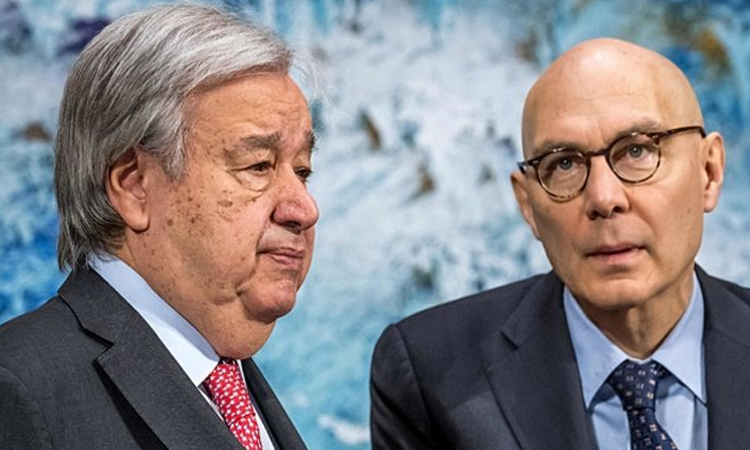
GENEVA, Feb 28, 2026 (BSS/AFP) - The UN rights chief warned Friday that leaders were increasingly wielding power for power's sake and normalising the use of force to solve disputes, spurring surging numbers of global conflicts.
"The world is upside down," Volker Turk told the United Nations Human Rights Council in Geneva.
Presenting an update on rights situations around the world, he voiced alarm at a number of raging conflicts, including in Sudan, Ukraine and the occupied Palestinian territories.
"The threat and use of force to solve disputes is becoming more frequent and normalised," he said.
"The number of armed conflicts has almost doubled since 2010, to around 60," he pointed out. "The world really is becoming a more dangerous place."
The UN High Commissioner for Human Rights cautioned that the growing number of conflicts came at a devastating cost, causing "a human rights wasteland".
"We must not revert to violence as an organising principle," he insisted.
- 'Exploit and subjugate' -
Turk said an increasingly relentless competition for power for power's sake was on display in the world, to the detriment of rights everywhere.
"Players compete for control over land, energy, attention. But to what end?" he asked.
"Dominating the global economy? Accumulating more power? Putting AI into space? Surely power must serve other purposes."
Without naming names, Turk slammed leaders who "use power for their own ends, (who) exploit and subjugate".
Instead of trying to reverse the current dangerous trends, he lamented that some were actually "attacking the institutions designed to keep us safe", including the UN and international courts.
"The world cannot stand by as the edifice of international humanitarian and human rights law is dismantled before our eyes," he warned.
The UN rights chief listed a range of concern trends, including how a number of countries were "militarising their law enforcement operations".
He pointed to how immigration officers and other agents in the United States had "used excessive force during large-scale operations against migrants and peaceful protestors, and have shot and killed several people during these operations".
Rising hate speech targeting migrants and refugees in places including the United States, Europe and Libya was "a deeply worrying trend", he said, also noting "a sharp increase in antisemitism, Islamophobia and other forms of religious hate across several regions".
- 'Global emergency' -
Turk voiced particular concern over rising threats to the rights of women and girls.
"Violence against women, including femicide, is a global emergency," he said, pointing out that in 2024 alone, "around 50,000 women and girls worldwide were killed... most by family members".
He also pointed to two cases that have recently caused shock waves around the world: those of convicted sex offender Jefferey Epstein and of Gisele Pelicot, whose ex-husband Dominique was convicted in France along with dozens of strangers who he brought to rape her while she was unconscious.
Both cases "show the extent of the exploitation and abuse of women and girls", Turk said, asking: "does anyone think there are not many more men like Dominique Pelicot or Jeffrey Epstein?"
"Such horrific abuse is enabled by social systems that silence women and girls, and insulate powerful men from accountability."
Turk also said he was deeply concerned by swelling attacks against women in the public eye.
"Every woman politician I meet tells me they face constant misogyny and online hate," he said.
More broadly, Turk highlighted the challenges posed by digital technologies and artificial intelligence, warning that without adequate oversight and accountability, they "invade privacy, undermine democratic processes and pose serious risks to the safety of our children and ourselves".
"They also turbocharge inequality and reproduce existing biases," he said, voicing particular concern about "the use of AI systems in armed conflict, to shape battlefield decisions with deadly impact".