Sunday
14 June, 2026
News Flash
News Flash
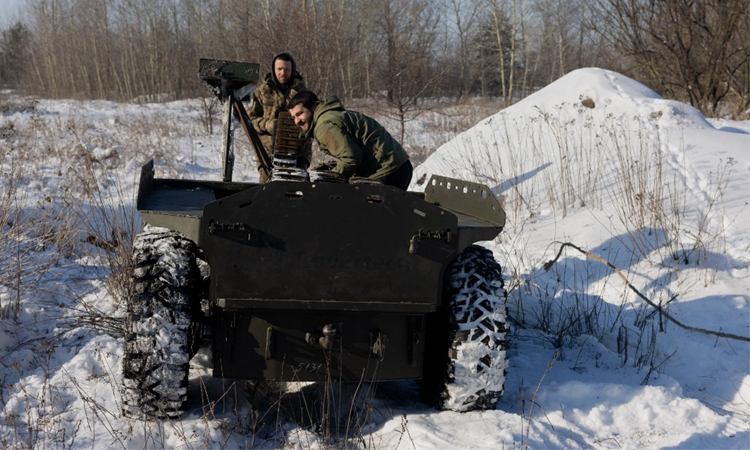
KYIV, Ukraine, Feb 16, 2026 (BSS/AFP) - Earlier this winter, Ali's unit was flying an interceptor drone in subzero temperatures on the front when the camera suddenly froze, sabotaging their mission to detect and thwart an incoming Russian attack.
Temperatures across the 1,200-kilometre (745-mile) front line have plunged to their lowest of the entire four-year Russia-Ukraine war, complicating the use of battery-powered drones, central to both sides' military tactics.
"The impact on our drones is completely negative," said Ali, who asked AFP to identify him by his call sign, in line with military protocol.
"Batteries lose charge faster, the cameras and wires freeze, they just ice up."
Both Russia's and Ukraine's army have come to use cheap drones ubiquitously.
Small reconnaissance craft scope out enemy positions and can drop grenades on targets and soldiers, detecting even the smallest movement on the ground below, while others are packed with explosives and designed to slam into vehicles and buildings.
Some drones are now connected to their operators with an extremely thin fibre-optic cable, ensuring the connection to the pilot remains stable and immune to electronic jamming.
Interceptor drones, like the kind Ali's unit was flying, are used for defence -- a kind of drone-on-drone aerial warfare to hobble incoming attacks.
But as temperatures have hit -20C on the front, both the equipment and men operating the devices freeze up.
Near the southern front, pilots from the 18th brigade were getting ready to launch their interceptor drones.
The light polystyrene craft resembles a toy plane.
"Frost, low cloud, fog. In such weather, it is difficult for a drone to fly. It can short-circuit, it can break in the air," said Nazariy, one of the brigade's squad commanders.
- Death trap -
Old-school solutions are sometimes required to help the high-tech devices stay airborne.
Denys Shtilierman, chief constructor at Fire Point, a company making Ukraine's first long-range drones, said rubbing grease over them provided an extra layer of insulation from the frost.
"We just put lard on them and it takes off. I'm laughing, but it's how it is," he told AFP during a visit of the company factory.
The craft have become far too central to the war effort to abandon them because of tough weather.
"Drones are being used regardless of the conditions. We have certain limits, but we need to use them," Shtilierman said.
While the winter poses a technical challenge, in other respects it makes drones an even more potent threat.
When the skies clear, the white layer of snow can quickly turn into a death trap for any troops trying to traverse it.
"It's very easy to see where someone walked or drove because tracks stand out sharply in the snow," said Lafayette, a pilot with the Achilles brigade.
Some drones are also equipped with thermal cameras, which makes the heat they pick-up from human bodies much more visible in winter.
- 'Die from the cold' -
Amid the cold snap, Russia has upped its long-range attacks on Ukraine's energy sites, cutting off electricity and heating for hundreds of thousands of civilians across the country and triggering a major energy crisis.
At the front, Ukrainian forces are also struggling from the cold.
In January, Moscow's army recorded one of its fastest advances of any winter month, according to AFP analysis.
Though several Ukrainian military officials have noted other periods of reduced intensity in Russian assaults due to the bitter cold.
At a recent training session for Ukrainian infantry, an instructor shouted as soldiers ran through thick snow, the layers of ice crushing under their boots.
"Infantry that comes out is literally destroyed because they have nowhere to hide," said Koleso, a 31-year-old infantryman.
In the frost, wounds quickly turn deadly, as hypothermia weakens the body's ability to cope with trauma.
Hypothermia and frostbite on limbs are common, said Nastya, a paramedic with the Da Vinci Wolves brigade.
"The wounded die not only from shrapnel and bullets -- they also die from the cold, which accompanies them like a dark companion in the frost," she said.
"The cold is a very insidious enemy, it should not be underestimated," she said.
Despite these risks, Nazariy said there was no way but to keep fighting, and ensure Kyiv's drones stay in the air.
"We are at war. We work in any weather."